


The Battle of Eylau, fought on February 7-8, 1807, is remembered as one of the bloodiest and most brutal battles of the Napoleonic Wars. It was a clash of titans, pitting Napoleon's formidable French army against the determined Russian forces led by General Bennigsen, and marked a crucial turning point in the conflict.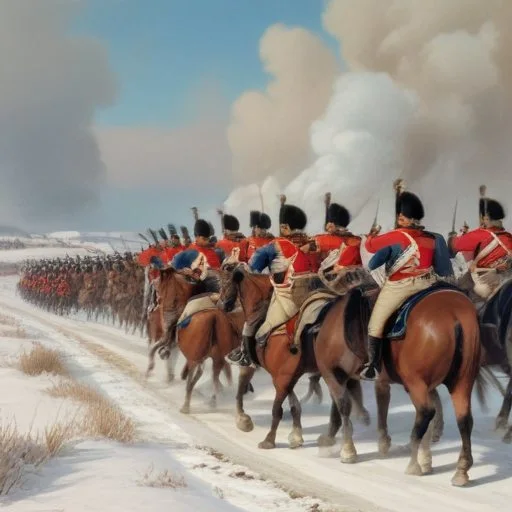
In the early 19th century, Napoleon's French Empire was expanding rapidly, and he had set his sights on conquering Eastern Europe. Russia, under the leadership of Tsar Alexander I, was determined to halt Napoleon's advances and protect its territories. The stage was set for a epic showdown, and the small town of Eylau in East Prussia would become the unlikely battleground.
The battle began on February 7, as Napoleon's forces launched a series of attacks on the Russian lines. The fighting was fierce, with both sides suffering heavy casualties. Despite being outnumbered, the Russians held their ground, and the French were forced to regroup and recharge for a second day of battle.
The next day, February 8, the fighting resumed, with the French pushing forward with a series of bombardments and infantry charges. The Russians, however, refused to yield, and the battle raged on for hours. The outcome hung in the balance, as the fate of Europe teetered on the brink of chaos.
In the end, the French emerged victorious, but at great cost. The town of Eylau was left in ruins, and the casualty count was staggering. Estimates suggest that between 15,000 to 20,000 soldiers lost their lives on both sides, making it one of the bloodiest battles of the Napoleonic Wars.
The Battle of Eylau marked a significant shift in the nature of warfare. The brutal and relentless fighting demonstrated that the age of chivalry was truly dead, and that modern warfare would be characterized by brutality and carnage on an unprecedented scale.
The Battle of Eylau had far-reaching consequences, marking a turning point in the Napoleonic Wars and setting the stage for the eventual defeat of Napoleon's empire. The brutal fighting also had a profound impact on the development of modern warfare, as armies began to adopt more brutal and relentless tactics.
The Battle of Eylau has been immortalized in literature and art, with writers and artists seeking to capture the brutality and heroism of the battle. The battle has also become a symbol of Russian determination and resistance, and continues to be celebrated in Russian culture today.
One of the most famous accounts of the battle comes from Napoleon himself, who wrote: "The Battle of Eylau was the most terrible of all my battles. The courage of the Russians is beyond description."
The Battle of Eylau set the stage for the eventual defeat of Napoleon's empire, as the Russian army continued to resist French advances. The battle also marked a shift in the balance of power in Europe, as Russia emerged as a major player in the Continental struggle against Napoleon.
Did you know that the Battle of Eylau was fought in the midst of a snowstorm, with temperatures dropping as low as -20°C (-4°F)?
Did you know that the battle was so brutal that it was nicknamed the "killing field" by Napoleon's soldiers?
Did you know that the Battle of Eylau was one of the first battles to be reported in real-time, with journalists sending dispatches back to Paris and St. Petersburg?
In conclusion, the Battle of Eylau was a pivotal moment in the Napoleonic Wars, marking a turning point in the conflict and setting the stage for the eventual defeat of Napoleon's empire. Its impact on modern warfare, cultural and social influences, and personal accounts make it a fascinating and complex event that continues to captivate historians and enthusiasts alike.
The Battle of Eylau was not an isolated incident, but rather a culmination of years of tensions between France and Russia. The conflict had its roots in the early 19th century, when Napoleon's French Empire began to expand its borders, threatening the territorial integrity of Russia. The Russian Empire, under the leadership of Tsar Alexander I, was determined to resist French aggression and protect its interests in Eastern Europe.
In the years leading up to the Battle of Eylau, Napoleon's armies had been making steady gains, conquering much of Central and Western Europe. Russia, meanwhile, had been strengthening its military and forming alliances with other European powers to counter the French threat. The stage was set for a massive clash of armies, and Eylau would be the site of one of the bloodiest battles in history.
The Road to EylauThe French army, led by Napoleon, had been making its way eastward, conquering Prussia and pushing into Polish territory. The Russian army, led by General Bennigsen, had been retreating, luring the French deeper into the wilderness of Eastern Prussia. The two armies finally clashed on February 7, 1807, in the small town of Eylau.
General Bennigsen: The Russian Commander
Levin August von Bennigsen was a seasoned military commander who had fought in several battles against the French. Born in 1745 in Hannover, Germany, Bennigsen joined the Russian army in 1773 and quickly rose through the ranks, becoming a general in 1796.
Bennigsen was known for his bravery and tactical genius, which earned him the respect of his troops and the admiration of his enemies. Despite being outnumbered and outgunned, Bennigsen's leadership and determination helped the Russian army to hold its ground against the French at Eylau.
After the Battle of Eylau, Bennigsen continued to play a key role in the Napoleonic Wars, leading Russian forces against the French in several battles. He died in 1826, at the age of 81, and is remembered as one of the greatest military minds in Russian history.
The Battle of Eylau had a profound impact on the cultural landscape of Europe. The sheer brutality and scale of the battle shocked the public, leading to a widespread outcry against the senseless violence and carnage.
The battle also inspired a wave of artistic and literary works, as writers and artists sought to capture the horror and heroism of the conflict. The French poet and writer, François-René de Chateaubriand, wrote a powerful elegy to the fallen soldiers of Eylau, while the Russian artist, Vasily Vereshchagin, painted a series of vivid and haunting works depicting the battle.
In Russia, the Battle of Eylau became a symbol of national resistance and patriotism, with poems, songs, and stories celebrating the bravery and sacrifice of the Russian soldiers.
Napoleon's Strategy: A Turning Point in the Napoleonic Wars
The Battle of Eylau marked a significant shift in Napoleon's strategy, as he began to adopt more brutal and ruthless tactics to achieve his goals. The French Emperor had long been known for his military genius, but Eylau showed that he was willing to go to great lengths to secure victory, even if it meant sacrificing thousands of lives.
The battle also highlighted the limitations of Napoleon's power, as he faced stiff resistance from the Russian army and was forced to regroup and reassess his strategy. The defeat at Eylau was a temporary setback, but it marked a turning point in the Napoleonic Wars, as Napoleon's enemies began to sense vulnerability and started to rally against him.
The Battle of Eylau also had significant implications for European politics, as it marked a shift in the balance of power between France and Russia. The battle cemented Russia's status as a major player in European affairs and paved the way for the eventual defeat of Napoleon's empire.
Historians have long debated the significance of the Battle of Eylau, with some viewing it as a crushing defeat for Napoleon and others seeing it as aPyrrhic victory. The French Emperor's decision to push forward with the battle, despite heavy casualties and uncertain outcomes, has been seen as a turning point in his career, marking a shift from military genius to reckless gambler.
Other historians have argued that the Battle of Eylau was a necessary evil, as it forced Napoleon to re-evaluate his strategy and adopt more brutal tactics to achieve his goals. This perspective views Eylau as a key moment in the development of modern warfare, as armies began to adopt more ruthless and efficient tactics to win battles.
Regardless of interpretation, the Battle of Eylau remains one of the most fascinating and complex events in military history, continues to captivate historians and military strategists alike.