


The Battle of Salamanca, fought on July 22, 1812, is revered as one of the most significant military encounters of the Napoleonic Wars. This decisive victory for British forces, led by the illustrious Arthur Wellesley, later the Duke of Wellington, marked a critical turning point in the Peninsular War, ultimately contributing to the expulsion of French troops from Spain.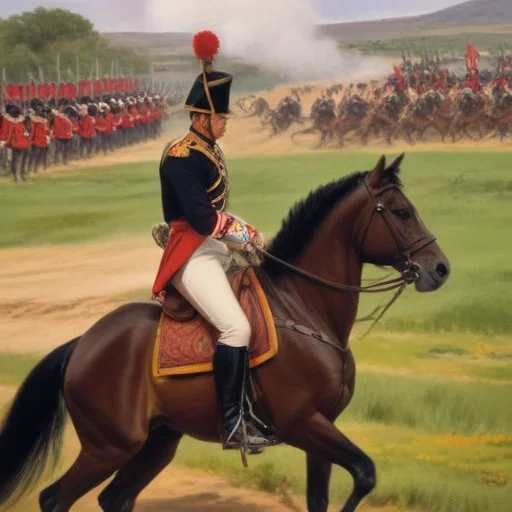
The Peninsular War, sparked by Napoleon's invasion of Spain in 1807, had been raging for five years by the time the Battle of Salamanca took place. The conflict pitted French forces, seeking to expand Napoleon's empire, against a coalition of British, Spanish, and Portuguese troops, determined to preserve Iberian independence. As the war dragged on, the British army, under the command of Wellesley, had been gradually pushing the French back, but a decisive victory was still elusive.
The Battle of Salamanca was characterized by the presence of two military giants: Arthur Wellesley, the British commander, and Auguste Marmont, the French commander. Wellesley, a seasoned veteran of the Indian campaigns, was renowned for his tactical brilliance and calm demeanor under pressure. Marmont, a trusted ally of Napoleon, was equally respected for his military prowess. Their clash would prove to be a defining moment in the war.
The battle unfolded on a sweltering summer day, as Wellesley's forces, numbering around 50,000 troops, confronted Marmont's army of approximately 40,000 soldiers. The French commander, anticipating a frontal assault, had positioned his troops in a series of defensive lines. Wellesley, however, had other plans. He orchestrated a daring flanking maneuver, exploiting a gap in the French lines, which enabled his cavalry to outflank and encircle the enemy.
The consequences of the Battle of Salamanca were far-reaching and devastating for the French. The British victory resulted in the capture of over 12,000 French soldiers, the destruction of several artillery units, and the loss of crucial supplies. The defeat shook the very foundations of Napoleon's empire, undermining his authority and morale.
The Battle of Salamanca had a profound impact on British morale, restoring confidence in the military leadership and revitalizing the war effort. News of the victory sparked widespread celebrations throughout Britain, as the public hailed Wellesley as a hero. The triumph also solidified the reputation of the British army, demonstrating its capability to overcome seemingly insurmountable odds.
In the aftermath of the battle, Wellesley himself remarked, "The Battle of Salamanca is the most glorious and important victory that has been gained in the present war." This statement, reflective of the British commander's humility and dedication, has become an enduring testament to the bravery and resilience of the British troops.
The Battle of Salamanca invites comparison with other pivotal clashes of the Napoleonic Wars, such as the Battle of Austerlitz. While both battles showcased the military genius of their respective commanders, the outcome of Salamanca was distinctly different, as the French, rather than the British, were defeated. This contrast highlights the adaptability and strategic brilliance of Wellesley, who had learned from past experiences and refined his tactics accordingly.
Among the British troops who fought at Salamanca was a young rifleman named Harry Smith, who would later become a renowned historian and writer. Smith's accounts of the battle, offering a soldier's-eye view of the conflict, provide a unique perspective on this pivotal event.
The Battle of Salamanca serves as a powerful reminder of the importance of perseverance, strategic thinking, and bravery in the face of adversity. This iconic victory has inspired generations of military leaders, historians, and enthusiasts, solidifying its place as one of the most significant battles in British history.
Arthur Wellesley, the Duke of Wellington, was a master strategist who played a crucial role in the Battle of Salamanca. Born on May 1, 1769, in Dublin, Ireland, Wellesley was educated at Eton College and later at the Royal Academy of Sandhurst. He began his military career in 1787 and quickly rose through the ranks, distinguishing himself in various campaigns, including the Flanders Campaign and the Peninsular War.
Wellesley's military prowess was marked by his exceptional tactical skills, ability to adapt to changing circumstances, and unwavering calmness under pressure. These traits, coupled with his experience in the Indian campaigns, made him an ideal commander for the British forces in the Peninsular War.
At the Battle of Salamanca, Wellesley's strategic brilliance was on full display. He successfully executed a daring flanking maneuver, outmaneuvering the French forces and securing a decisive victory. This triumph cemented his reputation as one of the greatest military minds in British history.

The Battle of Salamanca had a profound impact on British culture, serving as a powerful symbol of resistance against the French Empire. The victory sparked widespread celebrations throughout Britain, with the public hailing Wellesley as a hero.
The battle also inspired a surge of patriotic art and literature, as British artists and writers sought to capture the essence of the conflict. Painters such as Thomas Barber and Henry Singleton created iconic works depicting the battle, while poets like Lord Byron and William Wordsworth composed odes to the bravery of the British troops.
Furthermore, the Battle of Salamanca reinforced the British sense of national identity, solidifying the notion of Britain as a beacon of liberty and freedom. This cultural legacy has endured, with the battle remaining an integral part of British history and heritage.
The Battle of Salamanca invites comparison with another pivotal clash of the Napoleonic Wars: the Battle of Austerlitz. While both battles showcased the military genius of their respective commanders, the outcomes were strikingly different.
Austerlitz, fought in 1805, saw Napoleon's forces defeat a combined Austrian and Russian army, cementing his dominance over Europe. In contrast, Salamanca marked a decisive victory for the British forces, dealing a significant blow to Napoleon's empire.
However, both battles share a common thread: the importance of adaptability and strategic thinking. Both Napoleon and Wellesley demonstrated an uncanny ability to read the battlefield, adjusting their tactics to outmaneuver their opponents.

The Battle of Salamanca, fought on July 22, 1812, had significant environmental implications. The conflict took place during a sweltering summer, with temperatures soaring to over 100°F (38°C). The parched terrain and intense heat led to severe water scarcity, affecting both human and animal participants.
The battle also resulted in widespread destruction of the local ecosystem. Artillery fire and cavalry charges ravaged the countryside, destroying crops and infrastructure. Additionally, the presence of tens of thousands of soldiers and their equipment led to soil compaction, erosion, and pollution.
In the aftermath of the battle, the environment played a crucial role in the recovery efforts. The surrounding countryside was used as a makeshift hospital, with wounded soldiers being treated in open fields and tents.
Historians have long debated the significance of the Battle of Salamanca, with some arguing that it marked a turning point in the Peninsular War, while others view it as a tactical victory of limited strategic importance.
Traditional accounts of the battle, such as those by Charles Oman and William Napier, portray Salamanca as a triumph of British military prowess, highlighting Wellesley's brilliance and the bravery of his troops.
More recent scholarship, however, has sought to recontextualize the battle, examining its role within the broader framework of the Napoleonic Wars and the evolution of modern warfare. This nuanced approach has led to a deeper understanding of the battle's complexities and its enduring impact on military strategy.