


In the vast expanse of our solar system, one planet has long been shrouded in mystery – Mercury. But on March 29, 1974, NASA's Mariner 10 spacecraft embarked on a daring mission to unveil the secrets of this scorching hot, cratered world, becoming the first space probe to fly by Mercury.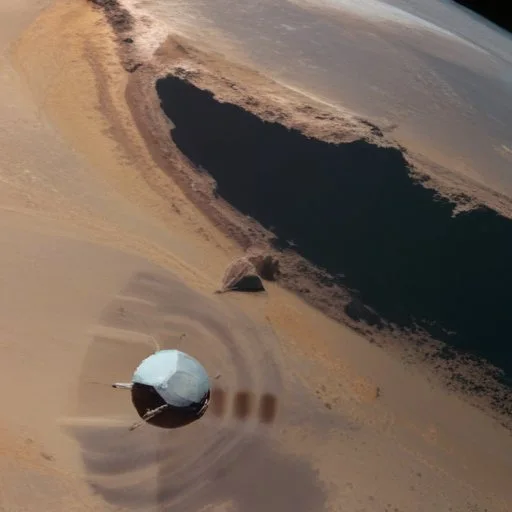
Launched on November 3, 1973, Mariner 10 was designed to study the solar system's innermost planet, a world so close to the sun that temperatures soar to 800°F (427°C) during the day. The NASA mission aimed to gather data on Mercury's geology, magnetic field, and atmospheric composition, but what the spacecraft revealed was far more astonishing.
As Mariner 10 flew within 200 miles (320 kilometers) of Mercury's surface, it captured breathtaking close-up images of the planet's rugged terrain. The spacecraft's camera exposed vast, dark basins, towering cliffs, and a cratered surface that told the story of a planet shaped by intense meteorite impacts. One of the most striking features was the enormous Caloris Basin, a depression approximately 960 miles (1,550 kilometers) in diameter, believed to have been formed by a massive asteroid impact.
At the helm of Mariner 10's success were a team of dedicated scientists and engineers, led by Principal Investigator Bruce Murray and Project Manager John D. rather. Their tireless efforts ensured the spacecraft was equipped with cutting-edge technology, including a television camera, infrared radiometer, and magnetometer, to collect data that would rewrite the textbooks on Mercury.
The Mariner 10 mission marked a major milestone in space exploration, paving the way for future planetary research and inspiring generations of scientists and engineers. The wealth of data collected by Mariner 10 has continued to influence our understanding of Mercury, with NASA's MESSENGER spacecraft building upon its discoveries in the 2000s.
As we continue to push the boundaries of space exploration, the legacy of Mariner 10 serves as a reminder of the power of human ingenuity and the importance of pursuing the unknown. As we venture further into the depths of our solar system, we may yet uncover secrets that challenge our understanding of the cosmos and inspire new generations of space pioneers.
As Mariner 10 soared through the skies, it marked a significant turning point in the space race between the United States and the Soviet Union. The mission's success was not only a testament to American ingenuity but also a demonstration of the country's commitment to exploring the unknown. With the Cold War simmering in the background, the Mariner 10 mission served as a beacon of hope and international cooperation, highlighting the potential of space exploration to bring nations together. The mission's success paved the way for future collaborations, such as the Apollo-Soyuz Test Project, which saw American and Soviet spacecraft docking in orbit.
Mariner 10's flyby of Mercury also coincided with a period of significant social and cultural change in the United States. As the country grappled with the aftermath of the Vietnam War and the Watergate scandal, the mission provided a much-needed distraction and a symbol of American exceptionalism. The mission's success was celebrated across the nation, with newspapers and television networks devoting extensive coverage to the event.

Bruce Murray: The Visionary Behind Mariner 10
Bruce Murray, the Principal Investigator of Mariner 10, was a planetary scientist with a passion for exploring the unknown. Born in 1931, Murray grew up in a family of modest means and worked his way through college, earning a degree in geology from the University of Toronto. He later earned his Ph.D. from the California Institute of Technology, where he became fascinated with the study of planetary surfaces.
Murray's leadership played a crucial role in the success of Mariner 10, as he worked tirelessly to ensure that the spacecraft was equipped with the necessary instruments to gather data on Mercury's geology, magnetic field, and atmospheric composition. His dedication to the mission paid off, as Mariner 10 revealed breathtaking images of the planet's rugged terrain and provided scientists with a wealth of new data.
The Technological Legacy of Mariner 10
Mariner 10's innovative design and cutting-edge technology paved the way for future space missions. The spacecraft's use of a radioisotope thermoelectric generator (RTG) as a power source marked a significant milestone in the development of nuclear batteries. The RTG provided a reliable source of power, enabling the spacecraft to travel over 1.4 billion miles during its mission.
The mission also demonstrated the effectiveness of gravity-assisted flybys, a technique that has since been used in numerous space missions. By using the gravitational pull of Venus to alter its trajectory, Mariner 10 was able to gain enough speed to reach Mercury, making it one of the most fuel-efficient space missions in history.

Unraveling the Mysteries of Mercury's Geology
Mariner 10's flyby of Mercury provided scientists with their first glimpse of the planet's rugged terrain. The spacecraft's camera revealed a surface pockmarked with craters, canyons, and vast, dark basins. One of the most striking features was the enormous Caloris Basin, a depression approximately 960 miles in diameter, believed to have been formed by a massive asteroid impact.
The mission's findings challenged prevailing theories about Mercury's geology, suggesting that the planet's surface was shaped by a combination of meteorite impacts, volcanic activity, and tectonic forces. The data collected by Mariner 10 has continued to influence our understanding of Mercury, with NASA's MESSENGER spacecraft building upon its discoveries in the 2000s.
Mariner 10 and the Dawn of a New Era in Space Exploration
The Mariner 10 mission marked a significant cultural shift in the way people perceived space exploration. As the first spacecraft to fly by Mercury, Mariner 10 captured the public's imagination, inspiring a new generation of scientists, engineers, and explorers. The mission's success demonstrated the power of human ingenuity and the importance of pursuing the unknown.
The mission's cultural impact extended beyond the scientific community, inspiring artists, writers, and musicians to explore the theme of space exploration in their work. Mariner 10 became a symbol of American ingenuity and a testament to the country's commitment to pushing the boundaries of human knowledge.