


The inauguration of Dachau, the first Nazi concentration camp, on March 22, 1933, marked the beginning of a dark era in human history. This notorious camp, located in the shadow of the Bavarian Alps, would serve as a blueprint for the atrocities that would soon unfold, exemplifying the brutal efficiency of the Nazi regime's machinery of terror and oppression.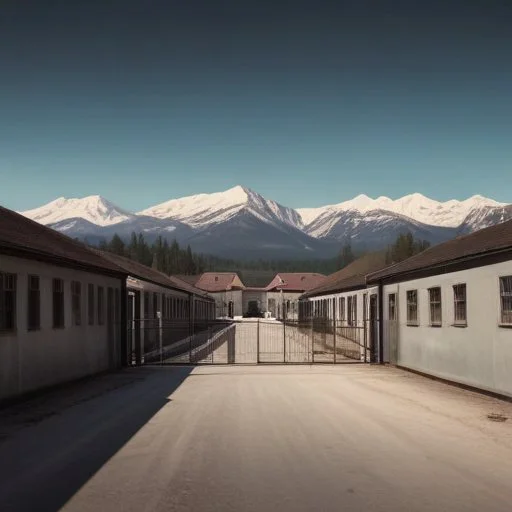
In the aftermath of World War I, Germany was plagued by political instability, economic crisis, and widespread discontent. The Nazi Party, led by Adolf Hitler, capitalized on these sentiments, promising to restore national pride and prosperity. As the Nazis consolidated power, they began to implement their radical ideologies, including the persecution of political opponents, Jews, and other minority groups.
Heinrich Himmler, the ruthless and ambitious leader of the SS (Schutzstaffel), played a pivotal role in the establishment and administration of Dachau. Himmler, who would eventually become one of the most powerful men in Nazi Germany, was instrumental in shaping the camp's purpose and operations.
Dachau was initially intended as a "reeducation" center for political prisoners, primarily members of the Communist Party and other left-wing organizations. The camp's purpose, however, soon expanded to include the intimidation and persecution of Jews, along with other groups deemed undesirable by the Nazi regime. Prisoners were subjected to forced labor, torture, and other forms of mistreatment, with many ultimately meeting their demise in the gas chambers or through brutal violence.
Dachau's existence and operations served as a precursor to the atrocities that would be committed during the Holocaust. The camp's "euthanasia" program, which involved the systematic murder of prisoners deemed unfit for work, was a precursor to the infamous "Final Solution." The camp's existence also contributed to the normalization of brutality and violence within the Nazi regime, paving the way for the horrors that would unfold in the coming years.
The atrocities committed at Dachau have had a profound impact on the collective psyche, serving as a stark reminder of the dangers of totalitarianism, racism, and xenophobia. The camp's legacy continues to influence contemporary discourse, informing discussions on human rights, social justice, and the importance of democratic values.
The existence and operations of Dachau have been the subject of intense controversy and debate. While some have argued that the camp's purpose was initially to "reeducate" political opponents, others have maintained that its true purpose was always to serve as a tool of terror and oppression. The debate surrounding the camp's legacy continues to this day, with many calling for greater awareness and education about the atrocities committed during the Holocaust.
One of the most notable accounts of Dachau's atrocities comes from the testimony of former prisoner, Viktor E. Frankl, an Austrian neurologist and psychiatrist who survived the camp. Frankl's memoir, "Man's Search for Meaning," details the brutal conditions and inhumane treatment he endured, providing a poignant and personal account of life within the camp.
The lessons learned from Dachau have informed international humanitarian law, with the Geneva Conventions and the Universal Declaration of Human Rights serving as direct responses to the atrocities committed during World War II. The camp's existence has also contributed to the development of Holocaust education and awareness, with many institutions and organizations dedicated to preserving the memories of its victims.
The opening of Dachau concentration camp marked the beginning of a dark era in human history, serving as a stark reminder of the dangers of unchecked power and ideology. As we reflect on the atrocities committed within its walls, we are reminded of the importance of promoting tolerance, understanding, and democratic values, lest we forget the lessons of the past and risk repeating the horrors of Dachau.
Dachau's significance extends beyond its role as the first Nazi concentration camp. It was also a testing ground for the SS's experiments in mass incarceration and brutalization. The camp's commanders, including Heinrich Himmler, used Dachau as a laboratory to perfect the techniques of psychological manipulation, forced labor, and mass murder that would later be employed on a much larger scale in the extermination camps of Auschwitz and Treblinka.
In addition to its role in the development of the Holocaust, Dachau played a key part in the Nazi regime's broader program of persecution and oppression. The camp's prisoners included not only Jews, but also communists, socialists, Romani people, homosexuals, and individuals with disabilities, making it a microcosm of the regime's efforts to eliminate perceived enemies and undesirables.

Heinrich Himmler, the ruthless and ambitious leader of the SS, played a pivotal role in the establishment and administration of Dachau. Born in 1900, Himmler was a young and ambitious officer in the German army during World War I, but was denied a commission due to his physical limitations. He later became obsessed with the idea of creating a racially pure Germany, and saw the SS as a means to achieve this goal.
Himmler's obsessive attention to detail and his fascination with esoteric mysticism led him to create a vast network of secret police and intelligence agencies, including the Gestapo and the SD. Through these organizations, Himmler exerted control over every aspect of German life, using terror and intimidation to maintain his grip on power.
Dachau shares eerie similarities with other concentration camps established by totalitarian regimes throughout history. For example, the Soviet Union's Gulag system, established in the 1930s, was characterized by similar brutality, forced labor, and mass murder. Similarly, the Khmer Rouge's S-21 prison in Cambodia, active during the 1970s, was notorious for its use of torture, forced confessions, and mass executions.
These parallels highlight the dangers of unchecked state power, xenophobia, and ideological extremism, and serve as a stark reminder of the importance of protecting human rights and promoting democratic values.

Dachau's impact on popular culture is undeniable. The camp's atrocities have inspired countless works of literature, art, and film, including Elie Wiesel's "Night", Viktor Frankl's "Man's Search for Meaning", and Steven Spielberg's "Schindler's List". These works have helped to raise awareness about the Holocaust and its victims, and have contributed to a global conversation about the dangers of prejudice, hatred, and violence.
In addition, Dachau has become a pilgrimage site for those seeking to understand the horrors of the Holocaust. The camp's museum and memorial, established in the 1960s, attracts millions of visitors each year, providing a poignant reminder of the importance of preserving historical memory and promoting tolerance and understanding.
Dachau's existence was a direct result of the Nazi regime's political ideology, which emphasized the superiority of the "Aryan" race and the need for territorial expansion and racial purity. The camp's establishment marked the beginning of a coordinated effort to eliminate political opponents, Jews, and other perceived enemies of the state, and paved the way for the atrocities committed during the Holocaust.
The camp's operations were also deeply intertwined with the Nazi regime's political machinery, with Himmler and other high-ranking officials using Dachau as a tool to consolidate their power and crush opposition. This emphasis on state control and repression highlights the dangers of totalitarianism and the importance of protecting individual rights and freedoms.