


In the heart of Nigeria, a nation torn apart by ethnic and political divisions, the Eastern Region dared to challenge the status quo by declaring its independence as the Republic of Biafra in 1967, plunging the country into a devastating three-year civil war. This bold move, led by the charismatic Chukwuemeka Odumegwu Ojukwu, would test the very fabric of Nigerian unity, claiming millions of lives and leaving deep scars that would linger for generations to come.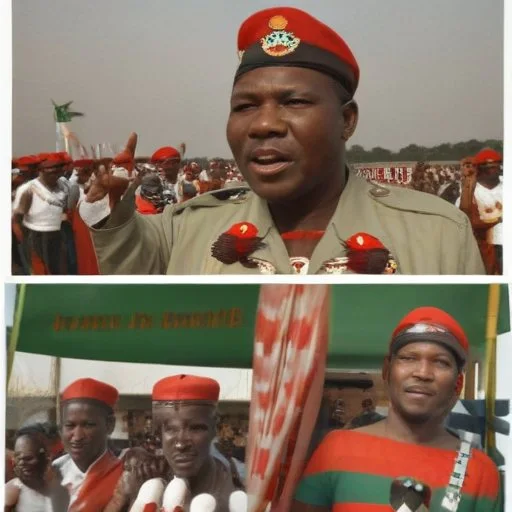
The seeds of disillusionment were sown long before the declaration of independence. Nigeria, a British colony, was forced to confront its own identity after gaining independence in 1960. The country was plagued by ethnic and religious divisions, with the Hausa-Fulani Muslims dominating the north, the Yoruba in the west, and the Igbo in the east. These ethnic groups, with their distinct languages, customs, and traditions, coexisted uneasily, fueling tensions that would eventually erupt into violence.
May 1967: The Eastern Region declares its independence as the Republic of Biafra, sparking a brutal conflict with the Nigerian government.
July 1967: The Nigerian army, led by General Gowon, launches a military campaign to crush the Biafran rebellion.
1968: The Biafran forces, despite being heavily outnumbered and outgunned, manage to hold off the Nigerian army, sparking a stalemate that would last for over a year.
January 1970: The Biafran capital, Umuahia, falls to the Nigerian army, marking a decisive turning point in the war.
January 15, 1970: The Biafran government surrenders, bringing an end to the war, but not the suffering of the Igbo people.
The Biafran War, as it came to be known, would claim the lives of an estimated one to three million people, mostly civilians, and leave countless others displaced and traumatized. The war would also lead to a devastating famine, triggered by the Nigerian government's blockade of Biafra, which would further exacerbate the humanitarian crisis.
Today, the Biafran War remains a painful reminder of Nigeria's troubled past, a testament to the devastating consequences of ethnic and political divisions. Yet, it also serves as a beacon of hope, inspiring generations of Nigerians to strive for unity and reconciliation in the face of adversity.
In the words of Chukwuemeka Odumegwu Ojukwu, "The Biafran spirit will never die, for it is the spirit of freedom, of justice, and of the pursuit of happiness."
The Biafran War sparked a cultural and social awakening in Nigeria, inspiring a new generation of artists, writers, and musicians to explore the complexities of Nigerian identity and the human experience. The war would also lead to a renewed focus on education and development, as Nigerians sought to rebuild their shattered nation.
The Biafran War remains a contentious issue, with many Nigerians still debating the merits of the Biafran secession and the Nigerian government's response. While some hail Ojukwu as a hero, others view him as a rebel who sought to divide the nation. The war continues to be a sensitive topic, with many arguing that it was a necessary evil to safeguard Nigerian unity, while others see it as a brutal suppression of the Igbo people's right to self-determination.
The Biafran War would have far-reaching consequences, shaping Nigeria's political and social landscape for decades to come. It would also serve as a cautionary tale for other African nations, highlighting the dangers of ethnic and political divisions in the face of fragile national unity.
As Nigeria continues to grapple with its own identity and purpose, the Biafran War serves as a poignant reminder of the devastating consequences of division and the enduring power of the human spirit in the face of adversity.
The Biafran War was a pivotal moment in Nigerian politics, exposing the deep-seated ethnic and regional divisions that had been simmering since the country's independence. The war marked a turning point in the country's political trajectory, solidifying the dominance of the federal government and setting a precedent for the suppression of secessionist movements. The war also led to a significant shift in the balance of power, with the Igbo people emerging as a powerful force in Nigerian politics.
The war had far-reaching implications for Nigerian politics, contributing to the rise of a strong central government and the suppression of regional autonomy. It also led to the marginalization of the Igbo people, who were forced to rebuild their communities and economy in the aftermath of the war.
Chukwuemeka Odumegwu Ojukwu was a complex and enigmatic figure, driven by a strong sense of nationalism and a desire for self-determination. Born into a wealthy Igbo family, Ojukwu was educated in Nigeria and Britain, where he developed a deep appreciation for Western culture and values.
Ojukwu's leadership style was marked by charisma and Vision, he was able to inspire loyalty and devotion in his followers, who saw him as a symbol of Igbo resistance against Hausa-Fulani domination. Despite his flaws and controversies, Ojukwu remains a revered figure in Igbo folklore, a symbol of courage and defiance in the face of overwhelming odds.
The Biafran War had a profound impact on Nigerian culture, inspiring a new generation of artists, writers, and musicians to explore the complexities of Nigerian identity and the human experience. The war led to a flourishing of Igbo culture, as artists and intellectuals sought to preserve and promote Igbo language, literature, and music.
The war also led to a renewed focus on education and development, as Nigerians sought to rebuild their shattered nation. The war inspired a new wave of Nigerian writers, including Chinua Achebe and Wole Soyinka, who drew on their experiences during the war to produce some of the most powerful and poignant literature of the 20th century.
Historians have long debated the causes and consequences of the Biafran War, with some viewing it as a necessary evil to preserve Nigerian unity, while others see it as a brutal suppression of the Igbo people's right to self-determination. The war remains a contested and controversial topic, with competing narratives and interpretations emerging over the years.
Despite the controversy, the Biafran War remains a pivotal moment in Nigerian history, a powerful symbol of the nation's capacity for violence and destruction, as well as its ability to forgive and rebuild. The war serves as a reminder of the dangers of ethnic and political divisions, and the need for reconciliation and unity in the face of adversity.
The Biafran War took place against the backdrop of the Cold War, with the Soviet Union and the United States vying for influence in Africa. The war marked a significant shift in the global balance of power, as Nigeria emerged as a key player in African politics and the Igbo people became a symbol of resistance against colonialism and imperialism.
The war also had significant implications for African politics, highlighting the dangers of ethnic and political divisions, and the need for regional cooperation and unity. The war served as a catalyst for the formation of the Economic Community of West African States (ECOWAS), which was established in 1975 to promote economic cooperation and integration in the region.