


The 1976 German Grand Prix at Nürburgring will forever be etched in the annals of motor racing history as one of the most harrowing and miraculous survival stories of all time. It was on this fateful day that three-time Formula One World Champion Niki Lauda's Ferrari 312T2 burst into flames on the second lap, leaving him on the brink of death.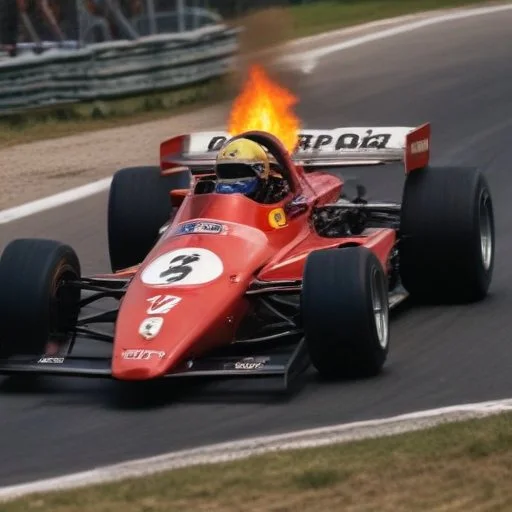
The 1976 German Grand Prix was the tenth round of the 1976 Formula One World Championship, with the Nürburgring circuit in West Germany serving as the backdrop for what promised to be an electrifying race. The event drew in a crowd of over 200,000 spectators, all of whom were eager to witness the likes of Lauda, James Hunt, and Clay Regazzoni battle it out for pole position.
As Lauda navigated the treacherous Nordschleife section of the circuit, his Ferrari 312T2 suddenly careened out of control, its rear tires failing catastrophically on the second lap. The car spun wildly, crashing into a concrete barrier before bursting into a fiery inferno. Lauda, trapped inside the burning wreckage, was at the mercy of the blaze, his screams echoing through the cockpit as his life hung in the balance.
In a heart-stopping display of courage, fellow drivers Arturo Merzario, Guy Edwards, and Harald Ertl risked their own lives to rescue Lauda from the burning car. The trio, alerted by the sound of Lauda's screams, sprinted towards the wreckage, braving the intense heat and toxic fumes to extricate the stricken driver. Their heroism would prove to be the difference between life and death for Lauda, who was subsequently rushed to the nearby Koblenz Hospital for treatment.
Lauda's injuries were severe, with second- and third-degree burns covering his face, hands, and legs. His lungs had also suffered significant damage, having inhaled toxic fumes from the burning gasoline and rubber. Despite the gravity of his condition, Lauda's indomitable spirit and fighting instincts propelled him towards a miraculous recovery. Against all odds, he would return to the track just six weeks later, his determination to compete in the Italian Grand Prix at Monza earning him a standing ovation from the crowds.
The accident had far-reaching consequences for motor racing as a whole. Lauda's near-death experience prompted a thorough re-examination of safety protocols, leading to the introduction of more stringent safety standards and improved fire-resistant materials in Formula One racing. The incident also cemented Lauda's status as a legend of the sport, his bravery and resilience in the face of adversity earning him widespread admiration and respect.
The accident at Nürburgring has been immortalized in popular culture, featuring prominently in the 2013 biographical film Rush, which chronicled Lauda's rivalry with James Hunt. The incident has also been the subject of numerous books, documentaries, and articles, serving as a testament to the enduring fascination with Lauda's story.
The Lauda accident served as a wake-up call for the Formula One community, prompting a renewed focus on safety and driver protection. The incident has been cited as a catalyst for numerous safety innovations, including the development of advanced fire-resistant materials, improved helmet design, and enhanced trackside safety procedures.
Niki Lauda's survival against all odds has inspired generations of racing drivers, engineers, and enthusiasts alike. His bravery and determination have made him an icon of the sport, with his legacy continuing to inspire future champions and safety advocates.
Niki Lauda's life was a testament to his unwavering dedication to racing. Born on February 22, 1949, in Vienna, Austria, Lauda's childhood was marked by a passion for speed and competition.
Before his near-fatal accident at Nürburgring, Lauda had already established himself as a force to be reckoned with in the world of Formula One. His unrelenting drive and strategic approach to racing earned him numerous accolades, including three World Championships.
Lauda's persona extended beyond the racetrack, however. He was known for his dry wit, his love of airplanes, and his entrepreneurial spirit. After retiring from racing, Lauda went on to become a successful businessman, investing in various ventures, including airlines and hotels.

In the world of Formula One, few rivalries are as legendary as that of Niki Lauda and James Hunt. The two drivers, with their contrasting styles and personalities, captivated audiences worldwide.
While Lauda was known for his calculated approach to racing, Hunt was the epitome of reckless abandon. Their rivalry, which played out on and off the track, was marked by intense competition and mutual respect.
The 1976 German Grand Prix, where Lauda's accident occurred, was a turning point in their rivalry. Hunt's subsequent win at the British Grand Prix and Lauda's miraculous recovery only added fuel to the fire, setting the stage for a thrilling conclusion to the 1976 season.
Niki Lauda's accident at Nürburgring transcended the world of sports, resonating with a broader audience.
The incident was a stark reminder of the risks involved in professional racing, sparking a national conversation about safety protocols and the human cost of competition.
In the years that followed, Lauda's story inspired numerous books, films, and documentaries, cementing his status as a cultural icon.

The 1976 German Grand Prix was a wake-up call for the Formula One community, prompting a renewed focus on safety and driver protection.
In the aftermath of Lauda's accident, the FIA implemented a series of safety innovations, including more stringent fire-resistant materials, improved helmet design, and enhanced trackside safety procedures.
These advancements have since become the standard for open-wheel racing, saving countless lives and preventing injuries.
Historians often view the Lauda accident as a pivotal moment in the evolution of Formula One.
The incident marked a shift in focus from pure speed to safety and innovation, paving the way for the modern, high-tech sport we know today.
By examining the Lauda accident through a historiographical lens, we gain a deeper understanding of the complex interplay between technology, politics, and human drama that shapes the world of Formula One.