


On June 3, 1984, the Indian government launched Operation Blue Star, a military offensive targeting Harmandir Sahib, the Golden Temple, Sikhism's most revered shrine in Amritsar. For four days, the sacred site witnessed intense fighting, leaving hundreds dead, including civilians, militants, and soldiers, and sparking widespread outrage among Sikhs worldwide.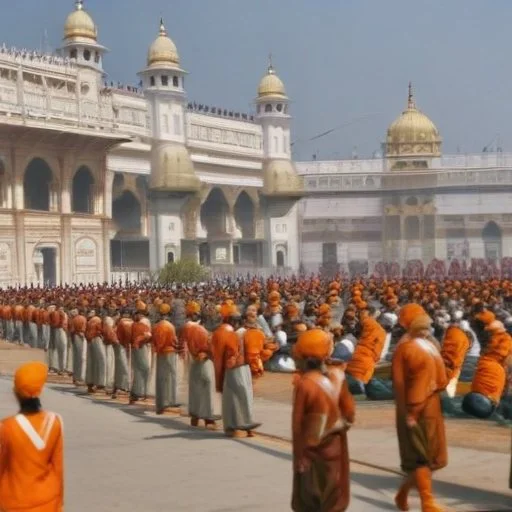
In the early 1980s, Sikh separatist movements gained momentum, demanding greater autonomy for Punjab and even independence. The Akali Dal, a Sikh political party, began to mobilize supporters, and the Golden Temple became a hub for Sikh activism. The Indian government, led by Prime Minister Indira Gandhi, viewed the movement as a threat to national unity and decided to take decisive action.
June 3, 1984:
June 4-6, 1984:
The operation resulted in:
The operation had far-reaching cultural and social implications:
The operation remains shrouded in controversy:
Operation Blue Star serves as a poignant reminder of the complexities of faith, identity, and politics in modern India. As the country continues to grapple with the legacy of this event, one thing is clear: the wounds of 1984 will take a long time to heal.
In the decade leading up to Operation Blue Star, Punjab was plagued by communal violence, political unrest, and economic stagnation. The Sikh community, which formed the majority of the population in Punjab, felt increasingly marginalized and disillusioned with the Indian government. The Akali Dal, a Sikh political party, began to mobilize supporters, demanding greater autonomy for Punjab and even independence.
The Indian government, led by Prime Minister Indira Gandhi, viewed the movement as a threat to national unity and responded with a heavy hand. The Punjab police and central paramilitary forces were deployed to quell the protests, leading to widespread human rights abuses and further alienating the Sikh population.

Jarnail Singh Bhindranwale, the Sikh extremist leader killed during Operation Blue Star, remains a complex and controversial figure. Born in 1947, Bhindranwale was a charismatic preacher who rose to prominence in the 1980s, advocating for Sikh rights and autonomy. His fiery sermons and calls to action resonated with many young Sikhs, who saw him as a champion of their faith and community.
Despite his popularity, Bhindranwale's methods were often violent and divisive. He was accused of orchestrating attacks on Hindus and moderate Sikhs, and his followers were known to be heavily armed and militant. The Indian government viewed him as a threat to national security, and his death during Operation Blue Star remains a point of contention to this day.
Operation Blue Star had a profound impact on the Sikh identity and community. The desecration of the Golden Temple, a sacred site and symbol of Sikhism, was seen as an attack on the faith itself. Many Sikhs felt betrayed by the Indian government, which they perceived as having violated the sanctity of their holiest shrine.
In the aftermath of the operation, Sikh identity became increasingly politicized. Many Sikhs began to see themselves as a distinct nation, separate from India, and demanded greater autonomy or even independence. This sentiment was fueled by the Indian government's heavy-handed response to Sikh protests and the perceived marginalization of the community.

Operation Blue Star marked a turning point in the history of Sikh nationalism. The Indian government's actions were seen as a declaration of war against the Sikh community, and many Sikhs responded by embracing extremist ideologies. The operation led to a surge in militancy, with many Sikh groups taking up arms against the Indian government.
The Indian government's response to the militancy was brutal, with widespread human rights abuses and extrajudicial killings. The cycle of violence and repression further radicalized the Sikh community, creating a sense of siege mentality and fueling demands for greater autonomy or independence.
Operation Blue Star took place against the backdrop of a shifting global geopolitical landscape. The Indian government was anxious to maintain stability and control in the face of rising separatist movements and Islamic fundamentalism in the region.
The operation was also influenced by Cold War rivalries, with the United States and Soviet Union vying for influence in South Asia. The Indian government's heavy-handed response to the Sikh militants was seen as a way to demonstrate its resolve to maintain national unity and stability in the face of external threats.