


The Ottoman Empire's victory at the Battle of Ridaniya in 1517 marked a pivotal moment in history, cementing its status as a dominant world power and securing control over present-day Egypt. This decisive battle, fought on the dusty plains of Ridaniya, saw the Ottoman army, led by Sultan Selim I, defeat the Mamluk Sultanate, a powerful rival kingdom that had long been a thorn in the Ottomans' side.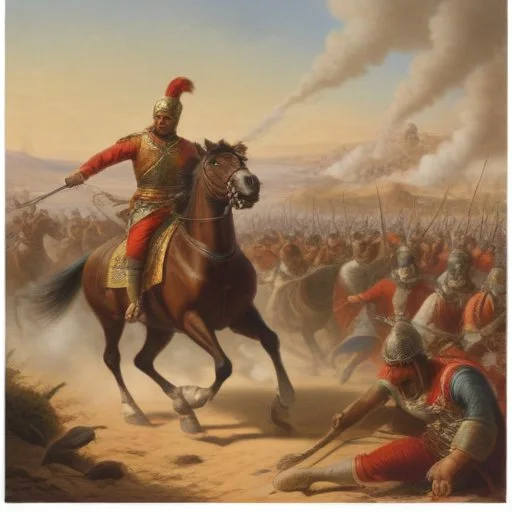
The Mamluk Sultanate, founded by former slaves turned warriors, had been a formidable force in the Middle East for centuries. But as the Ottoman Empire began to expand its borders, a rivalry born of ambition and a desire for territorial control was ignited. Selim I, known for his ruthless determination, saw the Mamluks as a threat to his empire's growth and was determined to bring them under his control.
The two armies clashed on the plains of Ridaniya, each side boasting a formidable force of cavalry, archers, and artillery. The Mamluks, relying on their traditional tactics of speed and mobility, launched a series of lightning-fast cavalry charges. But the Ottomans, armed with cannons and a disciplined infantry, held their ground, gradually wearing down the Mamluk forces.
The Ottoman victory at Ridaniya marked the beginning of the end for the Mamluk Sultanate. The Mamluk army was decimated, and their capital, Cairo, fell to the Ottomans shortly after. The conquest of Egypt brought immense wealth and prestige to the Ottoman Empire, solidifying its position as a dominant world power.
The conquest of Egypt had far-reaching cultural and social implications. The Ottomans introduced new administrative systems, architecture, and infrastructure, which transformed the urban landscape of Cairo and beyond. The city became a center of learning and culture, attracting scholars and artists from across the Islamic world.
Selim I's victory at Ridaniya cemented his reputation as a ruthless and ambitious leader, driven by a desire for territorial expansion and dominance. His legacy would shape the course of Ottoman history, inspiring future generations of leaders to pursue their own ambitions.
In the end, the Battle of Ridaniya serves as a testament to the Ottoman Empire's enduring legacy, a reminder of the power and ambition that drove its rise to greatness.
Selim I, known for his cunning and military prowess, was the driving force behind the Ottoman Empire's expansionist policies. Born in 1470, Selim was the son of Sultan Bayezid II and was groomed from a young age to take over the throne. He was known for his intelligence, strategic thinking, and above all, his ambition to expand the Ottoman Empire.
Selim's reign was marked by a series of military campaigns, which he personally led, to expand the empire's borders. He was feared by his enemies and respected by his allies, earning the nickname "Selim the Grim."

The Ottoman conquest of Egypt had a profound impact on the cultural landscape of the region. The introduction of Ottoman architecture, art, and literature transformed the urban landscape of Cairo and beyond.
The Ottomans also introduced their own system of education, which emphasized the study of Islamic law, theology, and literature. This led to a flourishing of intellectual and artistic activity in the region, with Cairo becoming a major center of learning and culture.
The Battle of Ridaniya was not an isolated incident, but rather the culmination of a series of skirmishes and battles between the Ottoman Empire and the Mamluk Sultanate.
In the years leading up to Ridaniya, the Ottomans had been making gradual gains against the Mamluks, capturing key towns and cities in Syria and Palestine. The Mamluks, meanwhile, had been struggling to maintain their territorial integrity, facing challenges from internal power struggles and external threats.

The Ottoman conquest of Egypt brought immense economic benefits to the empire. The region's fertile soil, abundant water resources, and strategic location made it an ideal hub for trade and commerce.
The Ottomans exploited Egypt's natural resources, exporting grains, textiles, and other goods to markets across the empire. The conquest also brought a significant influx of revenue from taxes, tariffs, and tribute payments, which helped to finance the empire's military campaigns and infrastructure projects.
The Battle of Ridaniya took place against the backdrop of a rapidly changing geopolitical landscape. The Ottoman Empire was expanding its borders, while the Mamluk Sultanate was struggling to maintain its territorial integrity.
In the years leading up to the battle, the Europeans had been making gains in the Mediterranean, while the Safavid Empire was rising to power in Persia. The battle was a pivotal moment in the struggle for dominance in the Middle East, marking the beginning of Ottoman hegemony in the region.