


The Battle of Grunwald, fought on July 15, 1410, is etched in the annals of history as one of the most pivotal and brutal battles of the Middle Ages. It was a day when the allied forces of the Kingdom of Poland and the Grand Duchy of Lithuania, led by King Jagiello and Grand Duke Vytautas, clashed with the mighty Teutonic Order, a German military organization, in a frenzy of steel, blood, and primal fury.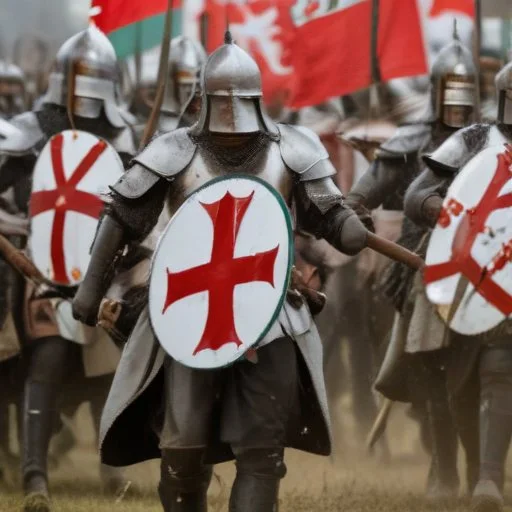
In the years leading up to the battle, the Teutonic Order had been expanding its territories, casting a shadow of fear over the region. Faced with the threat of annihilation, the Kingdom of Poland and the Grand Duchy of Lithuania put aside their differences and forged an unlikely alliance, united against a common enemy.
The stage was set for a conflict of epic proportions. On the fields of Grunwald, over 30,000 soldiers from both sides clashed in a melee of chaos and destruction. The Teutonic Knights, with their gleaming armor and precision tactics, were pitted against the Polish-Lithuanian forces, driven by a fierce determination to protect their homeland.
The battle raged on for hours, the din of clashing steel and the cries of the wounded filling the air. The Teutonic Knights, despite their superior training and equipment, found themselves bogged down in the muddy terrain, their line of advance repeatedly breached by the Polish-Lithuanian forces.
In the heat of the battle, Grand Master Ulrich von Jungingen, the leader of the Teutonic Order, was struck down by a Polish nobleman, later identified as Mszczuj of Skrzynno. This pivotal moment marked the beginning of the end for the Teutonic Order, as their army began to falter and retreat.
The Battle of Grunwald was a crushing defeat for the Teutonic Order, with estimates suggesting that up to 20,000 of their soldiers fell that day. The loss of their Grand Master and many of their high-ranking officials dealt a devastating blow to their power and influence.
In the wake of the battle, the Polish-Lithuanian alliance had secured a vital victory, cementing their position as a dominant force in the region. The Teutonic Order, once invincible, was forced to retreat and regroup, their ambitions checked for the first time in centuries.
Today, the Battle of Grunwald is remembered as a testament to the bravery and resilience of the Polish and Lithuanian people. The clash of steel, the cries of the wounded, and the fall of the Grand Master are etched in the collective memory of the region, a reminder of the power of unity in the face of adversity.
The battle may have been fought six centuries ago, but its impact still resonates today, a beacon of hope and inspiration to those who dare to stand against oppression and fight for their freedom.
Grand Master Ulrich von Jungingen was a seasoned military leader who had led the Teutonic Order to numerous victories in the past. However, his stubborn refusal to adapt to the changing circumstances of the battle ultimately sealed his fate. Despite being outnumbered, von Jungingen was confident in his knights' superior training and equipment, and he led the charge against the Polish-Lithuanian forces with characteristic bravery.
Little is known about von Jungingen's early life, but it is clear that he was a skilled diplomat and strategist who had risen through the ranks of the Teutonic Order. His death at the Battle of Grunwald marked the beginning of the end of the Order's dominance in the region.
The Battle of Grunwald has been the subject of much debate among historians, with some viewing it as a symbol of Polish-Lithuanian unity and others seeing it as a crushing defeat for the Teutonic Order. The battle has been variously interpreted as a clash of cultures, a struggle for power, and a testament to the bravery of the Polish and Lithuanian people.
Despite the differing interpretations, most historians agree that the battle marked a significant turning point in the region's history, as it checked the Teutonic Order's expansionist ambitions and cemented the Polish-Lithuanian alliance as a dominant force in the region.
The Teutonic Knights were famed for their heavy cavalry, which had proven invincible in countless battles. In contrast, the Polish-Lithuanian forces were largely infantry-based, with lighter cavalry units and a greater emphasis on mobility.
Despite their differences, both armies were well-trained and well-equipped, with the Teutonic Knights boasting the latest in military technology, including cannons and handguns. The Polish-Lithuanian forces, on the other hand, relied on their knowledge of the terrain and their experience fighting in the region to gain an advantage.

The Battle of Grunwald took place against the backdrop of a rapidly changing geopolitical landscape. The Teutonic Order, which had once been a powerful force in the region, was facing increasing opposition from the Kingdom of Poland and the Grand Duchy of Lithuania.
The battle was also influenced by the wider European context, with the Holy Roman Empire and the Kingdom of Hungary both vying for power in the region. The Polish-Lithuanian alliance's victory at Grunwald marked a significant shift in the balance of power, as the Teutonic Order's influence began to wane and the alliance's star began to rise.
The Battle of Grunwald has had a lasting impact on the cultural heritage of Poland and Lithuania, with the battle being celebrated as a national triumph in both countries.
In Poland, the battle is remembered as a symbol of national resistance against foreign occupation, while in Lithuania, it is seen as a testament to the country's rich cultural heritage. The battle has also inspired numerous works of art, literature, and music, cementing its place in the collective imagination of the region.