


The Battle of Warsaw, fought between August 13 and 25, 1920, is remembered as one of the most pivotal moments in modern European history. This defining conflict marked a crushing defeat for the Red Army, breathing new life into Poland's struggle for independence and casting a long shadow over the tumultuous relationship between Poland and the Soviet Union.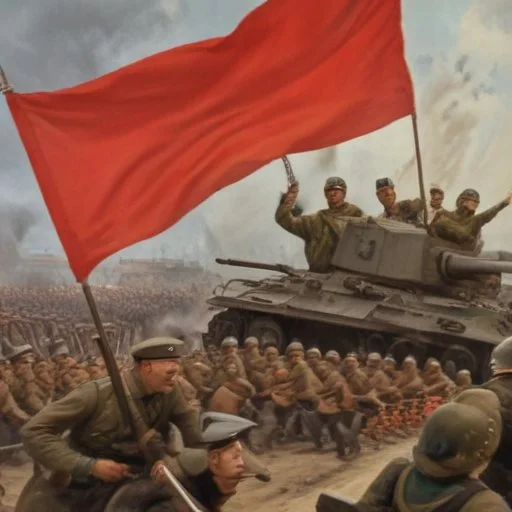
In the aftermath of World War I, the borders of Eastern Europe were in a state of flux. Poland, re-established as an independent nation after over a century of foreign rule, was determined to assert its sovereignty amidst the chaos. The Soviet Union, fresh from its revolution, saw an opportunity to expand its borders and spread communist ideology. The stage was set for a clash of titans, as these two nations with competing visions for the region collided in the Polish-Soviet War.
As the Red Army advanced on Warsaw, Polish General Józef Piłsudski devised a daring plan to counter the Soviet juggernaut. Piłsudski, well-versed in guerrilla warfare, orchestrated a series of surprise attacks and strategic retreats, exploiting the Red Army's overextension and logistical vulnerabilities. The Poles, vastly outnumbered and outgunned, fought with a ferocity that would become the hallmark of their national identity.
The Battle of Warsaw was a resounding victory for Poland, one that would have far-reaching consequences for the region. The defeat of the Red Army not only secured Poland's independence but also halted the spread of communism, buying time for the fledgling democracies of Europe to consolidate their power.
General Józef Piłsudski, the mastermind behind Poland's defense, was hailed as a national hero. His tactical brilliance and unwavering resolve inspired a generation of Polish leaders. Władysław Sikorski, Piłsudski's chief of staff, played a crucial role in coordinating the Polish army's efforts, earning him the sobriquet "the savior of Warsaw."
The Battle of Warsaw was not without its controversies. Soviet historians would later downplay the significance of the defeat, while Polish nationalists would elevate it to mythic status. The legacy of the battle continued to shape the Cold War landscape, as Poland and the Soviet Union remained bitter foes for decades to come.
The Battle of Warsaw set the tone for a century of tense relations between Poland and the Soviet Union. The conflict would simmer, then boil over into proxy wars, espionage, and finally, the tumultuous events of 1989 that saw the fall of communism in Eastern Europe. Today, the Battle of Warsaw remains a potent symbol of Polish resistance, a testament to the power of national determination in the face of overwhelming odds.
The aftermath of the Battle of Warsaw saw a significant shift in the balance of power in Eastern Europe. Poland's triumph over the Red Army led to a brief period of relative stability, but tensions between Poland and the Soviet Union continued to simmer.
In the years that followed, Poland became increasingly isolated, struggling to maintain its independence in the face of Soviet aggression. The Soviet Union, still reeling from its defeat, began to reorganize its military and political strategies, setting the stage for future conflicts.
Born on December 5, 1867, in Zułów, Lithuania, Józef Piłsudski was an unlikely hero. His early life was marked by poverty and hardship, but he was driven by a fierce determination to restore Polish independence.
Piłsudski's involvement in the Polish Socialist Party and his participation in the Russian Revolution of 1905 shaped his political beliefs and instilled in him a deep distrust of Russia and its imperial ambitions.
The Polish-Soviet War was not an isolated conflict, but rather part of a larger struggle for power and influence in Eastern Europe.
In the aftermath of World War I, the region was plagued by instability, with borders shifting and new nations emerging. The conflict between Poland and the Soviet Union was just one of many flashpoints in a complex web of alliances and rivalries.

The Battle of Warsaw was a clash of two vastly different military strategies. Józef Piłsudski, the Polish commander-in-chief, employed unconventional tactics, leveraging guerrilla warfare and surprise attacks to outmaneuver the Red Army.
In contrast, the Soviet commander, Mikhail Tukhachevsky, relied on brute force, attempting to overwhelm the Polish defenses with sheer numbers and firepower. This contrast in approach highlights the innovative thinking of Piłsudski and the Soviet Union's rigid adherence to traditional military doctrine.
Historians have long debated the significance of the Battle of Warsaw, with some viewing it as a minor skirmish and others regarding it as a pivotal moment in modern European history.
Recent scholarship has emphasized the battle's impact on the development of Soviet foreign policy, suggesting that the defeat led to a reevaluation of the Soviet Union's approach to international relations and the rise of a more pragmatic, realpolitik-driven foreign policy.