


In June 1979, Pope John Paul II made history by becoming the first Pope to set foot in a Communist country, his native Poland, sparking unprecedented excitement and hope among the Polish people. This nine-day visit marked a significant turning point in the country's struggles against Soviet domination, and cemented the Pope's status as a champion of unity, faith, and resistance.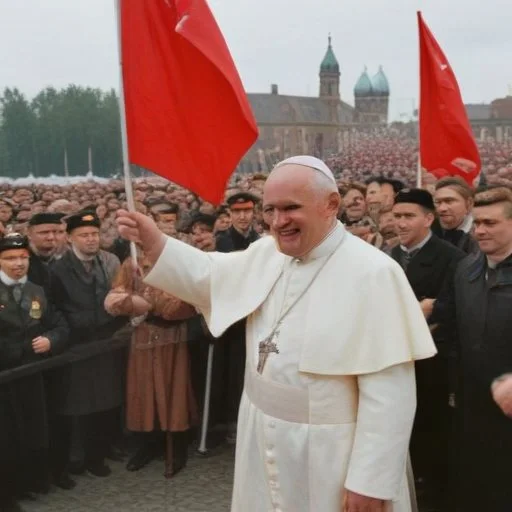
Poland had long been suffocated under Soviet rule, its people yearning for freedom and autonomy. The appointment of Karol Wojtyła, a Polish cardinal, as Pope John Paul II in 1978 brought renewed hope to the nation. The Polish people saw their new Pope as a symbol of national pride and resistance against the Communist regime.
Throughout his visit, Pope John Paul II's words resonated deeply with the Polish people, emphasizing the importance of faith, hope, and unity in the face of oppression. His message galvanized the nation, inspiring a sense of national pride and resistance against Soviet domination.
The Pope's visit had a profound impact on Polish culture and society. It marked a turning point in the country's struggle for independence, paving the way for the Solidarity movement and eventual collapse of Communism in Poland.
The Polish government, while initially reluctant to allow the visit, eventually succumbed to public pressure. The event was met with widespread enthusiasm, with millions thronging the streets to catch a glimpse of their beloved Pope.
"There can be no just Europe without the independence of Poland."
- Pope John Paul II, 1979
Pope John Paul II's visit to Poland set a precedent for future papal visits to Communist countries, paving the way for increased diplomatic engagement and eventual reforms.
One eyewitness account recalls the electric atmosphere during the Pope's Mass in Victory Square, where "tears of joy streamed down the faces of the faithful as the Pope celebrated Mass in their native language."
Pope John Paul II's historic visit to Poland serves as a beacon of hope and inspiration, reminding us of the power of faith, unity, and resistance in the face of oppression.
The Polish Pope's visit was not just a homecoming, but a deliberate attempt to challenge the Soviet-sponsored government. The Communist Party, wary of the Pope's influence, had initially denied permission for the visit, but eventually relented due to mounting public pressure. This cat-and-mouse game between the Church and the State set the tone for the Pope's nine-day stay in Poland.
In this high-stakes game of political chess, Pope John Paul II proved to be a master strategist. He cleverly used his public masses and sermons to subtly critique the communist regime, while simultaneously avoiding direct confrontation.
One notable example was his sermon at Kraków's St. John's Cathedral, where he emphasized the importance of faith and unity in the face of oppression. His words were laced with nuance, yet conveyed a powerful message that resonated deeply with the Polish people.
Karol Wojtyła, the man who would become Pope John Paul II, was born in Wadowice, Poland in 1920. His early life was marked by tragedy, including the loss of his mother at the age of nine and his brother at 12. These early hardships instilled in him a deep sense of empathy and compassion that would later define his papacy.
As a young man, Wojtyła was drawn to the priesthood, and his intellectual prowess and charisma quickly propelled him up the ranks of the Catholic Church.
Wojtyła's appointment as Pope in 1978 was met with widespread jubilation in Poland, where he was seen as a national hero and a symbol of resistance against Soviet domination. His papacy would go on to be marked by his unwavering commitment to human rights, freedom, and social justice.
The Pope's visit had a profound impact on Polish culture, particularly in the realm of music. The visit inspired a proliferation of patriotic songs and hymns, many of which were written specifically to commemorate the event.
One notable example is the song "Abba Ojcze" (Oh Father), which became an unofficial anthem of the Solidarity movement. Written by Polish composer and musician, Stefan Stuligrosz, the song's haunting melody and poignant lyrics captured the mood of a nation yearning for freedom.
The Pope's visit also sparked a renewed interest in traditional Polish folk music, which had been suppressed under communist rule. This cultural renaissance played a significant role in shaping Poland's national identity and provided a powerful symbol of resistance against Soviet domination.
The Polish government's decision to allow the Pope's visit was a calculated gamble. On one hand, it hoped to curry favor with the international community and improve its tarnished human rights record. On the other hand, it risked infuriating its Soviet patrons and sparking widespread unrest.
In the end, the government's strategy backfired spectacularly. The Pope's visit galvanized the Polish people, emboldening them to demand greater freedoms and autonomy. The event marked a turning point in the country's struggle for independence, paving the way for the eventual collapse of communism in Poland.
The Polish government's handling of the visit also highlighted the complex and often fraught relationship between the Church and the State in communist Poland. While the two entities had historically been at odds, the Pope's visit exposed deep divisions within the government itself, ultimately contributing to its downfall.
The Pope's visit to Poland took place against the backdrop of a rapidly changing global landscape. The Cold War was at its height, and the Soviet Union was facing growing challenges to its hegemony in Eastern Europe.
In this context, the Pope's visit was seen as a bold challenge to Soviet authority, and his message of hope and unity resonated deeply with people across the Eastern Bloc.
The visit also marked a significant shift in the Vatican's foreign policy, with Pope John Paul II emerging as a key protagonist in the struggle for human rights and democracy in Eastern Europe.