


In the year 1095, Pope Urban II stood before the esteemed Council of Clermont, his words igniting a fire that would resound throughout Christendom, marking the beginning of a centuries-long conflict that would forever alter the course of history. It was on this day that he declared the First Crusade, urging the faithful to reclaim the Holy Land from Muslim occupation and ensure safe passage for pilgrims.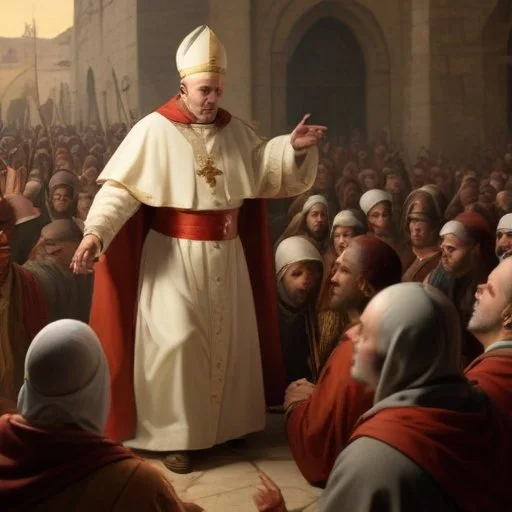
The 11th century was a time of great turmoil, with the Holy Roman Empire and the Byzantine Empire vying for power, and the Muslim world having conquered vast swaths of Christian territory. The Seljuk Turks, in particular, had been making gains in Anatolia, threatening the very heart of Christendom. It was against this backdrop of tension and uncertainty that Pope Urban II made his impassioned plea.
The declaration of the First Crusade had a profound impact on the course of history, shaping the trajectory of Christian-Muslim relations, the development of medieval society, and the very fabric of European politics. The Crusade also sparked a wave of anti-Semitic violence, as Christian mobs turned on Jewish communities in Europe, leaving a dark stain on the conscience of Christendom.
The First Crusade was a complex, multifaceted phenomenon that drew upon deep-seated cultural and religious convictions. It was an era of fervent religiosity, marked by a desire to reclaim sacred space and assert Christian dominance. At the same time, the Crusade was fueled by a sense of adventure, curiosity, and a thirst for material gain, as knights and nobles sought to expand their territories and fortunes.
The First Crusade remains a deeply contested and controversial event, with opinions divided on its motivations, methods, and legacy. While some view it as a heroic defense of Christianity, others condemn it as a brutal, colonialist enterprise that sowed seeds of hatred and intolerance. As we reflect on this pivotal moment, we are reminded of the importance of nuance, complexity, and empathy in our understanding of history.
| Date | Event |
|---|---|
| 1095 | Pope Urban II declares the First Crusade at the Council of Clermont |
| 1096 | Peter the Hermit's army sets out for the Holy Land |
| 1099 | The Crusader army captures Jerusalem |
The First Crusade was driven by a constellation of motivations, from piety and duty to adventure and material gain. Yet, amidst the chaos and bloodshed, we find stories of remarkable courage, sacrifice, and devotion – tales that continue to inspire and challenge us to this day.
While Pope Urban II and Peter the Hermit are often credited with sparking the First Crusade, one individual played a crucial role in its military success: Bohemond of Taranto.
This Norman prince was a skilled warrior and shrewd politician, who saw the Crusade as an opportunity to expand his territories and secure a foothold in the East.
Bohemond's military prowess was instrumental in the Crusaders' victory at Antioch, and he would go on to establish the Principality of Antioch, which became a major Christian stronghold in the region.
Despite his significant contributions, Bohemond's legacy has been overshadowed by that of other Crusade leaders.
The Council of Clermont, where Pope Urban II issued his call to arms, is a well-documented event, but what do the primary sources reveal about this pivotal moment?
The most comprehensive account of the Council comes from the writings of Bishop Fulcher of Chartres, who was present at the event.
Fulcher's chronicle provides valuable insights into the atmosphere of the Council, including the emotional response of the attendees to Urban's speech.
A closer examination of the primary sources also highlights the role of other key figures, such as Emperor Alexios I Komnenos, who played a crucial part in Urban's decision to launch the Crusade.The First Crusade had a profound influence on Christian art, as a new wave of pilgrims and Crusaders flooded the Holy Land.
This influx of travelers sparked a renewed interest in the art and architecture of the region, leading to the development of new styles and motifs.
The Crusade also saw the introduction of Islamic artistic influences into Christian art, as artists and architects drew inspiration from the ornate decorations and intricate patterns of Middle Eastern buildings.
The fusion of Eastern and Western styles resulted in some of the most iconic and enduring works of Christian art, including the stunning mosaics of the Church of the Holy Sepulchre.
The First Crusade had far-reaching geopolitical consequences, as the Latin States established in the wake of the Crusade became a thorn in the side of the Byzantine Empire.
The Crusade also marked the beginning of a new era of rivalry between the Catholic and Orthodox Churches, as the Latin States challenged Byzantine authority in the region.
The establishment of the Kingdom of Jerusalem, in particular, would go on to play a significant role in the geopolitics of the Middle East, as a Christian stronghold in the heart of Muslim territory.
The lasting impact of the Crusade on the region's geopolitics continues to be felt to this day.Traditional accounts of the First Crusade often portray it as a heroic and pious endeavor, driven by a desire to reclaim the Holy Land for Christendom.
However, modern historians have challenged this narrative, arguing that the Crusade was a far more complex and multifaceted phenomenon.
Revisionist historians have highlighted the role of economic and political motivations, as well as the impact of the Crusade on Jewish and Muslim communities.
A more nuanced understanding of the Crusade's historiography reveals a rich and complex tapestry of motivations, interests, and consequences.