


Bogyoke Aung San, the charismatic leader of Burma's independence movement, and eight members of his cabinet, were brutally assassinated on July 19, 1947, in a meeting room of the Executive Council in Rangoon, Burma. This devastating event marked a turning point in the country's struggle for independence from British colonial rule, leaving a power vacuum that would have far-reaching consequences.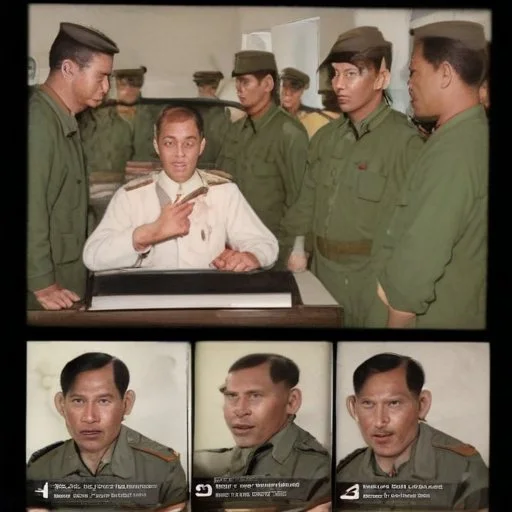
In the aftermath of World War II, Burma was in a state of flux. The country had been under British colonial rule since 1885, and the war had weakened the British Empire's grip on its colonies. Aung San, a young and ambitious leader, saw an opportunity to lead Burma to independence. He formed the Anti-Fascist People's Freedom League (AFPFL), which became the dominant force in the country's independence movement.
On July 19, 1947, Aung San and his cabinet gathered for a meeting at the Executive Council in Rangoon. Unbeknownst to them, a rival politician, U Saw, had hired an assassin to eliminate Aung San and his associates. As the meeting began, the assassin burst into the room, spraying the room with automatic gunfire. Aung San and eight others, including a bodyguard, fell victim to the attack.
The assassination of Aung San and his cabinet had a profound impact on Burma's struggle for independence. The country was plunged into turmoil, and the provisional government was left in shambles. The power vacuum created by Aung San's demise allowed the military to seize power, which would have far-reaching consequences for the country's future.
Aung San's legacy as the "Father of the Nation" continues to inspire generations of Burmese people. He is remembered as a champion of independence and a symbol of resistance against colonial rule. His assassination served as a catalyst for the country's eventual independence from British rule, which was achieved in 1948.
The assassination of Aung San remains a controversial topic, with many questioning the motives behind the attack. U Saw, the rival politician, was later arrested and executed for his role in the assassination, but many believe that the British colonial authorities were also involved.
"We will not be satisfied until we have achieved our goal of independence." - Bogyoke Aung San
Aung San's daughter, Daw Aung San Suu Kyi, would go on to become a prominent democracy activist and leader in her own right. She has spoken extensively about the impact of her father's assassination on her family and the country.
Aung San's assassination paved the way for the military to seize power, which would lead to decades of authoritarian rule in Burma. The country's struggle for democracy and human rights continues to this day, with Aung San's legacy serving as a powerful symbol of resistance against oppression.
The assassination of Bogyoke Aung San and eight others remains a pivotal moment in Burma's history, marking a turning point in the country's struggle for independence and self-determination. His legacy continues to inspire generations, serving as a powerful symbol of resistance against colonial rule and oppression.
The Geopolitical Context of Burma's Independence Movement
The assassination of Bogyoke Aung San took place amidst a complex web of geopolitical tensions and alliances. The aftermath of World War II had left the British Empire weakened, creating an opportunity for nationalist movements to emerge across Asia. The Cold War was also gaining momentum, with the United States and the Soviet Union vying for influence in the region.
In this context, Burma's independence movement was not only a struggle against British colonial rule but also a test of the country's ability to navigate the treacherous landscape of international politics.

U Saw: The Rival Politician Behind the Assassination
U Saw, a rival politician and leader of the Galon Party, was a key figure behind the assassination of Bogyoke Aung San. A charismatic leader in his own right, U Saw was driven by a desire for power and a deep-seated rivalry with Aung San.
Early Life and CareerU Saw was born in 1900 in the village of Natmauk, Burma. He was educated at Rangoon University and later became a lawyer and politician. U Saw's Galon Party was a prominent force in Burmese politics, and he was known for his populist rhetoric and anti-colonial stance.
The Cultural Significance of Bogyoke Aung San
Bogyoke Aung San is not only remembered as a hero of Burma's independence movement but also as a cultural icon. His legacy has inspired generations of Burmese people, and his image is often invoked in popular culture, art, and literature.
Aung San's cultural significance extends beyond Burma's borders. He is seen as a symbol of resistance against colonialism and oppression, inspiring movements across Asia and beyond.

The Political Ramifications of Aung San's Assassination
The assassination of Bogyoke Aung San had far-reaching political consequences for Burma. The power vacuum created by his demise allowed the military to seize power, paving the way for decades of authoritarian rule.
The Rise of Ne WinIn the aftermath of Aung San's assassination, General Ne Win, a former ally of Aung San, emerged as a key player in Burmese politics. Ne Win would go on to become a dominant figure in Burmese politics, ruling the country with an iron fist until his eventual downfall in 1988.
Historiographical Perspectives on Aung San's Assassination
Historians have debated the circumstances surrounding Aung San's assassination, with some pointing to British colonial involvement and others highlighting the role of internal rivalries.
The 'British Conspiracy' TheoryOne school of thought suggests that the British colonial authorities were involved in Aung San's assassination, seeking to eliminate a charismatic leader who threatened their grip on power.