


On a fateful day in 1947, the Radcliffe Line, a contentious border separating the newly formed Dominions of India and Pakistan, was unveiled, marking the birth of a new international frontier. This boundary, drawn by Sir Cyril Radcliffe, chairman of the Border Commissions, would go on to seal the fate of millions, unleashing a maelstrom of communal violence, mass migration, and enduring hostility between the two nations.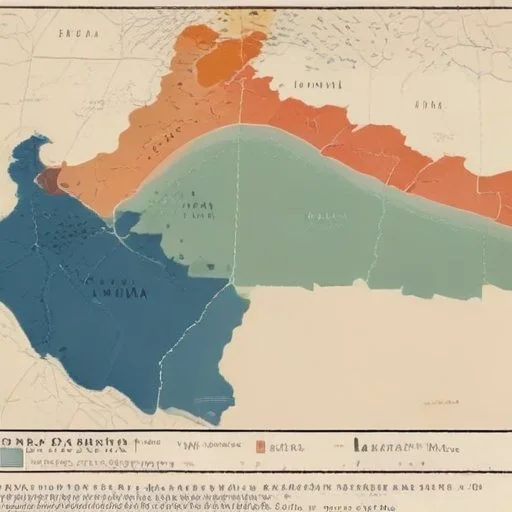
The Radcliffe Line was a product of the British Raj's hasty retreat from the Indian subcontinent, leaving behind a legacy of division and turmoil. As the British Empire's grip on India began to loosen, the country was plunged into a maelstrom of political upheaval, with the Indian National Congress and the Muslim League vying for power.
In the midst of this chaos, the British government, eager to stem the tide of rising nationalism, formulated a plan to divide the subcontinent into two separate dominions: India and Pakistan. The task of demarcating the border between these two newly formed nations fell to Sir Cyril Radcliffe, a British lawyer and politician with no prior experience in the region.
Radcliffe's commission was given the daunting task of dividing a landmass of over 1.8 million square miles, home to over 400 million people, and spanning a vast array of cultures, languages, and religions. The border, which stretched over 1,600 miles, was drawn with little regard for the cultural, linguistic, or geographical nuances of the region.
The resulting border, dubbed the Radcliffe Line, was a testament to the arbitrary nature of colonial rule. It sliced through the heart of villages, divided families, and severed ancient trade routes, leaving behind a legacy of displacement, violence, and uncertainty.
The Radcliffe Line's unveiling sparked a wave of violence and displacement on a catastrophic scale. Hindus and Muslims, who had coexisted for centuries, were now pitted against each other, as communal riots and massacres erupted across the border.
Millions of people were forced to flee their homes, abandoning their livelihoods and belongings, as they sought refuge in the newly formed nations. The violence and bloodshed that accompanied the partition of India and Pakistan would go on to claim the lives of over a million people, leaving behind a trail of mourning, loss, and trauma.
The Radcliffe Line has left an indelible mark on the psyche of the Indian subcontinent. It has fostered a climate of mistrust and hostility between India and Pakistan, perpetuating a cycle of conflict and tension that continues to this day.
Despite the passage of time, the Radcliffe Line remains a contentious issue, with both nations contesting its legitimacy and territorial claims. The border has become a symbol of the enduring legacy of colonialism, a reminder of the devastating consequences of imperial hubris and neglect.
As we reflect on the Radcliffe Line, we are reminded of the importance of understanding the complex tapestry of human experience, and the need for empathy, compassion, and cooperation in the face of adversity.
Rukmini Devi, a young Hindu woman from Punjab, recalls the horrors of communal violence that erupted along the border: "I saw my neighbors, people I had grown up with, butchered in the streets. The Radcliffe Line brought us nothing but bloodshed and tears."
Akbar Khan, a Pakistani refugee from Kashmir, remembers the journey he undertook with his family to reach Pakistan: "We walked for days, without food or water, as gunfire and screams echoed through the valleys. The Radcliffe Line left us penniless, homeless, and broken."
The Radcliffe Line has permeated the cultural consciousness of the Indian subcontinent, inspiring countless works of literature, art, and music. From Salman Rushdie's Midnight's Children to Manto's Partition Stories, the Radcliffe Line has become a symbol of the human cost of colonialism and the devastating consequences of division.
In popular culture, the Radcliffe Line has been referenced in films, songs, and poetry, serving as a poignant reminder of the enduring legacy of partition.
The Radcliffe Line, a seemingly innocuous border, has come to symbolize the darker aspects of human nature: intolerance, violence, and division. As we reflect on this contentious border, we are reminded of the importance of empathy, compassion, and cooperation in the face of adversity, and the need to confront the darker legacies of our shared human history.
The Radcliffe Line has been the subject of much historiographical debate, with scholars questioning the motivations behind the British government's decision to divide the Indian subcontinent. Some argue that the boundary was drawn to maintain British influence in the region, while others believe it was a genuine attempt to satisfy the demands of the Indian National Congress and the Muslim League.
Historians such as Stanley Wolpert and Yasmin Khan have underscored the importance of understanding the Radcliffe Line as a product of colonialism, highlighting the role of British imperialism in creating and perpetuating communal divisions. Others, like Ayesha Jalal, have emphasized the agency of Indian and Pakistani leaders in shaping the boundary and its aftermath.
Regardless of interpretation, the Radcliffe Line remains a contested and complex historical event, with its legacy continuing to shape the contemporary politics and identity of India and Pakistan.
The Radcliffe Line has had a profound impact on the cultural landscape of the Indian subcontinent. The partition of India and Pakistan led to a massive exchange of cultural, literary, and artistic works, as people from both sides of the border sought to make sense of the traumatic events.
In literature, writers like Salman Rushdie, Amitav Ghosh, and Kamila Shamsie have explored the themes of partition, identity, and belonging in their works. The Radcliffe Line has also inspired countless films, songs, and poems, cementing its place in the cultural consciousness of the region.
Moreover, the Radcliffe Line has influenced the development of art, architecture, and design in India and Pakistan, with many artists and architects incorporating motifs and themes related to partition and identity into their work.
The Radcliffe Line has been a focal point of political tension and conflict between India and Pakistan since its inception. The border has been the site of multiple wars, skirmishes, and diplomatic crises, with both nations disputing the legitimacy of the boundary.
The Line has also been a major factor in the Kashmir dispute, with both India and Pakistan claiming sovereignty over the region. The ongoing conflict has resulted in significant human rights abuses, displacement, and militarization along the Line of Control.
Despite numerous attempts at diplomatic resolution, the Radcliffe Line remains a contentious issue, with its legacy continuing to shape the political landscape of the Indian subcontinent.
The Radcliffe Line has had a profound impact on social change dynamics in the Indian subcontinent. The partition of India and Pakistan led to the displacement of millions of people, resulting in significant social and economic upheaval.
The trauma and violence experienced during partition have also had a lasting impact on the social fabric of both nations, with communal tensions and divisions persisting to this day. However, the Radcliffe Line has also inspired social and cultural movements aimed at promoting unity, reconciliation, and cross-border cooperation.
Moreover, the Line has influenced the development of social and cultural identities in India and Pakistan, with individuals and communities negotiating their relationships with the nation-state and each other.
The Radcliffe Line has had significant economic implications for the Indian subcontinent. The partition of India and Pakistan led to the division of natural resources, infrastructure, and markets, resulting in significant economic disruption and instability.
The ongoing conflict and tensions along the Line of Control have also hindered regional trade and economic cooperation, with both nations imposing trade restrictions and tariffs on each other.
Despite these challenges, the Radcliffe Line has also created opportunities for economic growth and development, with both India and Pakistan investing heavily in border infrastructure and regional trade agreements.