


The year was 1076, and the medieval world was abuzz with the news of a papal decree that would shake the foundations of power for centuries to come. In a bold move, Pope Gregory VII excommunicated Henry IV, the Holy Roman Emperor, after the latter refused to heed a letter calling for his abdication during the Lenten synod of February.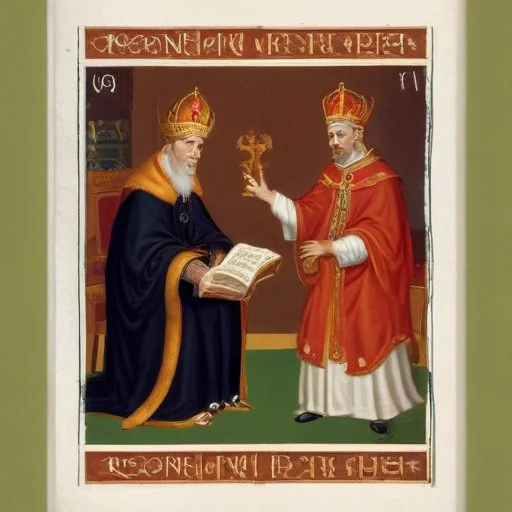
This fateful event marked a significant turning point in the complex dance of power between the papacy and the Holy Roman Empire. The relationship between Gregory VII and Henry IV had been strained for years, with the pope insisting on the authority of the Church over the state, while the emperor sought to consolidate his power and undermine the Church's influence.
The excommunication of Henry IV sent shockwaves throughout the empire, as many nobles and bishops began to question their allegiance to the emperor. The move also galvanized the German nobility, who saw an opportunity to curb Henry's power and assert their own authority.
The crisis triggered by Gregory VII's excommunication of Henry IV ultimately led to the Investiture Controversy, a decades-long struggle between the papacy and the empire over the right to appoint bishops. The controversy would eventually be resolved in favor of the papacy, establishing the supremacy of the Church in matters of ecclesiastical appointments.
"I will not come to you, brother, with carnal weapons, but with the armor of spiritual righteousness, with which the apostles and martyrs fought against the enemies of God."
- Pope Gregory VII, in a letter to Henry IV
The dramatic confrontation between Pope Gregory VII and Henry IV foreshadowed the eventual decline of the Holy Roman Empire and the rise of nation-states. The episode also marked a significant shift in the balance of power between the papacy and temporal authorities, cementing the Church's position as a major force in European politics.
In the end, Gregory VII's defiant stand against Henry IV would become a beacon of inspiration for generations of church leaders and reformers, shaping the course of Western history in profound and lasting ways.
The papal-imperial conflict sparked by Gregory VII's excommunication of Henry IV had significant implications for the balance of power in Europe. The crisis marked a turning point in the relationship between the Holy Roman Empire and the papacy, with the Church emerging as a major player in European politics.
The episode also highlighted the tension between the emperor's authority and the Church's claim to spiritual supremacy. Henry IV's refusal to abdicate was seen as a challenge to the Church's authority, while Gregory VII's excommunication was a bold assertion of the Church's power.
In the aftermath of the crisis, the German nobility saw an opportunity to curb the emperor's power and assert their own authority. This led to a shift in the distribution of power within the empire, with the nobility gaining more influence and the emperor's authority being gradually eroded.

Rudolf of Rheinfelden: The Anti-King
Rudolf of Rheinfelden, a German noble, emerged as a key player in the papal-imperial conflict sparked by Gregory VII's excommunication of Henry IV. Backed by the papacy, Rudolf was declared anti-king to Henry IV, marking a significant challenge to the emperor's authority.
Rudolf's rise to prominence was a direct result of the crisis, as the German nobility sought to curb the emperor's power and assert their own authority. His declaration as anti-king was a bold move, as it marked a direct challenge to Henry IV's rule.
Despite his ultimately unsuccessful bid for the throne, Rudolf's role in the crisis highlighted the shifting balance of power within the empire, with the nobility gaining more influence and the emperor's authority being gradually eroded.
The papal-imperial conflict sparked by Gregory VII's excommunication of Henry IV took place against the backdrop of a rapidly changing Europe. The 11th century was marked by the rise of nation-states, the decline of the Carolingian Empire, and the growth of papal power.
In this context, the crisis marked a significant turning point in the relationship between the Holy Roman Empire and the papacy, with the Church emerging as a major player in European politics.
The crisis also highlighted the tension between the emperor's authority and the Church's claim to spiritual supremacy, setting the stage for future conflicts between temporal and spiritual powers.

The events leading up to Gregory VII's excommunication of Henry IV were marked by a series of tense confrontations between the two leaders. In 1075, Henry IV appointed bishops without the pope's approval, sparking tension between the two leaders.
The following year, Gregory VII sent a letter to Henry IV during the Lenten synod, demanding his abdication. Henry IV's refusal to comply led to his excommunication, a move that sent shockwaves throughout the empire.
The crisis that followed was marked by a series of complex power struggles, as the German nobility and the papacy sought to assert their authority over the empire.
The papal-imperial conflict sparked by Gregory VII's excommunication of Henry IV had significant cultural implications for medieval Europe. The crisis marked a turning point in the relationship between the Church and the state, with the Church emerging as a major cultural force.
The crisis also highlighted the tension between the emperor's authority and the Church's claim to spiritual supremacy, setting the stage for future cultural and artistic developments.
In the aftermath of the crisis, the Church's influence over art, literature, and architecture grew, shaping the cultural landscape of medieval Europe.