


The Red Army's decisive victory over the White Army in 1921 marked a pivotal moment in Mongolian history, culminating in the establishment of the Mongolian People's Republic, a socialist state closely aligned with the Soviet Union. This watershed event irrevocably altered the country's trajectory, ushering in a new era of political, economic, and cultural transformation.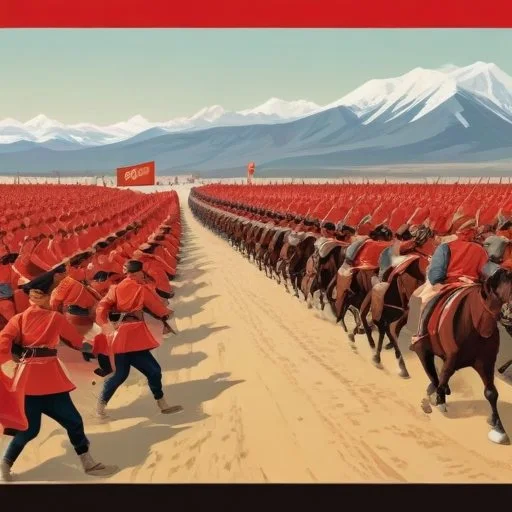
In the aftermath of the Russian Revolution, Mongolia found itself embroiled in a complex web of political intrigue, as various factions vied for control. The White Army, comprising former Russian imperial officers and Mongolian nobles, had held sway over the country since 1920, maintaining a precarious grip on power. However, the Soviet Union, eager to expand its sphere of influence, began to secretly back the Mongolian People's Party (MPP), a nascent socialist organization led by Damdin Sukhbaatar.
The Red Army's triumph had far-reaching consequences for Mongolia, including:
The establishment of the Mongolian People's Republic had a profound impact on the country's cultural and social landscape, including:
The Red Army's intervention and the subsequent establishment of the Mongolian People's Republic remain contentious issues, with some critics arguing that:
The establishment of the Mongolian People's Republic had significant implications for the region, contributing to:
Roman von Ungern-Sternberg, the rogue White Army commander, remains an intriguing figure in Mongolian history. His checkered past, marked by brutal tactics and megalomania, raises questions about his true motives. Born in 1885, Ungern-Sternberg was a Baltic German aristocrat who fought in the Russian Imperial Army during World War I. After the revolution, he joined the White Army, eventually becoming a commander in Mongolia.
Ungern-Sternberg's leadership was marked by chaos and violence. He was known for his brutal suppression of dissent, often using torture and executions to maintain control. His eventual defeat and capture by the Red Army in 1921 marked the beginning of the end for the White Army.
Despite his brutal reputation, Ungern-Sternberg was also a complex figure with a deep fascination for Eastern mysticism and the occult. His interests in spirituality and philosophy have led some historians to speculate about his true motivations in Mongolia.
The establishment of the Mongolian People's Republic has been the subject of intense historiographical debate. Soviet-era historians often portrayed the event as a heroic revolutionary moment, with the Mongolian People's Party (MPP) leading the charge against imperialist and feudal forces. In contrast, Western historians have tended to view the event as a Soviet-backed coup, highlighting the Red Army's decisive role in the conflict.
More recent scholarship has sought to nuance this binary view, exploring the complex relationships between the MPP, the Soviet Union, and the Mongolian people. This new wave of historiography emphasizes the agency of Mongolian actors, including Damdin Sukhbaatar and other MPP leaders, in shaping the country's revolutionary trajectory.
The establishment of the Mongolian People's Republic marked a cultural renaissance in the country. The new government, backed by the Soviet Union, invested heavily in education, art, and literature. This led to a flourishing of Mongolian culture, as writers, artists, and musicians explored new forms of expression.
The Mongolian People's Republic saw a significant increase in literary production, with writers like Tsendiin Damdinsüren and Byambyn Rinchen producing works of fiction and poetry that celebrated the country's revolutionary heritage. The government also established a network of cultural institutions, including the Mongolian State University and the Union of Mongolian Writers.

The establishment of the Mongolian People's Republic had a profound impact on the country's economy. The new government, with Soviet backing, implemented a series of radical reforms aimed at modernizing the economy and reducing inequality.
The government nationalized key industries, including mining and agriculture, and established a network of state-owned enterprises. The Soviet Union provided significant investment and technical assistance, helping to modernize Mongolia's infrastructure and industrial base.
The economic reforms of the Mongolian People's Republic led to significant growth and development, with the country's GDP increasing by over 50% in the first decade of socialist rule. However, the country's dependence on Soviet aid and investment would remain a contentious issue throughout the socialist period.
The establishment of the Mongolian People's Republic took place in a complex geopolitical context. The Russian Revolution had created a power vacuum in the region, with various factions vying for control. The Soviet Union, eager to expand its sphere of influence, saw Mongolia as a key strategic location.
The Mongolian People's Republic's alignment with the Soviet Union had significant implications for the region, contributing to the emerging Cold War dynamics. The country's new status as a socialist state also led to tensions with neighboring China, which viewed the Mongolian People's Republic as a Soviet satellite.