


The Battle of Tsushima, fought on May 27-28, 1905, is renowned for being one of the most decisive naval battles in history, where the Imperial Japanese Navy inflicted a crushing defeat on the Russian Baltic Fleet, marking a significant turning point in the Russo-Japanese War.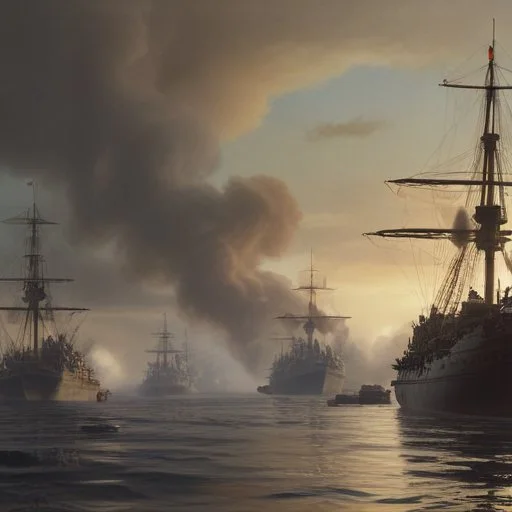
This pivotal battle solidified Japan's emergence as a global power, while foreshadowing the decline of the Russian Empire. The two-day battle at Tsushima Strait, located between Japan and Korea, showcased Admiral Heihachiro Togo's exceptional tactical genius, resulting in the sinking or capture of 34 out of 38 Russian ships and claiming the lives of over 3,500 Russian sailors.
The Russo-Japanese War was sparked by rival imperial ambitions in Manchuria and Korea. Japan, seeking to expand its influence, clashed with Russia, which aimed to strengthen its presence in East Asia. The war began in February 1904, with a Japanese surprise attack on the Russian fleet at Port Arthur.
The Russian Baltic Fleet, composed of over 30 warships, set sail from the Baltic Sea in October 1904, bound for the Pacific. After a grueling seven-month journey, the fleet arrived at the Tsushima Strait, where Admiral Togo's forces lay in wait.
The Battle of Tsushima had a profound impact on Japanese society, inspiring a sense of national pride and confidence. The victory also led to increased international recognition and respect for Japan, paving the way for its future involvement in global affairs.
Admiral Togo's famous signal to his fleet before the battle, "The fate of the Empire rests on this one battle, let every man do his utmost," showcases his leadership and strategic prowess.
The Battle of Tsushima served as a catalyst for Japan's continued expansion and modernization, influencing its role in World War I and World War II. The battle also led to a reevaluation of naval warfare strategies worldwide, with many nations adopting Japan's innovative tactics.
| Date | Event |
|---|---|
| February 1904 | Russo-Japanese War begins |
| October 1904 | Russian Baltic Fleet sets sail for the Pacific |
| May 27-28, 1905 | Battle of Tsushima takes place |
The Russo-Japanese War was not just a conflict between two nations, but a clash of empires with rival imperial ambitions in Manchuria and Korea. The war marked a significant turning point in the history of East Asia, as Japan's victory challenged the traditional European dominance in the region. The war also had far-reaching consequences for the Russian Empire, as it exposed the weaknesses of its military and forced a reevaluation of its role in international politics.
The war was fought on multiple fronts, including the land battles in Manchuria and the naval battles in the Yellow Sea and the Tsushima Strait. The Japanese military, led by General Iwao Oyama and Admiral Heihachiro Togo, proved to be a formidable force, defeating the Russian army and navy in a series of decisive battles. The war ended with the Treaty of Portsmouth, which was mediated by U.S. President Theodore Roosevelt and marked a significant shift in the balance of power in East Asia.
The Russo-Japanese War had a profound impact on the international community, as it marked the emergence of Japan as a major world power and challenged the traditional European dominance in the region. The war also led to a reevaluation of naval warfare strategies worldwide, as the Japanese navy's innovative tactics and use of wireless telegraphy caught the attention of naval powers around the world.
Admiral Heihachiro Togo was a Japanese naval officer who is best known for his role in the Russo-Japanese War. Born in 1848, Togo graduated from the Japanese Naval Academy and later studied at the Royal Naval College in Greenwich, England. He served in the Japanese navy during the First Sino-Japanese War and was appointed as the commander-in-chief of the Japanese fleet in 1904.
Togo's leadership during the Battle of Tsushima was instrumental in the Japanese victory, as he successfully implemented a naval blockade and used wireless telegraphy to coordinate his fleet's movements. His famous signal to his fleet before the battle, "The fate of the Empire rests on this one battle, let every man do his utmost," showcased his leadership and strategic prowess.
After the war, Togo was hailed as a hero in Japan and was promoted to the rank of marshal-admiral. He continued to serve in the Japanese navy until his retirement in 1913 and passed away in 1934. Togo's legacy as a naval commander and strategist continues to be celebrated in Japan and around the world.
The Battle of Tsushima was a landmark naval battle that showcased the innovative tactics and strategies of the Japanese navy. Compared to the traditional European navies, the Japanese navy was more agile and adaptable, with a greater emphasis on speed and maneuverability. The Japanese ships were also equipped with the latest technology, including wireless telegraphy and torpedoes.
In contrast, the Russian Baltic Fleet was slow and cumbersome, with outdated ships and tactics. The Russian navy's decision to send its fleet on a grueling seven-month journey from the Baltic Sea to the Pacific was a strategic blunder, as it allowed the Japanese navy to prepare and anticipate their arrival.
The Japanese navy's victory at Tsushima was a testament to its advanced tactics and strategies, which were years ahead of its European counterparts. The battle marked a significant shift in the balance of power in naval warfare, as other navies around the world began to adopt the Japanese tactics and strategies.
The Battle of Tsushima had a profound impact on Japanese society and culture, as it marked a significant turning point in the nation's history. The victory was seen as a symbol of Japan's emergence as a major world power, and it inspired a sense of national pride and confidence.
The battle also led to increased international recognition and respect for Japan, as the nation's military prowess and diplomatic skills were showcased to the world. The victory at Tsushima was celebrated in Japan through music, art, and literature, as the nation's artists and writers sought to capture the essence of the battle and its significance.
Today, the Battle of Tsushima is remembered as a pivotal moment in Japanese history, and it continues to inspire national pride and patriotism. The battle is also recognized as a significant turning point in the history of East Asia, as it marked the emergence of Japan as a major regional power.
The Russo-Japanese War was fought in the context of rival imperial ambitions in Manchuria and Korea. The war marked a significant turning point in the history of East Asia, as Japan's victory challenged the traditional European dominance in the region.
The war was also influenced by the geopolitics of the time, as the Russian Empire sought to expand its influence in East Asia and the Japanese Empire sought to protect its interests in the region. The war marked a significant shift in the balance of power in East Asia, as Japan emerged as a major regional power.
The war also had far-reaching consequences for the Russian Empire, as it exposed the weaknesses of its military and forced a reevaluation of its role in international politics. The war marked a significant turning point in the history of international relations, as it marked the emergence of Japan as a major world power and challenged the traditional European dominance in the region.