


The Battle of Tsushima, fought on May 27-28, 1905, is remembered as one of the most significant naval battles in history, where the Imperial Japanese Navy, under the command of Admiral Tōgō Heihachirō, achieved a crushing victory over the Russian Baltic Fleet, led by Admiral Zinovy Rozhestvensky. This pivotal battle not only marked a turning point in the Russo-Japanese War but also cemented Japan's status as a major naval power, sending shockwaves throughout the world.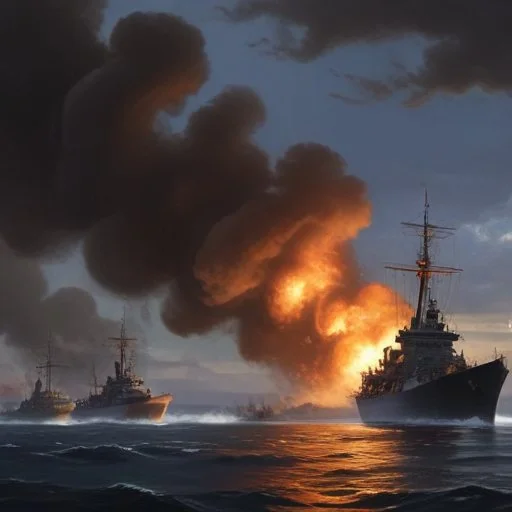
The roots of the Russo-Japanese War can be traced back to the late 19th century, when both Russia and Japan began to assert their influence in Manchuria and Korea. As tensions escalated, the two nations found themselves on a collision course, with control of the strategic port city of Vladivostok at stake. The Russian Baltic Fleet, considered one of the most powerful naval forces in the world, was dispatched to the Far East to break through to Vladivostok and establish a foothold in the region.
As the Russian fleet sailed through the Tsushima Strait, they were met with a series of cleverly engineered ambushes and decoy tactics orchestrated by Admiral Tōgō. The Japanese navy, consisting of smaller but faster and more agile vessels, exploited the weaknesses of the Russian fleet, taking advantage of their superior speed and maneuverability to outflank and encircle their opponents.
The Russian fleet, hampered by poor communication, inadequate intelligence, and inadequate training, struggled to respond to the Japanese onslaught. Despite being outnumbered, the Japanese navy's clever tactics and superior gunnery allowed them to sink or capture 28 Russian ships, including 7 battleships, while suffering minimal losses themselves.
The Battle of Tsushima marked a significant shift in the global balance of power, as Japan emerged as a major naval power, challenging the dominance of Western nations. The battle also showcased the effectiveness of modern naval tactics, particularly the use of speed and maneuverability to outflank and encircle opponents.
The aftermath of the battle saw a surge in Japanese nationalism, as the nation celebrated its stunning victory over a major European power. The battle also led to a significant increase in Japanese military spending, as the nation began to invest in its naval capabilities, cementing its status as a major player in global politics.
The Battle of Tsushima had a profound impact on Japanese culture, as the nation's confidence and sense of national pride soared. The battle inspired a wave of patriotic fervor, with the Japanese public embracing their nation's newfound status as a major world power.
The battle also had significant cultural implications, as it marked a turning point in Japan's modernization efforts, with the nation embracing Western-style military tactics and technology, while still retaining its unique cultural identity.
The Battle of Tsushima played a significant role in shaping the course of modern history, serving as a catalyst for Japan's rise as a major world power. The battle also had far-reaching implications for global politics, as it marked a shift in the balance of power, with non-Western nations beginning to assert their influence on the world stage.
The battle remains an important symbol of Japanese military prowess and national pride, serving as a reminder of the nation's ability to adapt and innovate in the face of adversity.
Admiral Tōgō Heihachirō, the Japanese naval commander who led the Imperial Japanese Navy to a stunning victory at the Battle of Tsushima, was born on January 27, 1848, in Kagoshima, Japan.
Tōgō's early life was marked by a strong fascination with the sea, and he joined the Japanese Navy at the age of 16. He quickly rose through the ranks, earning a reputation as a brilliant tactician and strategist.
In 1881, Tōgō traveled to the United Kingdom to study naval tactics and technology, where he was heavily influenced by the works of British Admiral Horatio Nelson. This experience would later shape his approach to naval warfare, including his famous "crossing the T" tactic employed at Tsushima.
The Battle of Tsushima has become an integral part of Japanese folklore, symbolizing the nation's rise to modernity and its ability to adapt to Western technology and tactics.
In the years following the battle, the Japanese public celebrated Tōgō as a national hero, with songs, plays, and novels written in his honor. The battle also inspired a wave of patriotic art, including woodblock prints and paintings depicting the heroic deeds of the Japanese Navy.
Today, the Battle of Tsushima remains an important symbol of Japanese national identity, with many regarding it as a testament to the nation's ability to overcome adversity and emerge victorious.
The Russian Baltic Fleet, led by Admiral Zinovy Rozhestvensky, was considered one of the most powerful naval forces in the world, with a total of 38 ships, including 11 battleships.
In contrast, the Imperial Japanese Navy, led by Admiral Tōgō Heihachirō, consisted of 45 ships, including 20 destroyers and 21 torpedo boats. Despite being outnumbered, the Japanese Navy's smaller size allowed for greater speed and maneuverability.
This contrast in naval strategy highlights the differing approaches to naval warfare adopted by Russia and Japan, with the former relying on brute force and the latter employing speed and agility to outmaneuver its opponent.
The Battle of Tsushima had far-reaching economic consequences, with Japan emerging as a major naval power and challenging the dominance of Western nations.
The battle led to a significant increase in Japanese military spending, as the nation invested heavily in its naval capabilities. This, in turn, stimulated economic growth, with Japan experiencing a surge in industrial production and trade.
The battle also marked a shift in the global balance of power, with non-Western nations beginning to assert their influence on the world stage. This led to new economic opportunities, as Japan established itself as a major player in global trade and commerce.
The Battle of Tsushima showcased the importance of modern naval technology, with the Japanese Navy's use of wireless telegraphy, high-speed torpedoes, and quick-firing guns proving decisive in the battle.
The battle highlighted the need for navies to invest in modern technology, with many nations, including the United States, Britain, and Germany, following Japan's lead in adopting new naval technologies.
The battle also led to significant advances in ship design, with the development of faster, more maneuverable vessels that could outpace their opponents.