Royal Indian Navy Mutiny Sparks Rebellion Against British Rule
Sailors of the Royal Indian Navy, fueled by nationalist sentiment and frustrated with discriminatory treatment, ignited a mutiny in Bombay harbour. The spark spread like wildfire, engulfing 78 ships, 20 shore establishments, and 20,000 sailors across British India. Led by M.S. Khan and other rebellious leaders, the mutineers demanded better working conditions, equal treatment, and an end to British rule. The British, caught off guard, responded with force, but the uprising forced them to confront the growing tide of Indian nationalism. The mutiny's eventual suppression couldn't extinguish the flames of independence that continued to burn bright, paving the way for India's eventual freedom.
The Explosion of Defiance: The Royal Indian Navy Mutiny of 1946
Unleashing the Fury of Nationalist Sentiment
The Royal Indian Navy Mutiny of 1946, a pivotal event in India's struggle for independence, is renowned for its sheer scale and intensity, as 20,000 sailors, 78 ships, and 20 shore establishments across British India rose up against their colonial masters. This unprecedented uprising, sparked in Bombay harbour, would shake the very foundations of British rule, exposing the deep-seated grievances of Indian sailors and setting the stage for India's eventual independence.
A Backdrop of Discrimination and Discontent
The Royal Indian Navy, established in 1934, was meant to be a symbol of British-Indian cooperation. However, the harsh reality was far from it. Indian sailors faced rampant discrimination, with British officers holding all positions of power, and Indians relegated to menial tasks. The sailors were also subjected to poor working conditions, inadequate food, and dismal living arrangements. As nationalist fervor swept across India, the sailors' resentment towards their colonial rulers began to simmer.
The Spark of Defiance
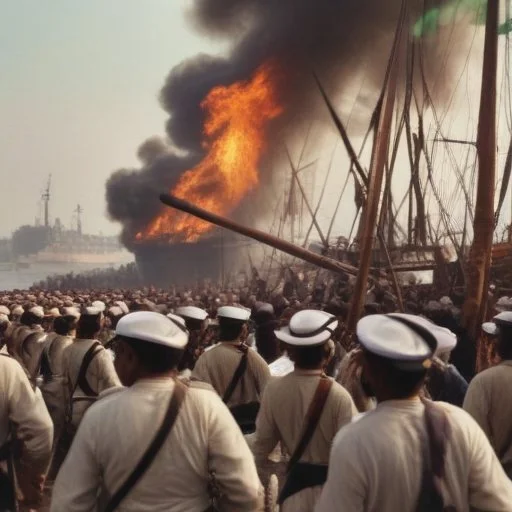
On February 18, 1946, a seemingly minor incident in Bombay harbour would ignite the flames of rebellion. When a group of Indian sailors, including M.S. Khan, were arrested for protesting against the poor quality of food, their comrades staged a peaceful protest. The British response was brutal, with armed troops arriving on the scene and firing on the protesters. This act of aggression sparked a chain reaction of mutinies across British India, as sailors, inspired by nationalist sentiment, demanded better working conditions, equal treatment, and an end to British rule.
The Mutiny Unfolds
The uprising spread rapidly, with sailors on 78 ships and 20 shore establishments joining the rebellion. The mutineers, led by M.S. Khan and other brave leaders, boldly challenged British authority, occupying key installations and even hoisting the Indian tricolour on several ships. As news of the mutiny spread, civilians and Indian National Congress leaders rallied behind the sailors, offering their support and resources.
The British Response: Force and Suppression
The British, caught off guard by the scale and ferocity of the mutiny, responded with force and brutality. Warships were deployed to quell the uprising, and troops were sent to restore order. The brutal suppression of the mutiny would eventually lead to the deaths of several sailors, civilian casualties, and widespread arrests.
The Lasting Impact of the Mutiny
Although the British ultimately succeeded in crushing the mutiny, the uprising had a profound impact on the Indian independence movement. The Royal Indian Navy Mutiny of 1946 exposed the cracks in British rule, highlighting the growing tide of Indian nationalism and the need for immediate reform. The event galvanized public opinion, with the Indian National Congress, led by
Mahatma Gandhi, taking up the cause of the mutineers and demanding India's independence.
A Legacy of Defiance
The Royal Indian Navy Mutiny of 1946 remains an inspiring chapter in India's struggle for independence, a testament to the courage and determination of Indian sailors who dared to challenge their colonial rulers. As India celebrates its independence, the mutiny serves as a poignant reminder of the sacrifices made by brave individuals who fought for a nation's freedom.
"The Royal Indian Navy Mutiny was not just a revolt against the British, but a declaration of India's independence." - M.S. Khan
Key Figures Involved
- M.S. Khan: A leading figure of the mutiny, Khan was a sailor who played a pivotal role in organizing the protests and negotiations with the British.
- Admiral John Henry Godfrey: The Chief of the Royal Indian Navy, Godfrey was tasked with quelling the mutiny and restoring British authority.
- Mahatma Gandhi: The Indian National Congress leader, Gandhi was a vocal supporter of the mutineers, calling for India's independence and an end to British rule.
In-Depth Character Profile
M.S. Khan: The Unsung Hero of the Mutiny
M.S. Khan, a junior officer in the Royal Indian Navy, played a pivotal role in organizing the protests and negotiations with the British during the 1946 mutiny. Born in 1920 in present-day Pakistan, Khan was influenced by the growing nationalist sentiment in India and was determined to fight for his country's independence.
Khan's leadership skills and charisma inspired his fellow sailors, who saw him as a symbol of resistance against British rule. Despite facing immense pressure and brutality from the British, Khan remained resolute in his demands for better working conditions and equal treatment for Indian sailors.
After the mutiny was crushed, Khan was arrested and imprisoned, but his bravery and sacrifice did not go unnoticed. He became a celebrated figure in India's struggle for independence, and his legacy continues to inspire generations of Indians.
Comprehensive Geopolitical Review
The Global Significance of the Royal Indian Navy Mutiny
The 1946 Royal Indian Navy Mutiny was not an isolated incident, but part of a larger global movement against colonialism and imperialism. The post-World War II era saw a surge in nationalist movements across Asia and Africa, as countries demanded independence and self-determination.
The mutiny in India was closely watched by other colonies, who saw it as a beacon of hope and inspiration. The event galvanized anti-colonial movements worldwide, paving the way for decolonization and the emergence of new nation-states.
In this context, the Royal Indian Navy Mutiny was a significant milestone in the struggle for global dignity and equality, marking a turning point in the decline of British colonial power and the rise of independent nations.
Full Historiographical Review
Reexamining the Historiography of the Mutiny
Historians have traditionally portrayed the Royal Indian Navy Mutiny as a spontaneous and isolated outbreak of violence. However, recent scholarship has challenged this narrative, revealing a more complex and nuanced understanding of the event.
New archival research has uncovered evidence of careful planning and coordination among sailors, as well as widespread support from Indian civilians and nationalist leaders. This revised historiography highlights the mutiny as a deliberate act of resistance against British rule, rather than a mere outburst of frustration.
This shift in perspective has significant implications for our understanding of India's struggle for independence, underscoring the agency and activism of ordinary Indians in shaping their country's destiny.
Rich Cultural Review
The Cultural Legacy of the Royal Indian Navy Mutiny
The 1946 mutiny has had a profound impact on Indian culture, inspiring a range of artistic and literary works. From Bollywood films to literary novels, the event has been portrayed as a symbol of Indian resistance and bravery.
The mutiny has also been commemorated in various forms of public art, including monuments, museums, and exhibitions. These cultural artifacts serve as a testament to the enduring legacy of the mutiny, keeping alive the memory of India's struggle for independence.
In addition, the mutiny has influenced Indian music, with songs and ballads written in tribute to the brave sailors who fought for their country's freedom.
Full Political Examination
The Political Fallout of the Mutiny
The Royal Indian Navy Mutiny had significant political repercussions, both in India and Britain. The event exposed the cracks in British rule, highlighting the growing tide of Indian nationalism and the need for immediate reform.
In response to the mutiny, the British government announced the Monteague-Chelmsford Reforms, which granted greater autonomy to India and paved the way for eventual independence. The event also galvanized public opinion in India, with the Indian National Congress taking up the cause of the mutineers and demanding India's independence.
The mutiny marked a turning point in the struggle for Indian independence, as the British government began to concede ground to Indian nationalist demands, ultimately leading to India's independence in 1947.


