


The event marked a pivotal moment in the East Timorese people's fight for freedom from Indonesia's occupation, which had begun in 1975. The massacre not only shocked the international community but also galvanized global support for East Timor's independence movement.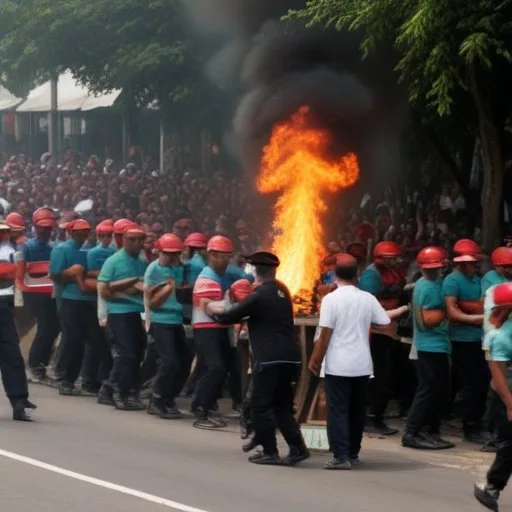
East Timor, a small island nation in Southeast Asia, had been a Portuguese colony for over 400 years before it declared independence in 1975. However, just nine days later, Indonesia, led by President Suharto, invaded and annexed the country. The East Timorese people, who had long desired self-determination, were forced to endure 24 years of brutal military occupation.
The resistance movement, led by the Fretilin (FRETILIN) party, had been growing in strength since the early 1980s. Student protests and demonstrations became increasingly frequent, with calls for independence and an end to human rights abuses.
On the morning of November 12, a group of students from the University of East Timor organized a peaceful protest in the Santa Cruz cemetery, where the body of a recently killed independence activist was being laid to rest. The protesters, mostly students, marched through the streets of Dili, carrying banners and chanting slogans demanding independence and an end to Indonesian occupation.
As the crowd approached the cemetery, Indonesian soldiers, armed with assault rifles and backed by tanks, blocked their path. Without warning, the soldiers opened fire on the protesters, using live ammunition and tear gas. The massacre continued for over an hour, with soldiers brutally beating and shooting anyone who tried to flee.
The Santa Cruz massacre sent shockwaves around the world, with international media outlets broadcasting images of the carnage and horror. The United States, European Union, and other nations condemned the Indonesian government's actions, calling for an immediate end to the violence.
The massacre also sparked widespread outrage and protests in Indonesia itself, with many Indonesians denouncing the military's brutality. The event marked a turning point in the East Timorese independence movement, with global pressure mounting on the Indonesian government to grant East Timor its freedom.
The Santa Cruz massacre remains a powerful symbol of the East Timorese people's struggle for freedom and self-determination. The event paved the way for East Timor's eventual independence in 2002, following a referendum in which the East Timorese people overwhelmingly voted to secede from Indonesia.
Today, the Santa Cruz massacre is remembered as a dark chapter in East Timor's history, but also as a catalyst for the country's liberation and a testament to the power of non-violent resistance.
"The Santa Cruz massacre was a turning point in our struggle. It showed the world the brutality of the Indonesian occupation and galvanized international support for our cause." - Xanana Gusmão, former President of East Timor
Xanana Gusmão, the former President of East Timor, was a key figure in the country's struggle for independence. Born on June 20, 1946, in Vemasse, East Timor, Gusmão was a charismatic leader who played a crucial role in rallying the East Timorese people against Indonesian occupation. As a young man, Gusmão was drawn to the revolutionary ideals of Marxism, which influenced his later politics. He joined the Fretilin party in 1975, soon after East Timor declared independence from Portugal. Throughout the 1980s and 1990s, Gusmão was a thorn in the side of the Indonesian regime, constantly challenging their authority and promoting East Timorese self-determination.
Gusmão's leadership was marked by his commitment to non-violent resistance, a strategy that earned him international admiration and respect. Despite being captured and imprisoned by the Indonesian authorities in 1992, Gusmão's message of freedom and democracy continued to inspire the East Timorese people. In 2002, following a UN-sponsored referendum, East Timor finally gained its independence, and Gusmão became the country's first President.
The Santa Cruz massacre took place within the broader context of Cold War geopolitics. Indonesia, a key ally of the United States, had been granted a free hand by the Western powers to crush any opposition to its rule in East Timor. The Indonesian government, led by General Suharto, had been concerned about the growing popularity of the Fretilin party and its demands for independence. The massacre was intended to quash the independence movement once and for all, but it ultimately had the opposite effect.
The international community, particularly the United States, had been providing military aid to Indonesia, which was used to repress the East Timorese people. The Santa Cruz massacre marked a turning point in global attitudes towards Indonesia's occupation, as the international community began to question its support for the regime.
Historians have long debated the significance of the Santa Cruz massacre in the broader narrative of East Timor's struggle for independence. Some argue that the massacre was a pivotal moment in galvanizing international support for the East Timorese cause, while others contend that it was merely one horrific incident in a long history of human rights abuses.
Recent scholarship has focused on the role of the Santa Cruz massacre in shaping East Timor's national identity. The event has become a powerful symbol of resistance and sacrifice, with its victims revered as martyrs for the independence cause. The massacre has also been invoked as a reminder of the brutal legacy of colonialism and the importance of protecting human rights.
The Santa Cruz massacre had a profound impact on East Timorese culture, as it became a rallying cry for the independence movement. The massacre inspired a wave of creative expression, with artists, writers, and musicians responding to the tragedy through their work. The event also reinforced the importance of traditional East Timorese music and dance, which became symbols of national identity and resistance.
In the years following the massacre, the East Timorese people began to reclaim their cultural heritage, which had been suppressed by the Indonesian occupation. The event marked a turning point in the country's cultural renaissance, as East Timorese people began to assert their distinct identity and challenge the dominant narrative imposed by the occupiers.
One of the most powerful artifacts from the Santa Cruz massacre is the photograph taken by journalist Max Stahl, which captures the moment when Indonesian soldiers opened fire on the protesters. The image, which has become an iconic representation of the event, was smuggled out of East Timor and published in newspapers around the world, shocking the international community.
Other artifacts, such as eyewitness testimonies, video footage, and personal belongings of the victims, provide a powerful testament to the brutality of the massacre. These artifacts have been preserved in the East Timor National Archives, where they serve as a grim reminder of the country's troubled past.