


The Loughgall ambush, a covert operation by the British Special Air Service (SAS), remains one of the deadliest single incidents during Northern Ireland's tumultuous period of ethnonationalist conflict known as the Troubles. On that fateful day, May 8, 1987, eight Provisional Irish Republican Army (IRA) volunteers and a civilian lost their lives in a hail of bullets, leaving an indelible mark on the region's history.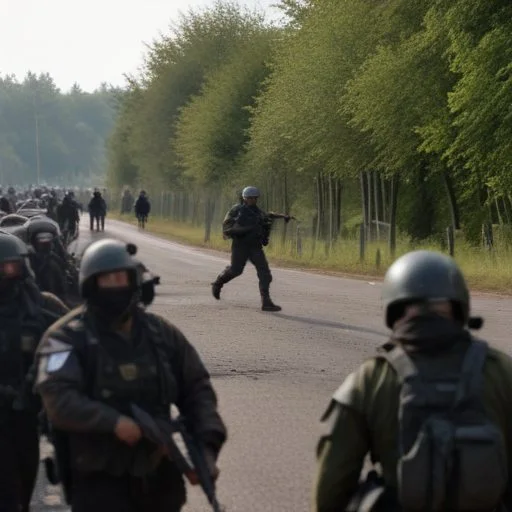
In the late 20th century, Northern Ireland was embroiled in a bitter struggle between unionists, who sought to maintain the region's ties to the United Kingdom, and nationalists, who pushed for reunification with the Republic of Ireland. The Provisional IRA, formed in 1969, emerged as a prominent force in the nationalist movement, employing guerrilla tactics and bombings to further their cause. Their militant approach sparked a violent response from British security forces, leading to a cycle of tit-for-tat killings and reprisals that would claim thousands of lives over the next three decades.
In the sleepy village of Loughgall, County Armagh, a group of eight IRA volunteers, armed with explosives and firearms, converged on a police station, intent on destroying the facility and killing its occupants. Unbeknownst to them, the SAS, an elite British special forces unit, had received intelligence about the planned attack and lay in wait, poised to strike. The IRA team, comprising seasoned operatives and a few newer recruits, was unaware of the deadly trap that awaited them.
At around 7:30 pm, the IRA team, dressed in civilian clothes, approached the police station in a hijacked digger, which they planned to use as a makeshift bomb. As they attempted to breach the perimeter, the SAS sprang into action, emerging from their hiding positions to unleash a withering hail of gunfire. The IRA volunteers, caught off guard, were cut down in a matter of minutes, their bodies riddled with bullets. A civilian, Anthony Hughes, who was driving by the scene, was also killed in the crossfire.
The Loughgall ambush sparked widespread outrage and shock throughout Northern Ireland and beyond. The British government hailed the operation as a major success, praising the SAS for their bravery and quick thinking. However, nationalists and human rights groups cried foul, accusing the British authorities of using excessive force and ignoring opportunities to arrest the IRA suspects rather than killing them. The incident also raised questions about the use of deadly force by the SAS and the broader implications for the conflict in Northern Ireland.
The Loughgall ambush marked a turning point in the Troubles, underscoring the ferocity and ruthlessness of the conflict. While it did not bring an immediate end to the violence, it highlighted the need for a more nuanced approach to addressing the region's deep-seated divisions. In the years that followed, diplomatic efforts intensified, ultimately paving the way for the Good Friday Agreement in 1998, which laid the foundation for a fragile peace in Northern Ireland.
In conclusion, the Loughgall ambush remains a haunting reminder of the brutal realities of the Troubles, a conflict that scarred generations and left an indelible mark on Northern Ireland's history. As we reflect on this watershed moment, we are reminded of the importance of diplomacy, dialogue, and reconciliation in the face of seemingly intractable conflicts.
The Loughgall ambush was not an isolated incident in the broader context of the Troubles. In the years leading up to the ambush, the IRA had been waging a campaign of violence against British security forces, and the British government had responded with increased militarization of the region. The ambush was part of a larger pattern of escalating violence and repression that characterized the late 1980s in Northern Ireland.
In the months following the ambush, the IRA continued to launch attacks against British targets, but the British government also stepped up its efforts to crack down on the IRA. The SAS, in particular, became notorious for their brutal tactics and their willingness to use lethal force against suspected IRA members.
The Loughgall ambush also had significant implications for the British government's strategy in Northern Ireland. The success of the ambush led to a renewed emphasis on covert operations and intelligence gathering, and the British government began to invest more heavily in its special forces capabilities. At the same time, the ambush highlighted the need for a more nuanced approach to addressing the root causes of the Troubles, and it helped to galvanize support for a peaceful resolution to the conflict.
Declan Arthurs, one of the IRA volunteers killed in the Loughgall ambush, was a seasoned operative with a reputation for bravery and cunning. Born in 1961, Arthurs had joined the IRA as a teenager and had quickly risen through the ranks to become one of the organization's most trusted and respected members.
Patrick Joseph Kelly, another volunteer killed in the ambush, was a relative newcomer to the IRA. A former member of the Irish republican party Sinn Féin, Kelly had become disillusioned with the party's moderation and had joined the IRA in search of a more radical approach to achieving Irish independence.
Anthony Hughes, the civilian killed in the crossfire, was a 36-year-old farmer who had been driving by the police station when the ambush took place. Hughes was a married father of three, and his death was widely mourned in the local community.
The Loughgall ambush bears some striking similarities to other covert operations carried out by the British military during the Troubles. The ambush at Gibraltar in 1988, for example, in which three IRA volunteers were killed by the SAS, shares many of the same hallmarks of the Loughgall ambush, including the use of intelligence gathering and surveillance to identify and track IRA operatives.
At the same time, the Loughgall ambush differs in important ways from other similar operations. The sheer scale of the ambush, for example, was unprecedented, and the number of casualties suffered by the IRA was exceptionally high. Additionally, the ambush took place in a civilian area, which raised concerns about the use of lethal force in populated areas.
The Loughgall ambush had a profound impact on the cultural and social fabric of Northern Ireland. The ambush helped to galvanize support for the IRA and its cause, and it contributed to a sense of outrage and rebellion among many in the nationalist community.
At the same time, the ambush also helped to drive a wedge between the nationalist and unionist communities in Northern Ireland. The ambush was seen by many unionists as a justified response to IRA violence, and it helped to reinforce their perception of the IRA as a terrorist organization.
The Loughgall ambush highlights the complex and often fraught political dynamics of the Troubles. The ambush was widely condemned by nationalist politicians and human rights groups, who argued that it represented a gross overreaction by the British government and a violation of human rights.
At the same time, the ambush was hailed by the British government as a major success, and it helped to bolster support for the government's policies in Northern Ireland. The ambush also highlighted the need for a more nuanced approach to addressing the root causes of the Troubles, and it helped to galvanize support for a peaceful resolution to the conflict.