


The city of Nanjing, the capital of China, fell to the Japanese on December 13, 1937, marking the beginning of one of the darkest periods in modern Chinese history. The Nanking Massacre, a six-week reign of terror, would forever be etched in the minds of the Chinese people, leaving behind a legacy of death, destruction, and unimaginable suffering.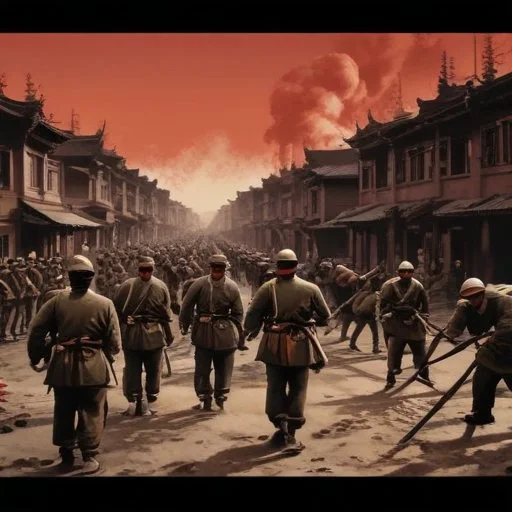
In the summer of 1937, the Chinese National Revolutionary Army, led by General Tang Shengzhi, prepared to defend Nanjing against the Japanese invasion. Despite being outnumbered and outgunned, the Chinese forces fought valiantly, but ultimately, the city walls were breached, and the Japanese troops poured in.
On December 13, 1937, Nanjing fell to the Japanese, and with it, the capital of China was lost. The city's defenders, exhausted and depleted, were no match for the Japanese army's superior firepower and brutal tactics. General Tang Shengzhi and his remaining troops retreated, leaving behind a city on the brink of chaos.
The Japanese occupation of Nanjing was marked by unimaginable brutality. In the six weeks that followed, Japanese troops embarked on a campaign of terror, slaughtering thousands of innocent civilians and prisoners of war. Women were raped, buildings were looted and burned, and the city was left in ruins. The streets ran red with blood, and the once-proud city was reduced to a mere shadow of its former self.
The Japanese army's brutality knew no bounds. Mass killings, often referred to as "killing fields," were a common occurrence. Thousands of people were rounded up and executed in public spaces, with some estimates putting the death toll at over 150,000. Rape camps were set up, where women and girls as young as 11 were held captive and repeatedly assaulted. The atrocities committed during the Nanking Massacre are still difficult to comprehend today.
The international community was aware of the atrocities being committed in Nanjing, yet few countries took decisive action to stop the massacre. The League of Nations, the precursor to the United Nations, condemned the Japanese aggression, but its words were empty, and no concrete action was taken to intervene. The silence of the international community in the face of such brutality remains a dark stain on humanity's conscience.
The Nanking Massacre left an indelible mark on the Chinese people and the world at large. The city of Nanjing would never be the same, and the memory of the massacre would be passed down through generations as a reminder of the horrors of war. The event also led to a re-evaluation of the international community's response to humanitarian crises, paving the way for future humanitarian interventions.
Today, the Nanking Massacre is remembered as a poignant reminder of the devastating consequences of war and the importance of protecting human life. The victims of the massacre are remembered through memorials and museums, ensuring that their stories are never forgotten. As we reflect on this dark chapter in history, we are reminded of the importance of promoting peace, understanding, and humanity in the face of adversity.
Remembering the Nanking Massacre serves as a poignant reminder of the devastating consequences of war and the importance of protecting human life. As we reflect on this dark chapter in history, we are reminded of the importance of promoting peace, understanding, and humanity in the face of adversity.
The Japanese invasion of China in 1937 was not an isolated event, but rather part of a larger strategy to expand its empire in East Asia. The Japanese government had long been dissatisfied with its limited access to resources and markets, and saw China as a key location for expansion. The occupation of Nanjing was a critical step in this process, providing Japan with a strategic foothold in central China and access to the Yangtze River. Furthermore, the fall of Nanjing sent a powerful message to other nations in the region, demonstrating Japan's military prowess and willingness to use force to achieve its objectives.
In the years leading up to the invasion, Japan had been engaging in a series of aggressive military actions in northern China, including the invasion of Manchuria in 1931. These actions had been met with little resistance from the international community, emboldening Japan to pursue its territorial ambitions further. The fall of Nanjing marked a significant escalation of this strategy, and paved the way for Japan's subsequent invasion of other parts of China and Southeast Asia.

Historians have long debated the motivations behind the Japanese invasion of Nanjing, with some arguing that it was driven by a desire for resources and territory, while others have pointed to a complex mix of cultural, economic, and political factors. The role of Japanese militarism and ultranationalism in the lead-up to the invasion has also been the subject of much scholarly debate.
Some historians have argued that the invasion was driven by a sense of racial and cultural superiority among the Japanese, who saw themselves as a superior civilization destined to dominate Asia. Others have pointed to the role of economic factors, including Japan's need for resources and markets, as well as the influence of military leaders who saw war as a means of solving Japan's economic problems.
Regardless of the motivations, the invasion of Nanjing marked a turning point in Japanese-Chinese relations, and had far-reaching consequences for the people of China and the world at large.
General Tang Shengzhi, the Chinese National Revolutionary Army leader who defended Nanjing against the Japanese invasion, was a highly respected military strategist and patriot. Born in 1893, Tang had fought in several campaigns against warlords and bandits in northern China before being appointed to lead the defense of Nanjing.
Despite being vastly outnumbered and outgunned, Tang's forces fought bravely, inflicting significant casualties on the Japanese before being forced to retreat. Tang himself was forced to flee the city, but continued to lead resistance efforts against the Japanese occupation.
Tang's bravery and leadership during the defense of Nanjing have made him a hero in Chinese history, and his legacy continues to be celebrated to this day.
The Nanking Massacre had a profound impact on Chinese culture, leading to a sense of deep-seated trauma and mistrust of foreign powers. The event was seen as a betrayal of the trust placed in the international community to protect civilians, and marked a turning point in China's relations with the West.
In the aftermath of the massacre, many Chinese writers and artists responded with works of literature and art that reflected the trauma and outrage felt by the Chinese people. The event also led to a renewed sense of national identity and resistance to foreign occupation, as well as a growing demand for justice and accountability for the perpetrators of the massacre.
Today, the Nanking Massacre is remembered as a powerful symbol of the horrors of war and the importance of protecting human life, and continues to shape Chinese identity and cultural memory.
The occupation of Nanjing and the subsequent Nanking Massacre had a devastating impact on the city's economy, with widespread destruction of infrastructure, industry, and commerce. The city's once-thriving business district was left in ruins, and many businesses were forced to close due to the interruption of trade and commerce.
The Japanese occupation also led to a significant decline in foreign investment in China, as international companies and investors became wary of the political instability and risk of further violence. The event also led to a decline in trade between China and other nations, further exacerbating the economic crisis.
In the years that followed, the Chinese government would struggle to rebuild and revitalize the economy, but the impact of the Nanking Massacre would be felt for decades to come.