


In a daring display of military prowess, Israel launched a series of surprise airstrikes against Egyptian airfields on June 5, 1967, marking the beginning of the Six-Day War. This swift and decisive action caught Egypt off guard, setting the tone for a conflict that would significantly alter the balance of power in the region.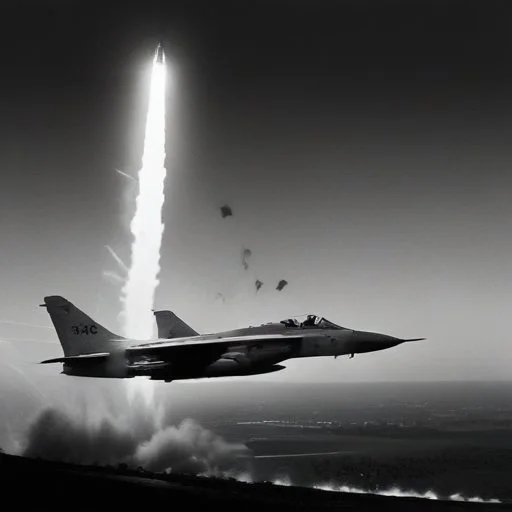
In the years leading up to the war, tensions had been escalating between Israel and its Arab neighbors, Egypt, Jordan, and Syria. The Straits of Tiran, which connected the Red Sea to the Gulf of Aqaba, had been blockaded by Egypt, thereby limiting Israel's trade routes. Additionally, the Egyptian military had been mobilizing along the Israeli border, prompting Israel to take decisive action.
Moshe Dayan, Israel's Minister of Defense, was the architect behind the surprise attack. A seasoned military leader and strategist, Dayan had a reputation for boldness and cunning. Under his leadership, the Israeli Defense Forces (IDF) had been preparing for such an eventuality, and Operation Focus was the result of months of meticulous planning.
The Six-Day War had far-reaching consequences for the Middle East. Israel tripled in size, gaining control of the Gaza Strip, the Sinai Peninsula, the West Bank, and the Golan Heights. The war also led to a significant shift in the balance of power, with Israel emerging as a major military force in the region.
The Six-Day War marked a turning point in Israeli history, instilling a sense of confidence and pride among the Israeli people. The war also led to a significant influx of Jewish immigrants to Israel, further strengthening the country's population.
The Six-Day War also sparked a heated debate over the occupation of Palestinian territories, which continues to this day. The war has been the subject of controversy, with some arguing that Israel's actions were necessary for self-defense, while others see it as an example of aggressive expansionism.
In a remarkable account, Israeli pilot Colonel Avraham Lanir, who participated in the surprise attack, recalled the moment when the Egyptian airfields came into view: "I saw the rows of perfectly lined up aircraft, and I knew we had them. It was like shooting fish in a barrel."
The Six-Day War set the stage for future conflicts in the Middle East, including the Yom Kippur War of 1973 and the numerous conflicts that have followed. The war also led to a significant increase in international diplomatic efforts to resolve the Arab-Israeli conflict.
The Six-Day War heroes were celebrated in Israel, with many soldiers and airmen receiving commendations and awards for their bravery. The war also led to the establishment of several museums and memorials, including the Israeli Air Force Museum.
Did you know that the Six-Day War was initially codenamed "Operation Moked" (Hebrew for "Focus")? The name was changed to "Operation Focus" to avoid confusion with a similar-sounding Hebrew word meaning "burned."
The Six-Day War was not just a military conflict, but a clash of ideologies and interests that had been building up for decades. In the years leading up to the war, the Arab-Israeli conflict had become increasingly polarized, with the Soviet Union backing the Arab states and the United States supporting Israel. The war was also a Cold War proxies' conflict, with the two superpowers competing for influence in the region.
The war itself was a testament to the complexity of the Middle East's geopolitical landscape. Israel's swift victory was not just a military achievement, but also a result of the country's strategic alliances and diplomatic maneuvering. The war marked a turning point in the region's history, setting the stage for future conflicts and diplomatic initiatives.
Moshe Dayan was not only a brilliant military strategist but also a complex and enigmatic figure. Born in 1915 in what is now Israel, Dayan grew up in a family of farmers and later became a key figure in the country's fight for independence. As a young soldier, he lost an eye in combat, earning him the nickname "the one-eyed general."
Dayan's leadership during the Six-Day War was instrumental in Israel's victory. His bold and unorthodox tactics caught the Egyptian army off guard, giving Israel the upper hand in the conflict. Despite his military prowess, Dayan was also a skilled diplomat and politician, serving as Israel's Minister of Defense and later as Foreign Minister.
The Six-Day War had a profound impact on Israeli culture and society. The war marked a turning point in Israel's identity, as the country transitioned from a vulnerable and embattled state to a confident and assertive nation. The war also spurred a wave of cultural and artistic creativity, with many Israeli artists and writers drawing inspiration from the conflict.
The war also had a significant impact on Israel's music scene, with many popular songs emerging in the aftermath of the conflict. One of the most iconic songs of the era is "Jerusalem of Gold," written by Naomi Shemer in 1967. The song became an anthem of sorts for the Israeli people, capturing the sense of pride and triumph that followed the war.

The Six-Day War marked a significant shift in the balance of power in the Middle East, with Israel emerging as a dominant military force in the region. The war also led to a major realignment of alliances, with the United States consolidating its position as Israel's primary ally and the Soviet Union losing influence in the region.
The war also had significant implications for the Palestinian national movement, which had been gaining momentum in the years leading up to the conflict. The war marked a setback for the movement, as Israel's occupation of the West Bank and Gaza Strip led to a significant increase in settlement activity and restrictions on Palestinian movement.
The Six-Day War was fought against the backdrop of a rapidly changing geopolitical landscape. In the years leading up to the war, the Middle East had become increasingly polarized, with the Arab-Israeli conflict at its center.
The war marked a turning point in the region's history, setting the stage for future conflicts and diplomatic initiatives. The war also had significant implications for the global balance of power, as the United States and the Soviet Union jockeyed for influence in the region.