


The September 30 Movement, a failed coup attempt in 1965, is infamously known for the brutal assassination of six high-ranking Indonesian Army generals and the subsequent mass killings of suspected leftists, ethnic Chinese, and innocent civilians, resulting in an estimated half a million deaths.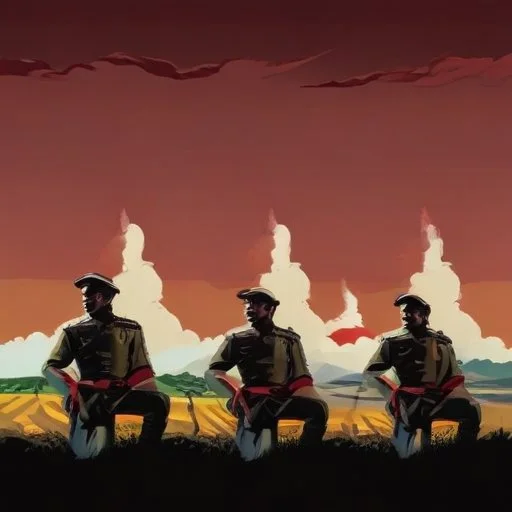
Indonesia, a newly independent nation since 1945, was struggling to find its footing in the midst of Cold War politics. The Indonesian Communist Party (PKI), a significant political force, was gaining popularity, much to the dismay of the military and Islamist groups.
In this tumultuous landscape, a group of disgruntled army officers, sympathetic to the PKI, hatched a plan to overthrow the government.
The September 30 Movement marked the beginning of a dark era in Indonesian history, characterized by violence, paranoia, and political repression.
The PKI, once a significant political force, was decimated, and the military, under Suharto's leadership, would dominate Indonesian politics for decades to come.
The event also led to a significant shift in Indonesia's international relations, with the country pivoting towards the West and away from socialism.
The September 30 Movement has had a lasting impact on Indonesian culture, with the trauma of the event still felt today.
The event has been immortalized in literature, film, and art, with many Indonesians seeking to come to terms with this dark chapter in their history.
The movement has also influenced Indonesia's social dynamics, with the rise of militarism, nationalism, and anti-communist sentiment.
The September 30 Movement remains a highly contested and controversial event in Indonesian history, with many questions still surrounding the circumstances of the coup and the subsequent massacres.
The event has been used by successive governments as a pretext for political repression, and the trauma of the event has been exploited to justify human rights abuses.
Despite this, the event has also sparked a necessary conversation about Indonesia's history, politics, and identity.
As Indonesia continues to grapple with the legacies of the September 30 Movement, one thing is clear: this dark chapter in Indonesian history serves as a stark reminder of the dangers of political repression, military impunity, and the importance of speaking truth to power.
"The September 30 Movement was a turning point in Indonesian history, marking the beginning of a new era of political repression and militarization." - Historian, John Roosa
"The event was a tragedy, but it also sparked a necessary conversation about Indonesia's history, politics, and identity." - Author, Leila S. Chudori
The September 30 Movement was preceded by a series of events that set the stage for the coup attempt. In the early 1960s, Indonesia was facing economic turmoil, with high inflation and food shortages. This led to growing discontent among the population, which the PKI capitalized on by organizing mass protests and demonstrations. The military, sensing a threat to their power, began to crack down on PKI supporters, leading to a further escalation of tensions.
In this climate of uncertainty, a group of disgruntled army officers, sympathetic to the PKI, saw an opportunity to overthrow the government and eliminate their perceived enemies. They were led by Omar Dani, a charismatic air force officer who had been sidelined by the military high command.
The plan was to abduct and assassinate six high-ranking generals, including the powerful Minister of Defense, Abdul Nasution. The rebels believed that with the generals out of the way, the military would collapse, and the PKI would be able to seize power.

Aidit, the PKI chairman, was a charismatic figure who had risen to prominence in the 1950s as a champion of the working class. Born in 1923, Aidit came from a poor family and was largely self-educated. He joined the PKI in the 1940s and quickly rose through the ranks, becoming chairman in 1959.
Aidit was known for his intelligence, strategic thinking, and oratory skills. He was a powerful advocate for land reform, nationalization of industry, and unionization of workers. His message resonated with many Indonesians who felt marginalized by the country's economic elite.
Despite his reputation as a radical, Aidit was also a pragmatist who sought to build alliances with other political parties and the military. However, his efforts were rebuffed by the military, who saw him as a threat to their power.
The September 30 Movement had a profound impact on Indonesian culture, stimulating a wave of artistic expression and cultural production. Many artists, writers, and filmmakers felt compelled to respond to the trauma and violence of the event, seeking to process and make sense of the chaos.
In the years that followed, Indonesian literature, film, and art flourished, as creatives sought to explore the darker aspects of the human experience. The movement inspired a new generation of artists, including writers like Pramoedya Ananta Toer and filmmakers like U-Wei Haji Saari.

The September 30 Movement marked a significant turning point in Indonesian politics, paving the way for a new era of militarization and authoritarian rule. The event led to a marked shift in the balance of power, with the military emerging as the dominant force in Indonesian politics.
Suharto, the rising star in the military, capitalized on the chaos and confusion of the event, using it as a pretext to consolidate power and eliminate his political rivals. His regime would go on to rule Indonesia for the next three decades, imposing a regime of repression, censorship, and human rights abuses.
The September 30 Movement was not just an internal Indonesian affair, but was also shaped by the broader geopolitical context of the Cold War. The event was partly driven by the rivalry between the United States and the Soviet Union, as both superpowers sought to extend their influence in the region.
The PKI, with its close ties to the Soviet Union, was seen as a threat by the United States, who feared the spread of communism in Southeast Asia. The CIA, in particular, played a significant role in supporting anti-communist forces in Indonesia, including the military, who would ultimately emerge victorious.