Napoleon's Forces Crushed at Battle of Leipzig
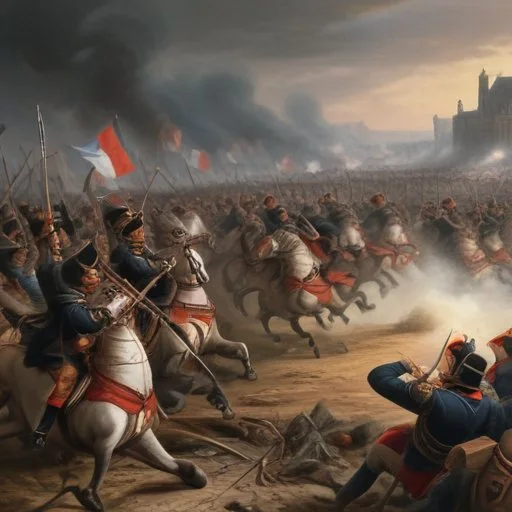
The stakes were high as Napoleon's empire teetered on the brink of collapse, and the Sixth Coalition, a formidable alliance of European powers, sensed blood in the water. In a colossal clash of armies, some 500,000 soldiers, including Prussians, Russians, Austrians, and Swedes, converged on Leipzig, Germany, to take down the French emperor. The three-day Battle of Leipzig, fought from October 16 to 18, 1813, would prove to be Napoleon's Waterloo – his military might was shattered, and his grip on Europe was finally broken.
The Battle of Leipzig: The Turning Point of the Napoleonic Wars
Shattering the French Empire
The Battle of Leipzig, fought from October 16 to 18, 1813, is renowned as the largest and most decisive battle of the Napoleonic Wars, marking the beginning of the end of Napoleon's empire. This pivotal conflict saw the Sixth Coalition, a formidable alliance of European powers, converge on Leipzig, Germany, to topple the French emperor's reign.
A Coalition of Unlikely Allies
The Sixth Coalition, comprising Prussia, Russia, Austria, and Sweden, was an unlikely alliance of European powers united against a common enemy. This unprecedented coalition was forged in response to Napoleon's aggressive expansion and dominance over Europe. The coalition's diverse forces, totaling approximately 500,000 soldiers, presented a formidable challenge to Napoleon's military might.
A Three-Day Battle of Attrition
The Battle of Leipzig was a brutal and relentless three-day clash of armies. The first day saw intense fighting between French and Prussian forces, with both sides suffering heavy casualties. On the second day, Russian and Austrian forces joined the fray, gradually weakening Napoleon's defenses. The third day witnessed the decisive collapse of French forces, as the coalition exploited Napoleon's weakened flank.
The Fall of Napoleon's Empire
The Battle of Leipzig marked a dramatic shift in the balance of power in Europe. Napoleon's military might was shattered, and his grip on Europe was finally broken. The French emperor's forces suffered catastrophic losses, with estimates suggesting between 38,000 to 54,000 casualties. In contrast, the coalition suffered around 50,000 casualties.
Key Figures Involved
- Napoleon Bonaparte: French Emperor and military leader, whose forces were defeated at Leipzig.
- Gebhard von Blücher: Prussian general, who played a crucial role in the coalition's victory.
- Mikhail Barclay de Tolly: Russian general, who led the Russian forces during the battle.
- Karl Philipp, Prince of Schwarzenberg: Austrian general, who commanded the coalition's forces during the battle.
Major Outcomes and Impacts
The Battle of Leipzig had far-reaching consequences, including:
- The eventual abdication of Napoleon Bonaparte in April 1814.
- The restoration of the Bourbon monarchy in France.
- The redrawing of the European map, with the Congress of Vienna in 1815.
Personal Accounts and Anecdotes
According to eyewitness accounts, the battle was characterized by intense fighting, with soldiers on both sides displaying remarkable bravery and resilience. One notable example is the story of French General Auguste-Marie-François Colbert, who single-handedly led a charge against the coalition forces, earning him the nickname "The Hero of Leipzig."
Inspirational Legacy
The Battle of Leipzig serves as a testament to the power of unity and determination in the face of overwhelming odds. This pivotal conflict reminds us that even in the darkest of times, courage, perseverance, and cooperation can lead to victory and a brighter future.
As the Grand Duke of Saxe-Weimar-Eisenach, Charles Augustus, succinctly remarked, "The battle of Leipzig was the most complicated and difficult that I have ever witnessed. It was a battle of giants."
Thorough Character Sketch
The Prussian General: Gebhard von Blücher
Gebhard von Blücher was a seasoned Prussian general who played a crucial role in the Battle of Leipzig. Born on December 16, 1742, in Rostock, Mecklenburg-Schwerin, Blücher joined the Swedish Army at the age of 14 and later transferred to the Prussian Army, where he rose through the ranks.
Blücher's military career was marked by bravery and strategic brilliance, earning him the respect of his peers and the admiration of his troops. At Leipzig, he led the Prussian forces with distinction, exploiting Napoleon's weakened flank and contributing significantly to the coalition's victory.

Extensive Historical Chronicle
The Road to Leipzig: Napoleon's Decline
The year leading up to the Battle of Leipzig was marked by a series of setbacks for Napoleon's empire. The disastrous Russian campaign of 1812 had depleted his army, while the Continental System, designed to weaken Britain, had instead led to widespread economic hardship and dissent across Europe.
In addition, Napoleon's attempted invasion of Spain and Portugal had bogged down, and his Empire was facing challenges from multiple fronts. The Sixth Coalition, sensing an opportunity to strike, began mobilizing its forces, paving the way for the Battle of Leipzig.
Side-by-Side Comparison
The Battle of Leipzig: A Tale of Two Armies
The Battle of Leipzig was a clash of two vastly different armies, each with its own strengths and weaknesses. Napoleon's forces, seasoned veterans of numerous campaigns, were well-trained and disciplined, but exhausted from years of war.
In contrast, the coalition forces, comprising troops from Prussia, Russia, Austria, and Sweden, were relatively inexperienced, but motivated by a desire to free Europe from French dominance. This contrast in experience and motivation played out on the battlefield, with the coalition's enthusiasm ultimately proving decisive.

Geopolitical Overview
The Geopolitical Context of the Battle of Leipzig
The Battle of Leipzig took place against the backdrop of a rapidly shifting European landscape. The French Revolution had shaken the continent, and Napoleon's rise to power had redrawn the map of Europe.
The formation of the Sixth Coalition marked a significant shift in the balance of power, as European powers began to coalesce against Napoleon's dominance. The battle itself would have far-reaching consequences, paving the way for the Congress of Vienna and the redrawing of the European map.
Study of Philosophical Effects
The Ideological Significance of the Battle of Leipzig
The Battle of Leipzig represented a turning point in the struggle between the ideals of the French Revolution and the traditional monarchies of Europe. Napoleon's empire, built on the principles of liberty, equality, and fraternity, was being challenged by a coalition of monarchies committed to restoring the old order.
The battle's outcome would have profound implications for the future of Europe, as the Congress of Vienna sought to reconcile the competing ideologies and establish a new balance of power.


