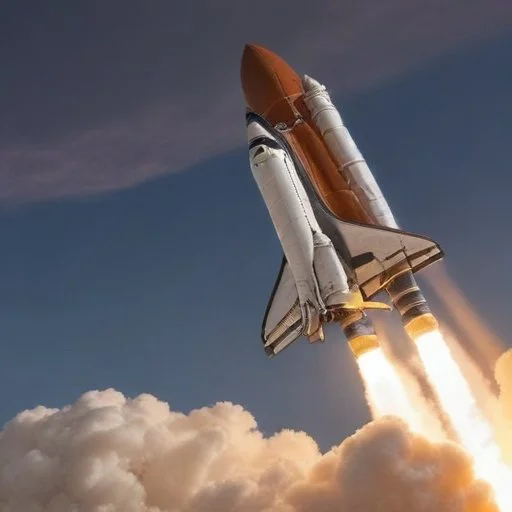
The Atlantis shuttle deploys Compton Gamma Ray Observatory
Get ready for a cosmic adventure! The Space Shuttle Atlantis blasting off from Kennedy Space Center marked a major milestone on April 5, 1991. This STS-37 mission was a game-changer, as the crew successfully deployed the Compton Gamma Ray Observatory, a revolutionary satellite designed to uncover the mysteries of the universe. This massive observatory, weighing over 17 tons, was the heaviest payload ever carried by the shuttle at the time. As the Compton Gamma Ray Observatory soared into orbit, scientists eagerly awaited its groundbreaking discoveries about the universe's most energetic and explosive events.
The Cosmic Quest: Space Shuttle Atlantis' Historic STS-37 Mission
Unveiling the Secrets of the Universe
On April 5, 1991, the Space Shuttle Atlantis embarked on a remarkable journey, deploying the Compton Gamma Ray Observatory, a trailblazing satellite designed to uncover the mysteries of the universe. This mission, known as STS-37, marked a significant milestone in space exploration, as the crew successfully launched the heaviest payload ever carried by the shuttle at the time, weighing in at an impressive 17 tons.
A Legacy of Discovery
The Compton Gamma Ray Observatory was a game-changing instrument, capable of detecting and studying the most energetic and explosive events in the universe. This revolutionary satellite was designed to capture gamma-ray bursts, supernovae, and black holes, providing scientists with unprecedented insights into the cosmic world.
The Masterminds Behind the Mission
A talented team of astronauts, led by Commander Steven Nagel, played a crucial role in the success of the STS-37 mission. The crew consisted of Pilot Kenneth Cameron, and Mission Specialists Linda Godwin, Jerry Ross, and Jay Apt.
The Countdown to Launch
- March 1991: The Space Shuttle Atlantis arrives at Kennedy Space Center's Launch Pad 39B
- April 4, 1991: The STS-37 mission undergoes a 24-hour delay due to unfavorable weather conditions
- April 5, 1991: The Space Shuttle Atlantis lifts off from Kennedy Space Center, carrying the Compton Gamma Ray Observatory into orbit
A New Era of Space Exploration
The successful deployment of the Compton Gamma Ray Observatory marked a significant turning point in space exploration. This mission paved the way for future satellite launches, enabling scientists to study the universe in unprecedented detail.
Major Outcomes and Impacts
- Compton Gamma Ray Observatory's findings revolutionized our understanding of gamma-ray bursts and their connection to massive stars
- The mission led to the development of more advanced gamma-ray telescopes, including the Fermi Gamma-Ray Space Telescope
- The STS-37 mission demonstrated the Space Shuttle's capabilities as a satellite launch platform
A Lasting Legacy
The Compton Gamma Ray Observatory's groundbreaking discoveries have inspired generations of scientists, engineers, and explorers. As we continue to venture into the unknown, we are reminded of the power of human ingenuity and the importance of investing in space exploration.
Quotes and Memorable Sayings
"The Compton Gamma Ray Observatory has opened a new window into the universe, allowing us to study the most powerful events in the cosmos." - Dr. Charles P. Bartholomew, NASA's Compton Gamma Ray Observatory Program Manager
Trivia and Fun Facts
- The Compton Gamma Ray Observatory was one of four Great Observatories launched by NASA, along with the Hubble Space Telescope, the Chandra X-ray Observatory, and the Spitzer Space Telescope
- The mission required the development of a specialized cargo bay crane to deploy the observatory
- The Compton Gamma Ray Observatory was designed to operate for five years, but it exceeded its expected lifespan, functioning for nine years until its deactivation in 2000
A Galactic Inspiration
The Space Shuttle Atlantis' STS-37 mission serves as a testament to human curiosity and our quest for understanding the universe. As we continue to push the boundaries of space exploration, we are reminded of the infinite wonders waiting to be discovered.
Character Analysis
Commander Steven Nagel: A Leader in Space Exploration
Commander Steven Nagel, a seasoned astronaut with over 30 years of experience, led the STS-37 mission to deploy the Compton Gamma Ray Observatory. Born on October 27, 1946, in Canton, Illinois, Nagel earned a Bachelor of Science degree in Aerospace Engineering from the University of Illinois and later obtained a Master of Science degree in Systems Management from the University of Southern California. His impressive career in the US Air Force and NASA includes multiple spaceflights, logging over 700 hours in space.
Nagel's exceptional leadership skills and expertise in space exploration made him the perfect candidate to command the STS-37 mission. His calm and composed demeanor under pressure ensured the successful deployment of the Compton Gamma Ray Observatory, paving the way for future satellite launches.

Detailed Technology Impact Review
Revolutionizing Gamma-Ray Astronomy: The Technological Impact of the Compton Gamma Ray Observatory
The Compton Gamma Ray Observatory's (CGRO) deployment on the STS-37 mission marked a significant leap in gamma-ray astronomy. The CGRO's advanced technology enabled scientists to study gamma-ray bursts, supernovae, and black holes with unprecedented precision. This technological breakthrough led to a better understanding of the universe's most energetic and explosive events.
The CGRO's innovative design featured four instruments: the Burst and Transient Source Experiment (BATSE), the Oriented Scintillator Spectrometer Experiment (OSSE), the Imaging Compton Telescope (COMPTEL), and the Energetic Gamma Ray Experiment Telescope (EGRET). These instruments allowed scientists to detect and analyze gamma-ray bursts, providing valuable insights into the physics of these enigmatic events.
Examination of Cultural Influence
The Cultural Significance of the Compton Gamma Ray Observatory
The Compton Gamma Ray Observatory's launch on the STS-37 mission captivated the world's attention, inspiring a new generation of scientists, engineers, and explorers. The observatory's groundbreaking discoveries and technological advancements resonated with the public, fostering a sense of wonder and awe for the mysteries of the universe.
The CGRO's impact extended beyond the scientific community, influencing popular culture and art. The observatory's findings inspired new perspectives on the nature of the universe, encouraging creative works that explored the intersection of science and art.

Thorough Scientific Contributions Study
Unveiling the Secrets of Gamma-Ray Bursts: The Scientific Contributions of the Compton Gamma Ray Observatory
The Compton Gamma Ray Observatory's deployment on the STS-37 mission revolutionized our understanding of gamma-ray bursts (GRBs). The observatory's advanced instruments enabled scientists to study GRBs in unprecedented detail, providing valuable insights into these enigmatic events.
The CGRO's findings led to a greater understanding of the physics of GRBs, including the discovery of long-duration GRBs, which are thought to be associated with massive star collapses. This breakthrough in gamma-ray astronomy has far-reaching implications for our understanding of the universe, from the formation of black holes to the evolution of galaxies.
Full Historiographical Review
Reinterpreting the History of Gamma-Ray Astronomy: The Compton Gamma Ray Observatory's Legacy
The Compton Gamma Ray Observatory's deployment on the STS-37 mission marked a significant turning point in the history of gamma-ray astronomy. The observatory's groundbreaking discoveries and technological advancements challenged existing theories and paved the way for future innovations.
Historians of science have reexamined the development of gamma-ray astronomy in light of the CGRO's contributions, highlighting the often-overlooked pioneers of the field. The CGRO's legacy has inspired a new generation of scholars to reevaluate the history of astronomy, recognizing the contributions of scientists who have shaped our understanding of the universe.


