


The SSTotenkopfverbnde, the notorious Nazi death squad, infamous for their brutal efficiency in murdering millions of innocent lives, embarked on a frantic evacuation of the Auschwitz concentration camp as the Red Army closed in, leaving behind a trail of destruction and despair.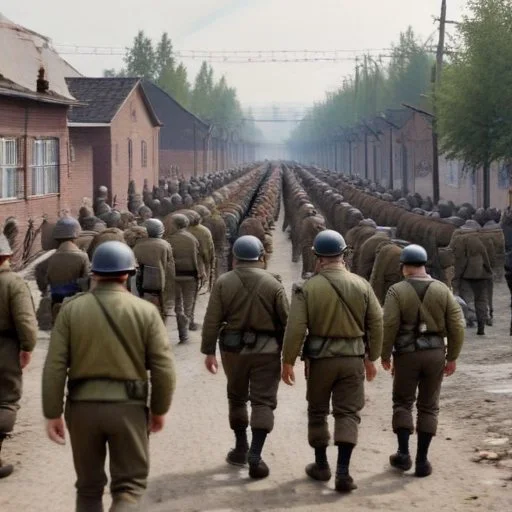
This catastrophic event, which took place in January 1945, marked the final days of one of the most heinous chapters in human history, and would go on to expose the atrocities committed within the camp's barbed-wire walls to the world.
The Auschwitz concentration camp, located in Poland, was established in 1940 as part of the Nazi's campaign to exterminate millions of Jews, Romani people, homosexuals, disabled individuals, and political dissidents. The camp was the epicenter of the Holocaust, with an estimated 1.1 million people murdered within its walls.
By January 1945, the Red Army, led by Soviet Marshal Ivan Konev, had advanced to within 100 kilometers of Auschwitz, prompting the Nazi high command to order the evacuation of the camp. The SSTotenkopfverbnde, led by camp commandant Richard Baer, was tasked with the gruesome task of evacuating the camp's remaining prisoners.
On January 17, 1945, the SSTotenkopfverbnde forced over 56,000 weakened prisoners to embark on a brutal death march, leaving behind the sick and the dead. The prisoners, dressed in thin clothing and malnourished, were forced to march through the snow-covered terrain, with many succumbing to the harsh conditions.
On January 27, 1945, the Red Army liberated Auschwitz, finding approximately 7,000 prisoners who had been left behind, largely because they were too sick or weak to be evacuated. The Soviet soldiers were met with unimaginable horrors, including mass graves, gas chambers, and the stench of death that permeated the air.
The evacuation of Auschwitz and the subsequent liberation by the Red Army marked the end of the Holocaust, but its impact would be felt for generations to come.
Survivors of the death march and those who remained in Auschwitz during the liberation shared harrowing accounts of their experiences, providing a glimpse into the unimaginable horrors they endured.
"I saw people dying all around me, their bodies frozen in the snow, their eyes open in a perpetual stare of death." - Survivor of the death march
Their stories serve as a testament to the resilience of the human spirit and a poignant reminder of the importance of remembrance and education in preventing similar atrocities from happening again.
Today, Auschwitz-Birkenau Memorial and Museum stands as a somber reminder of the atrocities committed during the Holocaust, serving as a symbol of the importance of promoting tolerance, understanding, and peace.
The evacuation of Auschwitz concentration camp and its subsequent liberation will forever be etched in history as a grim reminder of the devastating consequences of hatred, prejudice, and genocide.
The evacuation of Auschwitz was not a singular event, but rather part of a larger Nazi effort to conceal their atrocities from the advancing Allied forces. As the Red Army closed in, the Nazis implemented a series of brutal evacuations across multiple concentration camps, including Stutthof, Gross-Rosen, and Buchenwald.
These forced marches, often referred to as "death marches," were characterized by extreme brutality, with prisoners facing exposure to the elements, starvation, and violence at the hands of their captors. The true extent of these atrocities is still being uncovered, with many records having been destroyed or lost in the chaos of the war's final days.
Estimates suggest that tens of thousands of prisoners perished during these marches, with some sources placing the death toll as high as 250,000.
Richard Baer, the SS commandant of Auschwitz, played a pivotal role in the evacuation and cover-up of the camp's atrocities. A seasoned SS officer, Baer had previously served at the Dachau and Neckarelz concentration camps before being appointed to lead Auschwitz in May 1944.
Baer's tenure at Auschwitz was marked by brutality and corruption, with allegations of embezzlement and violence against prisoners. Despite his role in the Holocaust, Baer managed to evade capture until 1960, when he was arrested and ultimately convicted of war crimes.
Baer's eventual capture was largely due to the efforts of German prosecutor Fritz Bauer, who dedicated his career to bringing Nazi war criminals to justice.The Red Army's advance on Auschwitz was part of a broader Soviet campaign to push the German army out of Eastern Europe. As the Soviets closed in, the Nazi regime became increasingly desperate, resorting to scorched-earth tactics and brutal reprisals against civilians.
The Soviet Union's role in liberating Auschwitz was significant, not only in terms of the camp's physical liberation but also in terms of the propaganda value it held. The Soviet Union would go on to play a key role in shaping the post-war narrative, with the Auschwitz liberation serving as a powerful symbol of Soviet heroism and sacrifice.
The Red Army's capture of Auschwitz was a turning point in the war, marking the beginning of the end of the Nazi regime's grip on Eastern Europe.
The liberation of Auschwitz had a profound impact on the cultural psyche, serving as a grim reminder of the dangers of prejudice and hatred. The atrocities committed at Auschwitz were instrumental in shaping the post-war world, influencing the development of international human rights law and informing the creation of the State of Israel.
Auschwitz has since become a cultural touchstone, symbolizing the horrors of the Holocaust and serving as a warning against the dangers of extremism and genocide. The camp's liberation has inspired countless works of literature, art, and film, ensuring that the lessons of the Holocaust are never forgotten.
The Auschwitz-Birkenau Memorial and Museum stands today as a testament to the enduring power of human memory and the importance of preserving our shared cultural heritage.The evacuation of Auschwitz was a politically motivated decision, driven by the Nazi regime's desire to conceal their atrocities from the advancing Allied forces. The Nazis were well aware of the propagandistic value of Auschwitz, and the liberation of the camp would serve as a powerful indictment of their regime.
The political implications of the liberation were far-reaching, influencing the post-war narrative and shaping the development of international relations. The discovery of Auschwitz's atrocities served as a catalyst for the Nuremberg Trials, which would ultimately hold top Nazi officials accountable for their crimes.
The liberation of Auschwitz marked a major turning point in the war, exposing the true extent of Nazi atrocities and paving the way for the Allied victory.