


The First Crusade, a pivotal event in Christian history, was sparked by Pope Urban II's impassioned plea to reclaim the Holy Land from Muslim control. On November 27, 1095, Pope Urban II set the wheels in motion, calling upon Christian warriors to take up arms against the infidels and secure the sacred city of Jerusalem.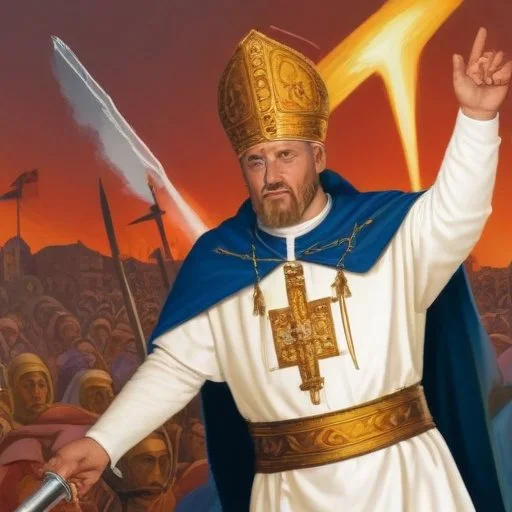
In the late 11th century, the Holy Land was under the dominion of the Seljuk Turks, who had gradually encroached upon Christian territories. This gave rise to growing unease among the Christian faithful, who saw the loss of Jerusalem as a grave affront to their religion. It was against this backdrop of tension and fervor that Pope Urban II seized the initiative, capitalizing on the pent-up emotions of the Christian masses.
In November 1095, Pope Urban II convened the Council of Clermont, a gathering of senior clergy and nobles. It was here that he delivered his historic speech, urging Christians to embark on a holy war to reclaim the Holy Land. The Pope's impassioned words, filled with zeal and conviction, resonated deeply with his audience, and the seeds of the First Crusade were sown.
The First Crusade left an indelible mark on history, with far-reaching consequences for the Christian and Muslim worlds. The Crusade not only resulted in the recapture of Jerusalem but also spawned a series of subsequent crusades, shaping the course of medieval history. The Crusade also fostered a climate of religious intolerance and enmity, whose reverberations continue to be felt to this day.
"Let those who have been accustomed unjustly to wage private warfare against the faithful now go against the infidels and end with honor a habit that was formerly reprehensible."
- Pope Urban II, Council of Clermont
The First Crusade remains a highly contested and debated topic, with opinions on its merits and demerits sharply divided. While some view the Crusade as a noble endeavor to reclaim holy lands, others see it as a brutal and misguided exercise in religious intolerance. As we reflect on this pivotal event, we are reminded of the complex and multifaceted nature of human history, where heroism and villainy often walk a fine line.
Pope Urban II, born Odo of Châtillon, was a French clergyman who played a pivotal role in shaping the course of Christian history. As the 159th Pope of the Catholic Church, he is remembered for his impassioned plea to reclaim the Holy Land, which sparked the First Crusade. Urban's early life was marked by a deep commitment to the Church, and he rose through the ranks to become a prominent figure in the ecclesiastical hierarchy.
Urban's papacy was marked by a series of reforms aimed at strengthening the Church and promoting Christian unity. His call to arms in 1095 was a culmination of his vision for a united Christendom, and his leadership galvanized the knights and nobles of Europe to take up the cross.

The Byzantine Empire, the eastern continuation of the Roman Empire, played a significant role in the events leading up to the First Crusade. With its capital in Constantinople, the Empire was a powerful and influential force in the Mediterranean region.
In the late 11th century, the Byzantine Empire was facing pressure from the Seljuk Turks, who had been expanding their territories in Anatolia. This led to a series of appeals to the Latin West for military aid, which ultimately culminated in the Council of Clermont and the launch of the First Crusade.
The Crusader's Charter, a historic document issued by Pope Urban II, is a testament to the fervor and zeal that characterized the First Crusade. This papal bull, issued in 1095, grants indulgences to all those who take up the cross and embark on the crusade to reclaim the Holy Land.
Written in Latin, the charter is a remarkable artifact that provides insight into the mindset of the medieval Church and the crusaders themselves. It is a powerful symbol of the religious fervor that drove the Crusade, and its language and tone continue to fascinate historians today.
The First Crusade had a profound impact on Western culture, shaping the course of art, literature, and music for centuries to come. The Crusade inspired a new wave of literary and artistic Works, including epic poems, songs, and illuminated manuscripts.
The Crusade also contributed to the development of medieval chivalry, with knights and nobles adopting a code of honor and conduct that emphasized bravery, loyalty, and courtesy. This cultural legacy continues to influence Western society, with the ideals of chivalry and the romanticized image of the crusading knight remaining powerful symbols in modern popular culture.
Historians have long debated the motivations and consequences of the First Crusade, with interpretations ranging from a holy war to a brutal exercise in colonialism. In recent years, historians have sought to reevaluate the Crusade in the light of new evidence and shifting scholarly perspectives.
Some scholars have argued that the Crusade was driven by a complex mix of religious, economic, and political factors, with the papacy playing a key role in mobilizing the knights and nobles of Europe. Others have emphasized the impact of the Crusade on the Muslim world, highlighting the devastating consequences of the crusaders' brutality and the prolonged instability that followed.