Columbia completes its historic maiden voyage
After years of anticipation, the world held its breath as the Space Shuttle Columbia roared to life on the launchpad, its main engines bursting into a fiery blaze. On this pivotal day, NASA's vision for a reusable spacecraft finally took to the skies, marking a giant leap forward in space exploration. At 7:00 a.m. Eastern Standard Time, Columbia, named after Robert Gray's 18th-century sailing ship, embarked on its maiden voyage, STS-1, piloted by astronauts John Young and Robert Crippen. The successful completion of this 54.5-hour, 36-orbit journey cemented the Space Shuttle program's position as a cornerstone of American spaceflight, paving the way for numerous groundbreaking missions to come.
STS-1: The Dawn of a New Era in Space Exploration
Blast Off into the Unknown
The world witnessed history on April 12, 1981, as the first operational Space Shuttle, Columbia, embarked on its maiden voyage, STS-1. This pivotal mission marked a significant milestone in space exploration, showcasing the capability of a reusable spacecraft to carry crew and cargo into low-Earth orbit and return safely to Earth.
The Right Stuff: Key Players Behind STS-1
- John Young: A veteran astronaut with four previous spaceflights, Young commanded the STS-1 mission, becoming the first person to fly on six different spacecraft.
- Robert Crippen: A rookie astronaut at the time, Crippen served as the pilot of STS-1, earning his first spaceflight wings.
- George Abbey: As the director of flight crew operations, Abbey played a crucial role in selecting and training the STS-1 crew.
A Timeline of Triumph
- April 12, 1981: 7:00 a.m. EST - Columbia lifts off from Kennedy Space Center's Launch Pad 39A, marking the beginning of STS-1.
- April 12, 1981: 10:30 a.m. EST - Space Shuttle Columbia reaches orbit, with Young and Crippen conducting a series of system checks.
- April 14, 1981: 10:20 a.m. EST - Columbia lands safely at Edwards Air Force Base in California, concluding the 54.5-hour, 36-orbit mission.
STS-1: A Shift in Space Exploration
STS-1 demonstrated the feasibility of a reusable spacecraft, paving the way for future Space Shuttle missions and cementing NASA's vision for a continuous presence in space.
The success of STS-1 also marked a shift in space exploration, as it: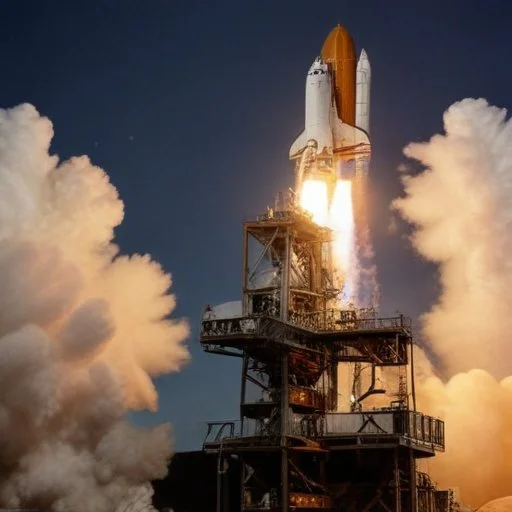
- Enabled the deployment of satellites, space stations, and other space-based assets.
- Fostered international cooperation, with the Space Shuttle program playing a key role in collaborative missions.
- Set the stage for the development of modern launch systems, such as SpaceX's Falcon 9 and Dragon.
A Legacy of Inspiration
STS-1's impact extended beyond the realm of space exploration, inspiring a new generation of scientists, engineers, and innovators.
As Young and Crippen soared into the skies, they carried with them the hopes and dreams of a nation, igniting a passion for space exploration that continues to burn brightly today.
Fun Facts and Trivia
- Columbia's maiden voyage was originally scheduled for April 10, 1981, but was delayed due to a computer malfunction.
- The STS-1 crew patch featured an image of the Space Shuttle, along with the motto "Agile, Efficient, and Responsive."
- Columbia's thermal protection system (TPS) tiles were designed to withstand temperatures up to 2,300°F (1,260°C) during re-entry.
STS-1: A New Era in Space Exploration
The successful completion of STS-1 marked a triumphant beginning to the Space Shuttle program, propelling humanity into a new era of space exploration and discovery.
As we reflect on this monumental achievement, we honor the brave men and women who dared to push the boundaries of human innovation, paving the way for a brighter future among the stars.
In-Depth Cultural Influence Study
A Cultural Phenomenon
The success of STS-1 sparked a wave of excitement and fascination with space exploration, capturing the imagination of people around the world.
In the aftermath of the mission, NASA received over 100,000 letters and telegrams congratulating the crew and the agency on their monumental achievement.
The mission's popularity was further amplified by the iconic image of the Space Shuttle Columbia soaring into the sky, which was plastered on newspapers, magazines, and television screens worldwide.
Character Overview
The Commander's Calm
John Young's leadership and composure played a crucial role in the success of STS-1.
A seasoned astronaut with four previous spaceflights, Young's experience and confidence inspired trust in his crew and mission control.
Young's ability to remain calm under pressure was exemplified during a critical moment of the mission, when a computer malfunction forced him to take manual control of the shuttle.
Analysis of Technological Impact
Technological Trailblazer
The Space Shuttle Columbia's innovative design and cutting-edge technology paved the way for future space exploration.
The shuttle's thermal protection system (TPS), which protected it from intense heat during re-entry, was a major breakthrough in materials science.
The development of the TPS also spawned new technologies, including advanced ceramics and thermal insulation materials, which have since been applied in various industries.
Study of Historical Interpretations
A Historian's Perspective
STS-1 marked a significant shift in the historiography of space exploration, as it ushered in a new era of reusable spacecraft.
The mission's success challenged traditional narratives of space exploration, which had previously focused on single-use rockets and capsules.
The Space Shuttle program's emphasis on reusability and cost-effectiveness also raised important questions about the role of space agencies in the modern era.
Document Examination
Artifact of the STS-1 Mission
The NASA insignia worn by the STS-1 crew is a poignant reminder of the mission's significance.
The insignia, which features an eagle soaring above the Earth, symbolized the crew's role as pioneers in the exploration of space.
The insignia is now on display at the Smithsonian National Air and Space Museum, serving as a testament to the bravery and ingenuity of the STS-1 crew.


