


Supernova 1987A is famously known for being the closest observed supernova to Earth since the invention of the telescope, and the first to be visible to the naked eye since 1604. This magnificent event was a once-in-a-lifetime opportunity for astronomers to study an exploding star up close, and it has had a profound impact on our understanding of these cosmic occurrences.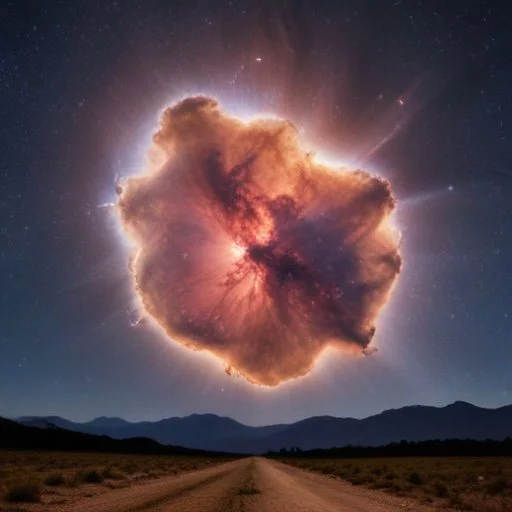
In the Large Magellanic Cloud, a satellite galaxy of the Milky Way, a massive star had been burning through its fuel at an incredible rate. Sanduleak 69 202, as it was known, had reached the end of its life cycle and was on the verge of collapse. As the star's gravity overwhelmed it, a massive explosion was imminent – and astronomers were ready.
On February 23, 1987, the supernova was discovered by Ian Shelton, a Canadian astronomer, and Oscar Duhalde, an Argentine astronomer, at the Las Campanas Observatory in Chile. News of the event spread like wildfire, and telescopes from around the world swung into action, capturing the event in unprecedented detail.
Supernova 1987A was a type II supernova, which occurs when a massive star runs out of fuel and collapses in on itself. The explosion was so powerful that it released as much energy as the sun would produce over its entire lifetime. The light from the supernova was visible from Earth for several weeks, making it a rare and awe-inspiring sight for astronomers and the public alike.
The observations of Supernova 1987A have greatly expanded our knowledge of these events. By studying the light curves and spectra of the supernova, astronomers have been able to learn more about the physics of these explosions, including the role of neutrinos and the formation of heavy elements. The data collected has also helped to refine models of supernovae and their impact on the surrounding interstellar medium.
Supernova 1987A has left a lasting impact on the field of astrophysics, with many astronomers crediting it as a catalyst for their interest in the field. The event has also inspired new generations of scientists, with its study continuing to yield new insights and discoveries to this day. As we look out into the universe, we are reminded that there are still many mysteries waiting to be uncovered, and Supernova 1987A will forever be remembered as a beacon of discovery.
Ian Shelton, the Canadian astronomer who discovered Supernova 1987A, was born in 1957 in Toronto, Canada. Growing up with a passion for astronomy, Shelton pursued his education at the University of Toronto, where he earned his undergraduate degree in astronomy. He later moved to Chile to work at the Las Campanas Observatory, where he made the groundbreaking discovery.
Shelton's fascination with astronomy began at a young age. He would often gaze at the stars with his grandfather, who sparked his interest in the field. Throughout his career, Shelton has made significant contributions to the field of astronomy, including the discovery of several supernovae.
Today, Shelton continues to work as an astronomer, dedicating his life to studying the mysteries of the universe. His discovery of Supernova 1987A has left a lasting impact on the field, inspiring new generations of astronomers and scientists alike.

The discovery of Supernova 1987A had a profound impact on our understanding of cosmic explosions. By studying the light curves and spectra of the supernova, astronomers have been able to gain insights into the physics of these events. The data collected has refined models of supernovae, allowing scientists to better understand the role of neutrinos and the formation of heavy elements.
The supernova has also provided a unique opportunity for scientists to study the interstellar medium. The explosion has interacted with the surrounding environment, creating a wealth of information for scientists to analyze. The data collected has greatly expanded our knowledge of the interstellar medium, allowing scientists to better understand the formation of stars and galaxies.
The study of Supernova 1987A has also led to new discoveries in the field of astrophysics. The detection of neutrinos from the supernova has opened up new avenues of research, allowing scientists to study the internal dynamics of supernovae. The data collected has also led to a greater understanding of the role of supernovae in shaping the universe as we know it.
Supernova 1987A is often compared to SN 1604, also known as Kepler's Supernova. Both events were visible to the naked eye and had a significant impact on our understanding of supernovae. However, there are some key differences between the two events. While SN 1604 was a type Ia supernova, Supernova 1987A was a type II supernova, occurring when a massive star runs out of fuel and collapses in on itself.
Another key difference between the two events is the distance from Earth. SN 1604 occurred in the Milky Way galaxy, approximately 20,000 light-years from Earth. Supernova 1987A, on the other hand, occurred in the Large Magellanic Cloud, a satellite galaxy of the Milky Way, approximately 163,000 light-years from Earth.
Despite these differences, both supernovae have greatly expanded our knowledge of these cosmic events. By studying these events, scientists have been able to gain insights into the physics of supernovae, allowing us to better understand the universe and its many mysteries.

The discovery of Supernova 1987A marked a significant milestone in the development of astronomical technology. The event was observed using a range of telescopes, from small amateur instruments to large professional observatories. The data collected has pushed the boundaries of astronomical technology, allowing scientists to study the supernova in unprecedented detail.
The supernova has also driven the development of new technologies, including the creation of advanced spectrometers and cameras. The event has also led to the development of new software and algorithms, allowing scientists to analyze the data collected in greater detail.
The study of Supernova 1987A has also highlighted the importance of international collaboration in astronomical research. The event was observed by astronomers from around the world, demonstrating the need for global cooperation in the pursuit of scientific knowledge.
The explosion of Supernova 1987A had a significant impact on the surrounding environment. The blast wave from the supernova has interacted with the interstellar medium, creating a wealth of information for scientists to analyze. The data collected has provided insights into the formation of stars and galaxies, as well as the role of supernovae in shaping the universe.
The supernova has also had an impact on the local ecosystem. The explosion has affected the surrounding star-forming regions, potentially disrupting the formation of new stars. The event has also provided a unique opportunity for scientists to study the impact of supernovae on the environment, allowing us to better understand the long-term effects of these events.
The study of Supernova 1987A has also highlighted the importance of considering the environmental impact of astronomical events. By studying the effects of supernovae on the environment, scientists can gain a greater understanding of the universe and its many mysteries.