


On April 21, 1836, the Republic of Texas forces, led by Sam Houston, secured a decisive victory over the Mexican army under General Antonio López de Santa Anna at the Battle of San Jacinto, marking a pivotal moment in the Texas Revolution and cementing the Lone Star State's independence from Mexico. This 18-minute battle, remembered for the Texans' defiant cry of "Remember the Alamo!", would go on to shape the course of American history.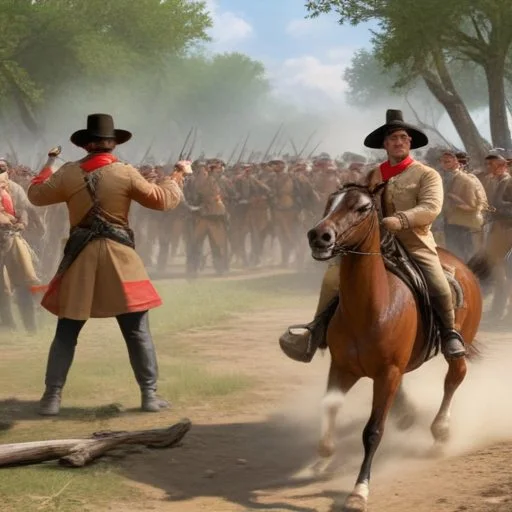
The Texas Revolution was a culmination of years of tensions between the American settlers in Texas and the Mexican government. The Mexican government had invited American settlers to Texas in the 1820s, but as the American population grew, so did their desire for greater autonomy. The Texans, who were predominantly of American and European descent, felt their rights and interests were being threatened by the increasingly centralist Mexican government.
In February 1836, a small band of Texan rebels, including famous figures such as Davy Crockett and Jim Bowie, occupied the Alamo, a small mission in San Antonio, in defiance of the Mexican government. The 13-day siege of the Alamo ended in a brutal massacre, with nearly all the defenders killed, including Crockett and Bowie. This event galvanized public opinion in Texas and sparked the call to arms against the Mexican government.
Sam Houston, the cunning commander of the Texan army, had been tracking down General Santa Anna's forces for weeks. On April 21, 1836, Houston's men ambushed the Mexicans near the San Jacinto River, catching them off guard. The Texans charged into battle, shouting "Remember the Alamo!" and quickly overwhelmed the Mexican forces. The battle was fierce but brief, lasting only 18 minutes, and ended with the capture of Santa Anna himself.
The Treaty of Velasco, signed on May 14, 1836, recognized Texas's independence from Mexico, with Santa Anna's signature guaranteeing the Texans' freedom. The Republic of Texas was born, and Sam Houston was hailed as a hero. This victory paved the way for Texas's eventual annexation by the United States in 1845 and cemented the region's unique cultural identity.
Sam Houston, the victor of San Jacinto, would go on to become the governor of Texas and later the state's first US senator. His cunning and strategic leadership during the battle solidified his place in Texan history, earning him the nickname "The Hero of San Jacinto".
The Battle of San Jacinto marked a turning point in the Texas Revolution, paving the way for the eventual creation of the Republic of Texas and, later, the state's annexation by the United States. This chain of events would have far-reaching consequences, influencing the course of American expansionism and the country's westward growth.
In conclusion, the Battle of San Jacinto stands as a testament to the power of rebellion and the unyielding desire for independence. This pivotal moment in American history continues to inspire and educate, serving as a reminder of the enduring spirit of those who fought for freedom and self-determination.
Sam Houston, the commander of the Texan army, was a complex and enigmatic figure. Born in Virginia in 1793, Houston was a son of Scottish-Irish immigrants and grew up in Tennessee. He served in the War of 1812 and later became a successful lawyer and politician, serving as the governor of Tennessee. However, a scandal surrounding his marriage led to his resignation and relocation to Texas, where he became a key figure in the Texas Revolution.
Houston's leadership during the Battle of San Jacinto was instrumental in securing the Texan victory. His decision to launch a surprise attack on the Mexican army, despite being outnumbered, showcased his cunning and strategic thinking. After the battle, he ensured that Santa Anna was treated with dignity, a move that would later pay off during the negotiations for the Treaty of Velasco.
The Battle of San Jacinto was not just a military victory, but also a testament to the logistical and strategic prowess of the Texan forces. The battle took place on a marshy terrain near the San Jacinto River, which made it difficult for the Mexican cavalry to maneuver. The Texans, who were largely infantry, used this to their advantage and launched a surprise attack on the Mexican flank.
The battle was also marked by a series of tactical decisions that favored the Texans. For instance, Houston's decision to delay the attack until the Mexican army was resting and unprepared gave the Texans an upper hand. Additionally, the Texans' use of the "flying army" tactic, where they rapidly moved from one location to another, made it difficult for the Mexicans to track their movements.
The Battle of San Jacinto has had a profound impact on Texan culture and identity. The famous cry of "Remember the Alamo!" has become an iconic symbol of Texan independence and pride. The battle is celebrated annually on April 21, known as San Jacinto Day, with parades, reenactments, and other festivities.
The battle has also inspired countless works of art, literature, and music. From films like "The Alamo" to songs like "The Battle of San Jacinto", the event has been immortalized in popular culture. Moreover, the battle has influenced the development of Texan architecture, with many buildings and monuments incorporating symbols and motifs that reflect the state's rich history.

The Battle of San Jacinto was not just a local conflict, but a key event in the broader geopolitical context of the time. The Mexican government, which had recently abolished the Mexican Constitution of 1824, was facing opposition from various states, including Texas. The Texans, who were largely of American and European descent, felt that their rights and interests were being threatened by the increasingly centralist Mexican government.
The battle had significant implications for the balance of power in North America. The Texans' victory marked a shift in power from Mexico to the United States, which would eventually lead to the annexation of Texas in 1845. This, in turn, would contribute to the Mexican-American War, as Mexico disputed the annexation and the border between the two nations.
The Battle of San Jacinto had significant economic implications for Texas and the surrounding region. The victory marked the beginning of a new era of economic growth and development, as the Texans were finally able to tap into the vast natural resources of the region. The battle also opened up new trade opportunities, as the Texans were able to establish trade relationships with the United States and other nations.
The most significant economic impact, however, was the subsequent growth of the Texan cattle industry. The battle paved the way for the development of vast ranches, which would eventually become a mainstay of the Texan economy. The growth of the cattle industry, in turn, contributed to the expansion of railroads, banking, and other industries, cementing Texas's position as a key player in the US economy.