


On July 12, 1191, the walls of Acre, a strategic stronghold in the Holy Land, finally cracked under the siege of the Christian forces led by King Philip Augustus of France, marking a crucial victory and a significant shift in the tide of the Third Crusade. This two-year-long siege, one of the bloodiest battles of the crusade, ended with the surrender of Saladin's garrison, paving the way for further Christian conquests in the region.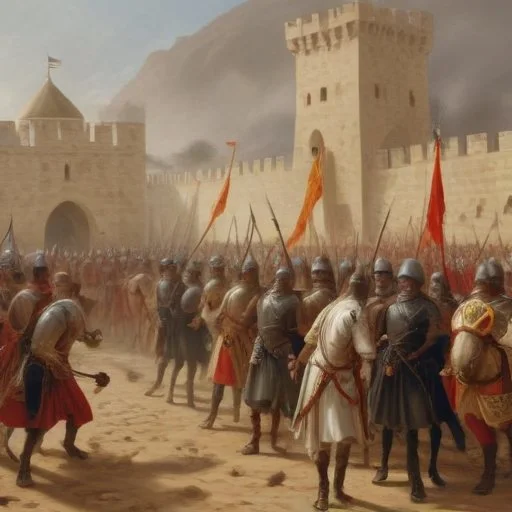
The Third Crusade, sparked by the recapture of Jerusalem by Saladin in 1187, had been brewing for years. European leaders, driven by a mix of religious fervor and political ambition, responded to the call to reclaim the Holy Land from Muslim rule. The crusade was marked by strategic alliances, bloody battles, and devastating sieges, with Acre being one of the most significant strongholds.
The fall of Acre was a significant blow to Muslim forces, marking a crucial turning point in the Third Crusade. The victory opened up the door for further Christian conquests in the Holy Land, including the capture of key cities like Jaffa and Beirut.
The siege of Acre had a profound impact on the cultural and social fabric of the region. The brutal conflict led to widespread destruction, displacement, and loss of life, leaving deep scars that would take centuries to heal. The fall of Acre also marked a shift in the balance of power in the region, paving the way for Christian rule and the establishment of Crusader states.
The bravery and resilience displayed by the defenders of Acre during the siege have become the stuff of legend, inspiring generations of warriors and leaders. The determination and perseverance of Philip Augustus and his crusaders serve as a testament to the power of conviction and the importance of standing up for one's beliefs.
The surrender of Acre to Philip Augustus marked a pivotal moment in the Third Crusade, a conflict that continues to shape our understanding of the complex and often fraught history of the Middle East. As we reflect on this event, we are reminded of the importance of understanding, tolerance, and peaceful coexistence.
Salaḥ ad-Dīn Yusuf ibn Ayyub, known to Western historians as Saladin, was a revered Muslim leader who united Egypt and Syria, defeating the Crusaders at the Battle of Hattin in 1187. He was a skilled military strategist, aJust ruler, and a patron of the arts. Saladin's unwavering dedication to his faith and his people earned him the respect of his enemies, including King Richard the Lionheart.
Saladin's leadership was marked by his ability to forge alliances and make strategic decisions, often choosing to negotiate rather than fight. His chivalry and honor were legendary, earning him the nickname "the Sultan of Chivalry."

Acre, a city situated on the Mediterranean coast, has a rich cultural heritage, with a history dating back to the Phoenicians. The city's strategic location made it a prized possession, with various empires and dynasties vying for control. The Crusaders' capture of Acre in 1191 marked a significant shift in the city's cultural identity, as Christian architecture, art, and customs began to dominate.
The city's unique blend of Christian, Muslim, and Jewish influences has resulted in a cultural melting pot, with each group leaving its mark on the city's architecture, cuisine, and traditions. Acre's cultural significance extends beyond its historical significance, with the city serving as a symbol of coexistence and tolerance.
The two-year siege of Acre had devastating economic consequences for the region. The prolonged conflict led to a decline in trade, as merchants avoided the war-torn area. The destruction of infrastructure, including roads, bridges, and buildings, disrupted commerce and led to a shortage of essential goods.
The Crusaders' victory came at a great cost, with the city's economy severely depleted. The subsequent Christian rule led to the imposition of heavy taxes, further exacerbating the economic strain on the local population. The economic impact of the siege was felt for generations, hindering the region's development and growth.

The fall of Acre had far-reaching political implications, marking a significant shift in the balance of power in the region. The Crusaders' victory paved the way for further Christian conquests, including the capture of key cities like Jaffa and Beirut.
The weakening of Muslim forces under Saladin's leadership created a power vacuum, which the Christian kingdoms of Jerusalem and Tripoli exploited. The Crusaders' success also led to increased European involvement in the region, with the papacy and European monarchies providing military and financial support to the Crusader states.
The Battle of Arsuf, fought on September 7, 1191, was a crucial precursor to the siege of Acre. The battle marked the first major engagement between King Richard the Lionheart's Crusader army and Saladin's Muslim forces.
The Crusaders' victory at Arsuf boosted their morale and paved the way for the subsequent siege of Acre. The battle showcased the military prowess of both leaders, with Richard's tactical genius and Saladin's cunning ultimately leading to a Crusader victory. The outcome of Arsuf set the stage for the dramatic events that would unfold at Acre.