


In May 1992, the bustling streets of Bangkok witnessed a tragic and pivotal event in Thai history – a brutal military crackdown on peaceful protesters demanding democratic reforms. The ensuing three-day bloodbath would become infamous as one of the darkest chapters in Thailand's modern history, leaving 52 confirmed dead, hundreds injured, and countless others vanished.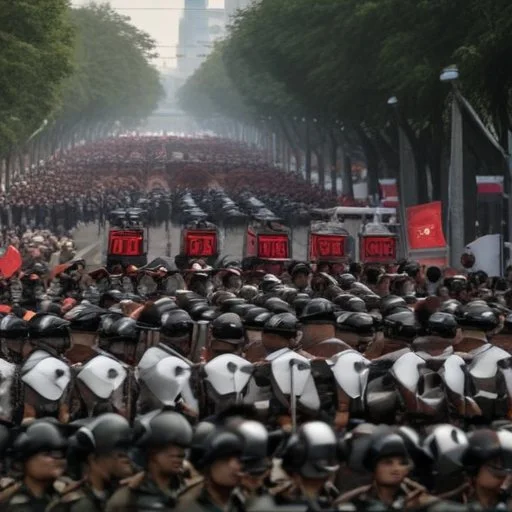
The roots of the May 1992 uprising can be traced back to the 1991 military coup, which ousted the democratically elected government of Chatichai Choonhavan. General Suchinda Kraprayoon, a former army chief, seized power and installed himself as Prime Minister. The new government's authoritarian stance and perceived corruption sparked widespread discontent among the Thai people.
Tens of thousands of protesters, comprising students, workers, and middle-class citizens, converged on Bangkok's streets to demand:
On May 17, 1992, the government responded to the protests with brutal force. Troops and tanks were deployed to disperse the crowd, resulting in a bloody clampdown. Protesters were met with live ammunition, tear gas, and baton charges. The streets of Bangkok became a battleground, with chaos and violence engulfing the city.
The three-day crackdown left a trail of destruction and human suffering in its wake. The official death toll stood at 52, although eyewitnesses reported many more fatalities. Hundreds were injured, and many more were arrested, detained, or forced into hiding. The international community condemned the violence, and the event sparked widespread outrage and calls for reform.
The May 1992 crackdown served as a watershed moment in Thailand's struggle for democracy. The event galvanized the pro-democracy movement, paving the way for future protests and ultimately, the adoption of a new constitution in 1997. Though the scars of Bloody May still linger, the event remains a powerful symbol of the Thai people's unwavering determination to fight for their rights and freedoms.
"The blood of the people will not be forgotten." – Chalard Worachat, prominent Thai activist and politician
"The May 1992 crackdown was a tragic reminder of the Thai government's willingness to use force against its own people. It is a dark chapter in our history, but it also serves as a testament to the resilience and courage of the Thai people in their pursuit of democracy and human rights." – Abhisit Vejjajiva, former Thai Prime Minister
The May 1992 crackdown was not an isolated incident, but rather the culmination of a long history of military interference in Thai politics. Since the end of absolute monarchy in 1932, Thailand had experienced multiple coups, with the military consistently playing a dominant role in shaping the country's governance. The 1991 coup, which brought General Suchinda Kraprayoon to power, was the 17th successful military takeover in Thailand's history. This legacy of military intervention created a culture of impunity, where the armed forces felt empowered to use force against civilians to maintain their grip on power.
The events of Bloody May can be seen as a turning point in this narrative, as they marked a shift in the military's relationship with the Thai people. The brutality of the crackdown sparked widespread outrage and galvanized the pro-democracy movement, ultimately leading to the adoption of a new constitution in 1997 that aimed to curb the military's influence.

General Suchinda Kraprayoon, the leader of the 1991 military coup, was a seasoned military officer with a reputation for ruthlessness. Born in 1933, Suchinda rose through the ranks of the Thai army, earning a reputation as a skilled operator and a loyal supporter of the military's traditionalist faction. Despite his authoritarian stance, Suchinda was known for his charisma and persuasive abilities, which helped him to maintain a degree of popular support despite his Junta's repressive policies.
Suchinda's leadership style was marked by a strong sense of discipline and a willingness to use force to maintain order. He saw the pro-democracy movement as a threat to the military's authority and was determined to crush it. His decision to deploy troops against the protesters on May 17, 1992, would ultimately prove to be a costly mistake, as it galvanized opposition to his rule and paved the way for his eventual downfall.
The May 1992 crackdown shares striking parallels with other instances of state-sponsored violence against civilian protesters. The Tiananmen Square massacre in China (1989) and the Gwangju uprising in South Korea (1980) are two notable examples of governments using brutal force to quell democratic movements. In each of these cases, the authorities sought to maintain their grip on power by crushing dissent, only to ultimately fuel further resistance and demands for reform.
In the case of Bloody May, the Thai government's response was remarkably similar, with troops and tanks deployed to disperse protesters, resulting in widespread bloodshed and human rights abuses. These comparisons serve as a poignant reminder of the dangers of unchecked state power and the importance of protecting human rights and democratic freedoms.

The May 1992 crackdown had significant implications for Thai politics, sparking a period of intense pressure on the government to reform and democratize. The event galvanized the pro-democracy movement, leading to widespread protests and calls for the resignation of Prime Minister Suchinda Kraprayoon. The government's response to the crisis was initially conciliatory, with promises of reform and greater civilian involvement in governance. However, these promises were ultimately empty, and the military continued to wield significant influence over the political process.
The aftermath of Bloody May saw a shift in the balance of power, with the monarchy and the business elite aligning themselves with the pro-democracy movement. This realignment ultimately paved the way for the adoption of a new constitution in 1997, which sought to curb the military's influence and establish a more robust system of democratic governance.
The May 1992 crackdown had significant economic implications for Thailand, with the country's tourism and investment sectors particularly hard hit. The bloodshed and chaos of Bloody May deterred tourists, leading to a sharp decline in visitor numbers and a corresponding drop in foreign exchange earnings. The country's reputation as a stable and attractive destination for investment was also severely damaged, leading to a decline in foreign direct investment.
In the aftermath of the crackdown, the Thai government was forced to implement a series of austerity measures to stabilize the economy. However, these measures ultimately proved ineffective, and the country was forced to turn to the International Monetary Fund (IMF) for assistance. The IMF's structural adjustment program imposed significant conditionalities on Thailand, including cuts to public spending and increases in taxes, which exacerbated the country's economic woes.