


The Trial of Martin Luther, which took place on April 18, 1521, marks a pivotal moment in the Protestant Reformation, as the German theologian and reformer refuses to recant his teachings, despite the risk of excommunication, in front of the assembly of the Diet of Worms.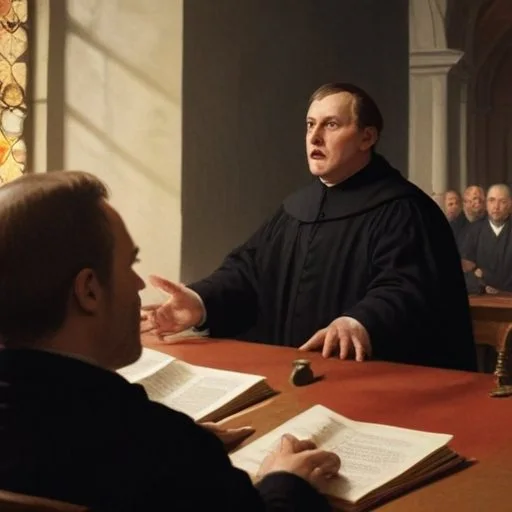
This event, which would become a watershed moment in Church history, was a culmination of Luther's years of criticism of the Catholic Church's practices and his advocacy for reform, ultimately leading to a permanent schism in Western Christianity.
In the early 16th century, the Catholic Church faced widespread criticism for its corruption, nepotism, and the sale of indulgences. Martin Luther, a professor of theology at the University of Wittenberg, was among the most vocal critics, arguing that the Church had strayed from the teachings of the Bible.
In 1517, Luther posted his famous 95 Theses on the door of the Castle Church in Wittenberg, sparking a theological firestorm that would engulf Europe. The Theses, which called for a return to biblical authority and an end to the sale of indulgences, resonated with many, who saw them as a call to reform.
In 1521, Luther was summoned to the Diet of Worms, a gathering of the Holy Roman Empire's Estates, to answer charges of heresy. The Diet, which was convened by Emperor Charles V, was dominated by Catholic clergy, who saw Luther's teachings as a threat to the authority of the Church.
Luther, who had been protected by the Elector of Saxony, Frederick the Wise, finally appeared before the Diet on April 17, 1521. The next day, he was asked to recant his teachings, but Luther refused, saying, "Unless I am convinced by the testimony of the Scriptures or by clear reason, I am bound by the Scriptures I have quoted, and my conscience is captive to the Word of God."
The Trial of Martin Luther had far-reaching cultural and social implications, shaping the course of Western Christianity and beyond. The event inspired a new wave of Protestant reformers, who saw Luther as a champion of individual freedom and conscience.
The Trial also had significant literary and artistic influences, with Luther's writings and teachings inspiring countless works of art, literature, and music.
"Here I stand, I can do no other. God help me. Amen." - Martin Luther, at the Trial of Worms
"Unless I am convinced by the testimony of the Scriptures or by clear reason, I am bound by the Scriptures I have quoted, and my conscience is captive to the Word of God." - Martin Luther, at the Trial of Worms
The Trial of Martin Luther shares similarities with other pivotal moments in Church history, such as the Council of Nicaea and the Trial of Jan Hus.
However, Luther's defiance in the face of opposition, and his unwavering commitment to his beliefs, set him apart as a champion of religious freedom and a precursor to modern Protestantism.
Luther's bravery in the face of intimidation and his unwavering commitment to his beliefs have inspired countless generations of Christians and non-Christians alike.
His legacy extends beyond the realm of theology, influencing art, literature, and politics, and continues to shape Western culture to this day.
The Trial of Martin Luther paved the way for the development of Protestantism, shaping the course of Western Christianity and beyond.
The event also had significant implications for the relationship between Church and State, influencing the development of modern democracy and human rights.
The Trial of Martin Luther, which took place on April 18, 1521, marks a pivotal moment in Church history, as the German theologian and reformer refuses to recant his teachings, despite the risk of excommunication.
This event, which has had far-reaching cultural, social, and literary implications, continues to inspire and influence Christians and non-Christians alike, shaping the course of Western culture and beyond.
Martin Luther was born on November 10, 1483, in Eisleben, Saxony, to Hans and Margaret Luther. His father, a copper miner, wanted Luther to become a lawyer, but Luther's passion for theology led him to pursue a career in the Church.
Luther's early education at the University of Erfurt and the University of Wittenberg laid the foundation for his later critiques of the Catholic Church. He received his doctorate in theology in 1512 and became a professor at the University of Wittenberg.
Luther's deep faith and commitment to reform were shaped by his experiences as a young monk and his study of the Bible. He became increasingly disillusioned with the corruption and abuse of power within the Church, setting the stage for his later confrontation with the Catholic Church.

Martin Luther's impact on art and literature was profound. His writings inspired a new wave of Protestant artists, writers, and musicians who saw him as a champion of individual freedom and conscience.
Luther's hymns, such as "A Mighty Fortress Is Our God," became iconic expressions of Protestant faith and have been translated into numerous languages. His translation of the Bible into German made scripture accessible to a wider audience, influencing the development of German literature.
Luther's legacy can be seen in the works of artists such as Lucas Cranach, who depicted Luther and his followers in his paintings. The Reformation also inspired a new wave of literary works, including the poetry of Hans Sachs and the writings of Philip Melanchthon.
In the months leading up to the Diet of Worms, Martin Luther was aware of the risks involved in challenging the Catholic Church. Despite the danger, he was determined to present his case to the Estates and the Emperor.
Luther's journey to Worms was marked by uncertainty and fear. He was unsure of what lay ahead, and his friends and allies urged him to be cautious. Nevertheless, he remained resolute, believing that his cause was just and that God would protect him.
On April 2, 1521, Luther set out on the long journey to Worms, accompanied by a small group of friends and supporters. Along the way, he preached to crowds of people, spreading his message of reform and galvanizing support for his cause.

Martin Luther's stand at the Diet of Worms bears striking similarities to the trial of Jan Hus, a Czech reformer who was executed for heresy in 1415.
Like Luther, Hus called for reform within the Catholic Church, criticizing its corruption and abuse of power. Both men were vocal in their opposition to the sale of indulgences, and both faced fierce opposition from the Church hierarchy.
Despite these similarities, there are significant differences between the two reformers. Hus's movement was more radical, advocating for the restoration of the Church to its apostolic roots. Luther, on the other hand, sought to reform the Church from within, working to correct its abuses and restore its biblical foundations.
The Reformation had significant economic implications for Europe. The split from the Catholic Church led to the confiscation of Church property, which was then redistributed to the state or private owners.
The Reformation also led to the emergence of a new class of merchants and entrepreneurs who were friendly to Protestantism. These individuals played a key role in shaping the economic landscape of Europe, investing in trade, industry, and education.
In addition, the Reformation led to the development of new economic theories, such as the concept of usury, which prohibited the charging of excessive interest on loans. This concept, which was first articulated by Luther, had a profound impact on the development of modern capitalism.