


The city of Tripolitsa, once a formidable stronghold of the Ottoman Empire in Greece, fell to the brave Greek rebels on October 5, 1821, marking a decisive turning point in the Greek War of Independence. This triumph not only bolstered the morale of the Greek revolutionaries but also paved the way for further victories, ultimately leading to Greece's long-awaited independence.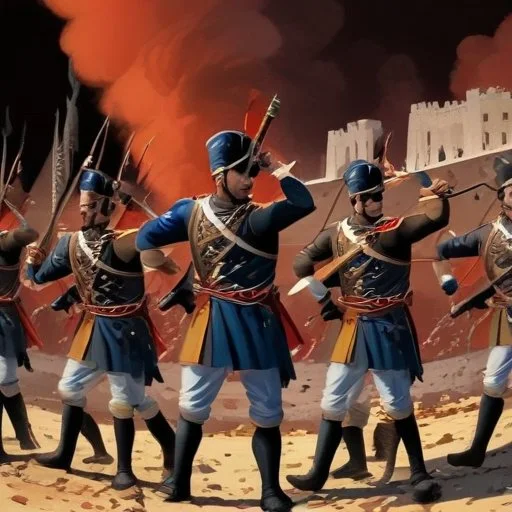
The Greek War of Independence, which began in 1821, was a culmination of centuries of Ottoman rule over Greece. The Greek people, fueled by the ideals of liberty, equality, and fraternity, sought to free themselves from the shackles of Ottoman domination. The struggle for independence was led by a group of visionaries, including Theodoros Kolokotronis, a seasoned military leader who would play a pivotal role in the Battle of Tripolitsa.
The Battle of Tripolitsa was a meticulously planned operation, with Kolokotronis at the helm. The Greek rebels, comprising approximately 10,000 men, employed a clever tactic, dividing their forces into three groups to surround the city. Meanwhile, the Ottoman forces, numbering around 8,000, were blissfully unaware of the impending attack.
The battle commenced on October 5, 1821, with the Greek rebels launching a surprise assault on the city. The Ottoman forces, taken aback by the sudden attack, struggled to respond effectively. As the fighting raged on, the Greek rebels managed to breach the city walls, and Tripolitsa was finally captured.
The capture of Tripolitsa had far-reaching consequences, boosting the morale of the Greek rebels and galvanizing support for the independence movement. The victory also demonstrated thereek rebels' ability to outmaneuver and defeat the Ottoman forces, paving the way for future triumphs.
The fall of Tripolitsa also had a profound impact on the international community, as European powers began to take notice of the Greek struggle for independence. The battle served as a catalyst for increased support from nations such as Russia, France, and Britain, which ultimately contributed to Greece's independence.
The Battle of Tripolitsa has become an integral part of Greek cultural heritage, symbolizing the nation's unwavering determination and bravery in the face of adversity. The battle is commemorated annually on October 5, with festivities and ceremonies held across Greece.
The victory at Tripolitsa also inspired a new generation of Greek artists, poets, and writers, who drew inspiration from the heroism and sacrifice of the rebels. The battle has been immortalized in literature, art, and music, ensuring its place in the annals of Greek history.
In his memoirs, Kolokotronis recalled the Battle of Tripolitsa as a "glorious and momentous day" that would be etched in Greek history forever. He praised the bravery and resilience of his men, saying, "We fought with our hearts, and our hearts were filled with the love of our country."
Another eyewitness account from a Greek rebel, Ioannis Makriyannis, provides a poignant description of the battle: "The cries of the wounded, the clash of swords, the smell of gunpowder... it was a scene from hell. But we were driven by our desire for freedom, and nothing could stop us."
The Battle of Tripolitsa served as a precursor to a series of Greek victories, ultimately paving the way for Greece's independence. The battle's significance extends beyond the Greek War of Independence, as it has inspired generations of Greeks to fight for their freedom and democracy.
In conclusion, the capture of Tripolitsa remains a testament to the bravery, determination, and sacrifice of the Greek people. This pivotal event has left an indelible mark on Greek history, serving as a beacon of hope and inspiration for generations to come.
The Battle of Tripolitsa has left an indelible mark on Greek cultural heritage, inspiring numerous artistic and literary works. The bravery and sacrifice of the Greek rebels have been immortalized in paintings, poems, and songs, ensuring that the battle remains a powerful symbol of Greek resistance and determination.
One of the most famous works inspired by the Battle of Tripolitsa is the painting "The Fall of Tripolitsa" by Greek artist Theodoros Vryzakis. The painting, created in 1855, vividly captures the intensity and drama of the battle, showcasing the Greek rebels' determination to overcome the Ottoman forces.
In addition to visual arts, the Battle of Tripolitsa has also inspired numerous literary works, including poems and novels that celebrate the heroism of the Greek rebels. The battle has become a powerful metaphor for the struggle for independence and freedom, transcending its historical context to become a timeless symbol of Greek identity.
Theodoros Kolokotronis, the renowned military leader who led the Greek rebels to victory at Tripolitsa, was a seasoned warrior with a keen strategic mind. Born in 1770, Kolokotronis was a member of the powerful Kolokotronis family, which had a long history of resistance against the Ottoman Empire.
Kolokotronis' military prowess was honed through years of fighting against the Ottomans, and he became known for his innovative tactics and ability to inspire his troops. His leadership during the Battle of Tripolitsa was instrumental in securing the Greek rebels' victory, and his heroism has become legendary in Greek history.
Despite his triumph at Tripolitsa, Kolokotronis' life was marked by turmoil and controversy. He was imprisoned and eventually exiled by the Greek government, only to be later pardoned and reinstated as a military leader. His legacy, however, remains unblemished, and he is remembered as one of the greatest heroes of the Greek War of Independence.
The Greek War of Independence, which began in 1821, was a complex and multifaceted conflict that involved not only the Greek rebels and the Ottoman Empire but also the great powers of Europe. The war was fought against the backdrop of growing nationalism and liberalism in Europe, which had created an environment conducive to revolutionary movements.
The Greek War of Independence was also influenced by the decline of the Ottoman Empire, which had once been the dominant power in the region. The empire's decline created a power vacuum that allowed for the emergence of new nationalist movements, including the Greek struggle for independence.
The war was further complicated by the involvement of European powers, including Russia, France, and Britain, which had their own interests and agendas in the region. The great powers' involvement in the war would ultimately prove crucial in shaping its outcome and securing Greece's independence.

The Battle of Tripolitsa had significant economic consequences for both the Greek rebels and the Ottoman Empire. The defeat of the Ottoman forces led to a decline in the empire's economic influence in the region, allowing for the emergence of a new Greek economy.
The Greek rebels' victory at Tripolitsa also led to an increase in trade and commerce in the region, as the Greeks were able to establish control over key trade routes and ports. The battle also led to an influx of foreign investment, as European powers such as Britain and France saw opportunities for economic gain in the newly independent Greece.
However, the battle also had negative economic consequences, particularly for the Ottoman Empire. The defeat at Tripolitsa led to a decline in the empire's economic power and influence, which would ultimately contribute to its decline and eventual collapse.