


The Ipatiev House in Yekaterinburg, Russia, will forever be etched in history as the site of one of the most brutal and senseless massacres of the 20th century. It was here, on the night of July 17, 1918, that Tsar Nicholas II, the deposed ruler of Russia, his family, and loyal servants were callously executed by a group of Bolshevik Chekists in a hail of gunfire.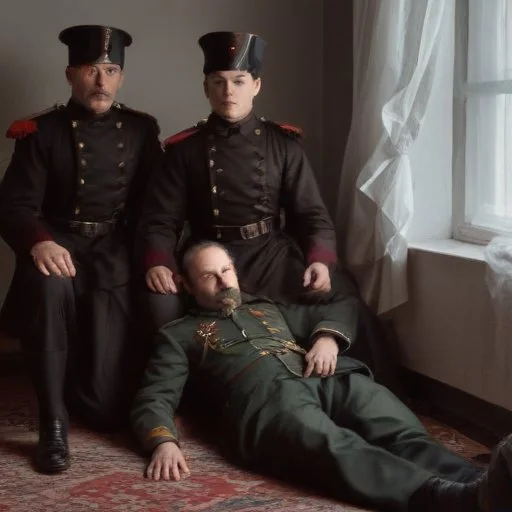
The Romanov dynasty, which had ruled Russia for over a century, came to a brutal end with the execution of Tsar Nicholas II and his family. The Tsar, who had been forced to abdicate in March 1917 following the February Revolution, was initially placed under house arrest with his family. However, as the Bolsheviks consolidated their power, the Tsar and his family were moved from one location to another, eventually ending up at the Ipatiev House in Yekaterinburg.
The night of July 17, 1918, was a mixture of chaos and calculation. A group of Bolshevik Chekists, led by Yakov Yurovsky, arrived at the Ipatiev House under the pretext of relocating the Tsar and his family to a safer location. Instead, they were met with a hail of gunfire, as the Chekists brutally executed the Tsar, his wife Alexandra, their four daughters Olga, Tatiana, Maria, and Anastasia, and four loyal servants, including the family doctor and a loyal valet.
Yakov Yurovsky, a seasoned Bolshevik and Chekist, was the mastermind behind the assassination of the Romanov family. Born in 1878, Yurovsky was a devoted Marxist who rose through the ranks of the Bolshevik party, earning the trust of Vladimir Lenin himself. It was Yurovsky who was tasked with the gruesome responsibility of eliminating the Romanov family, a task he carried out with ruthlessness and efficiency.
The execution of the Romanov family sent shockwaves throughout Russia and the world. The Bolsheviks, who had promised a brighter future for the Russian people, had instead revealed their true colors, opting for brutality and repression over diplomacy and cooperation. In the years that followed, the Soviet Union would be built on a foundation of fear, propaganda, and violence, with the Romanov family's fate serving as a cautionary tale for anyone who dared to oppose the regime.
The assassination of the Romanov family has left an indelible mark on popular culture. From films like Anastasia to books like The Romanov Prophecy, the story of the doomed family has captivated audiences around the world. The Romanovs have also inspired a range of artistic interpretations, from the hauntingly beautiful Romanov Tercentenary painting by Valentin Serov to the poignant Requiem by Nikolai Kachanov, dedicated to the memory of the executed family.
In 1991, after decades of secrecy and speculation, the remains of the Romanov family were finally rediscovered in a hidden grave in the Ural Mountains. The discovery, which was confirmed through DNA testing, brought a sense of closure to the Russian people, who had long been fascinated by the fate of the doomed family. Today, the Romanov family's remains are laid to rest in the St. Peter and Paul Cathedral in St. Petersburg, a poignant reminder of the tragic events that unfolded in the Ipatiev House nearly a century ago.
Yakov Yurovsky was born in 1878 in Tomsk, Russia, to a Jewish family of modest means. Despite his humble beginnings, Yurovsky rose through the ranks of the Bolshevik party, driven by his devotion to Marxist ideology. He became a seasoned Chekist, earning the trust of Vladimir Lenin, who tasked him with eliminating the Romanov family.
Yurovsky's background in dentistry and his experience as a hospital orderly may have influenced his approach to the execution, as he insisted on neatness and precision, ordering his men to shoot the family in a specific sequence to minimize bloodshed.

The tragic story of the Romanov family has inspired countless works of fiction, from films like Anastasia to books like The Romanov Prophecy. These works often romanticize the family's fate, portraying them as innocent victims of the Bolshevik revolution.
In reality, the Romanovs were a complex and multifaceted family, with their own strengths and weaknesses. Authors and filmmakers have drawn inspiration from their story, using it to explore themes of power, loyalty, and family.
In 1918, Russia was in the midst of a tumultuous period of political upheaval. The Bolsheviks had seized power in the October Revolution, and the country was descending into civil war.
The execution of the Romanov family was a strategic move by the Bolsheviks to consolidate their power and eliminate potential rivals. It marked a turning point in the Russian Civil War, as the Bolsheviks sought to establish themselves as the dominant force in Russia.
Historians have long debated the circumstances surrounding the execution of the Romanov family, with some scholars questioning the official account of events.
Recent studies have shed new light on the role of Yakov Yurovsky, highlighting his ruthlessness and efficiency in carrying out the execution. However, other historians have argued that the Bolsheviks' motives were more complex, driven by a desire to eliminate the Romanovs as symbols of the old regime.
The Ipatiev House, where the Romanov family met their fate, has become a haunting symbol of the brutal suppression of the Russian monarchy.
Today, the house has been demolished, replaced by the Church on the Blood, a grand cathedral built to commemorate the Romanov family's martyrdom.