


In a historic moment that reverberated across the globe, the two German states, along with the Four Powers - the United States, the United Kingdom, France, and the Soviet Union - gathered in Moscow on September 12, 1990, to sign the Treaty on the Final Settlement with Respect to Germany. This landmark agreement effectively ended the post-war occupation of Germany, paving the way for the long-awaited reunification of East and West Germany, and marking a significant milestone in the country's journey towards unity and sovereignty.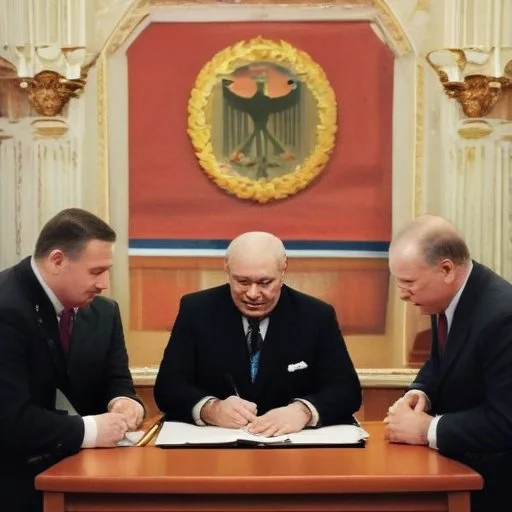
The Treaty on Final Settlement was the culmination of decades of division and occupation that had ravaged Germany since the end of World War II. The country was split into four occupation zones controlled by the Allied Powers, with the Soviet Union occupying the eastern sector and the United States, the United Kingdom, and France occupying the western sector. This division led to the formation of two separate German states: the German Democratic Republic (GDR or East Germany) and the Federal Republic of Germany (FRG or West Germany).
The years that followed were marked by a complex web of alliances, tensions, and ideological differences between the East and the West. The Berlin Wall, erected in 1961, physically and symbolically divided the city, becoming a powerful symbol of the Cold War.
In the late 1980s, a series of events set in motion the chain of events that would ultimately lead to German reunification. The fall of the Berlin Wall in November 1989 marked a turning point in modern German history. As the East German government's grip on power began to loosen, thousands of East Germans flooded into West Germany, demanding greater freedom and unity.
Against this backdrop of rising protest and political upheaval, the Four Powers and the two German states embarked on a series of negotiations that would culminate in the Treaty on Final Settlement. The treaty was the result of intense diplomatic efforts, with the Four Powers working together to address the complex issues surrounding Germany's reunification.
The Treaty on Final Settlement marked the beginning of a new era for Germany, one defined by unity, sovereignty, and a commitment to European integration. The reunification of Germany, which was formally completed on October 3, 1990, was a testament to the power of diplomacy, compromise, and the unwavering desire for freedom and unity.
As Germany looked to the future, it did so with a newfound sense of purpose and belonging. The Treaty on Final Settlement had unlocked the shackles of the past, clearing the way for a united, prosperous, and influential Germany to take its rightful place on the world stage.
The Treaty on Final Settlement has left an indelible mark on modern German history. It has served as a beacon of hope for nations torn apart by conflict and division, demonstrating that even the most seemingly intractable problems can be overcome through cooperation and diplomacy.
As we reflect on the significance of this landmark agreement, we are reminded of the power of courage, perseverance, and compromise in shaping the course of human events. The Treaty on Final Settlement will forever be remembered as a testament to the human spirit's ability to overcome even the most formidable obstacles, and to forge a brighter, more united future.
The Moscow negotiations that led to the Treaty on Final Settlement were not without their challenges. The Four Powers had differing opinions on the scope and nature of German reunification, and the two German states had their own concerns about sovereignty and territorial integrity. Despite these obstacles, the negotiators persevered, driven by a sense of urgency and a desire to bring an end to the division of Germany.
The treaty's signing was a testament to the power of diplomacy and compromise. The Four Powers had to balance their own interests with those of the German people, and the two German states had to reconcile their differences and find common ground. The result was a treaty that was far from perfect, but one that marked a significant step towards unity and sovereignty for Germany.
Helmut Kohl: The Chancellor of Unity
Helmut Kohl, the Chancellor of West Germany from 1982 to 1998, played a crucial role in the reunification of Germany. A strong advocate for European integration and a proponent of close ties with the United States, Kohl worked tirelessly to bring an end to the division of Germany. His leadership and vision helped to navigate the complexities of the reunification process, and his commitment to democracy and freedom inspired the German people.
Kohl's partnership with East German Prime Minister Hans Modrow was instrumental in shaping the terms of the reunification. Together, they worked to create a framework for a unified Germany that would be acceptable to both the East and the West.
The reunification of Germany in 1990 was not the first time that the country had been unified. In 1871, following the Franco-Prussian War, the German states were unified under the leadership of Otto von Bismarck, creating the German Empire. However, this earlier unification was marked by a strong centralized government and a militaristic approach, whereas the 1990 reunification was characterized by a commitment to democracy, freedom, and European integration.
In contrast to the earlier unification, the 1990 reunification was also marked by a significant shift in power dynamics. The earlier unification had been driven by the German states themselves, whereas the 1990 reunification was facilitated by the Four Powers and the collapse of the Soviet Union.
The reunification of Germany in 1990 was not an isolated event, but rather part of a broader process of geopolitical change that was taking place in Europe. The decline of the Soviet Union, the rise of the European Community, and the end of the Cold War all contributed to a new era of cooperation and integration on the continent.
The reunification of Germany also had significant implications for the European Community, which would eventually become the European Union. The integration of East Germany into the European Community marked a significant expansion of the organization, and paved the way for future enlargements.
The reunification of Germany in 1990 had a significant impact on the country's economy. The integration of East Germany into the Federal Republic of Germany led to a significant increase in economic output, as the East German economy was revamped and modernized.
The reunification also led to a significant increase in investment and trade, as Germany became a single, unified market. This, in turn, contributed to Germany's emergence as a major economic power in Europe, with significant implications for the European economy as a whole.