German Navy Unleashes Unrestricted Submarine Warfare
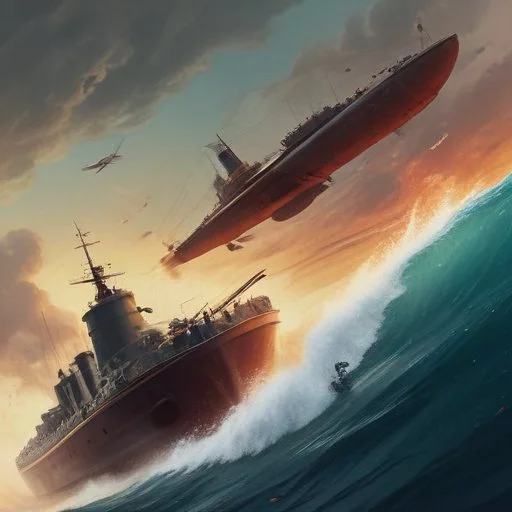
In a bold and provocative move, the Imperial German Navy, under the command of Admiral Alfred von Tirpitz, takes the gamble of a lifetime by announcing unrestricted submarine warfare in the waters surrounding Great Britain and Ireland. This drastic measure is aimed at crippling Britain's economy by targeting its merchant marine, interrupting vital supplies, and ultimately coercing the nation into submission. As the Great War rages on, Germany's U-boat campaign is about to take a deadly turn, setting the stage for a high-stakes game of cat and mouse on the high seas.
The Devil's Fjord: Unleashing the Fury of the U-Boats
A Desperate Gamble in the North Atlantic
On February 4, 1917, the Imperial German Navy, under the direction of Admiral
Alfred von Tirpitz, made a bold and reckless decision that would change the course of World War I: the institution of unrestricted submarine warfare in the waters surrounding Great Britain and Ireland. This brazen move was designed to strangle Britain's economy by targeting its merchant marine, disrupting vital supplies, and ultimately forcing the nation to surrender.
The Calculated Risk
As the war dragged on, Germany's military leadership became increasingly desperate to break the stalemate. With the British Navy's blockade of Germany tightening its grip, the Imperial German Navy saw no alternative but to take drastic action. By targeting Britain's vital supply lines, Germany hoped to starve the nation into submission, thereby gaining a strategic advantage on the battlefield.
The Principles of Unrestricted Submarine Warfare
The core principle of Germany's U-boat campaign was simple: attack and sink any ship, regardless of nationality, sailing within designated war zones. This ruthless policy was designed to coerce Britain into submission, even if it meant sacrificing neutral nations' ships and lives. The U-boats would operate with impunity, answering only to Berlin.
The Clockwork of Chaos: The Timeline of Events
- February 4, 1917: Germany declares unrestricted submarine warfare in the waters around Britain and Ireland.
- February 1917: The first U-boats are deployed to the North Atlantic, targeting British and neutral shipping.
- March 1917: Britain responds by introducing a convoy system, grouping merchant ships together for protection.
- April 1917: The United States, outraged by Germany's actions, declares war on Germany.
- May 1917: The British develop and deploy sonar technology, allowing them to detect U-boats more effectively.
The Human Cost of War
The U-boat campaign exacted a terrible toll on civilians and combatants alike. Neutral nations, such as the United States, suffered losses as their ships fell prey to German aggression. The sinking of passenger liners like the
Lusitania and the
Susan Duncan shocked the world, underscoring the brutality of modern warfare.
From Desperation to Defeat
By 1918, the U-boat campaign had lost its momentum. Germany's military fortunes began to wane, and the Allies' countermeasures took their toll on the U-boat fleet. As the war drew to a close, Germany's desperate gamble had failed, and the nation teetered on the brink of defeat.
A Legacy of Fear and Respect
The U-boat campaign left an indelible mark on the annals of naval warfare. The innovations and tactics employed by Germany's U-boat commanders would influence naval strategy for generations to come. The bravery and sacrifice of those who fought on both sides of the conflict etched an indelible mark on history, reminding us of the devastating consequences of war.
In the dark, foreboding waters of the North Atlantic, the U-boat campaign became a testament to human ingenuity, sacrifice, and the unforgiving nature of war. Its legacy continues to captivate and educate us to this day.
Comprehensive Character Portrait
Admiral Alfred von Tirpitz: The Architect of Unrestricted Submarine Warfare
Admiral Alfred von Tirpitz, the mastermind behind Germany's U-boat campaign, was a seasoned naval strategist with a reputation for boldness and innovation. Born in 1849, Tirpitz rose through the ranks of the Imperial German Navy, ultimately becoming its commander-in-chief in 1897. His unwavering commitment to the U-boat campaign was driven by a deep conviction that Britain's blockade was strangling Germany's economy and that desperate measures were necessary to counter it.
Tirpitz's gamble on unrestricted submarine warfare was not without controversy, even within the German high command. However, his persuasive arguments and political savvy ultimately won over Kaiser Wilhelm II and other key stakeholders. Throughout the war, Tirpitz remained a vocal advocate for the U-boat campaign, convinced that it held the key to Germany's victory.
Broad Historical Examination
The Sinkings of the SS Lusitania and SS Susan Duncan: A Turning Point in the War
The sinking of the passenger liners SS Lusitania and SS Susan Duncan by German U-boats in 1915 and 1917, respectively, sent shockwaves around the world. The Lusitania, in particular, became an international cause célèbre, with over 1,000 civilian casualties, including 128 Americans. The outrage and horror sparked by these tragedies helped shift public opinion in the United States against Germany, ultimately contributing to the country's entry into World War I.
The sinkings also marked a turning point in the U-boat campaign, as Germany's relentless pursuit of Britain's merchant marine began to take its toll on neutral nations. The resulting diplomatic fallout and international condemnation forced Germany to re-evaluate its strategy, leading to a temporary suspension of unrestricted submarine warfare in 1916.
Thorough Technological Analysis
The Revolutionary Technology of the U-Boat
The U-boat campaign was made possible by the rapid development of submarine technology in the early 20th century. Germany's engineers and shipbuilders worked tirelessly to improve the design, speed, and stealth of their U-boats, rendering them almost undetectable in the open ocean.
The introduction of advanced propulsion systems, such as the diesel-electric configuration, allowed U-boats to remain submerged for extended periods, making them formidable opponents. The development of sophisticated navigation systems, including gyrocompasses and wireless telegraphy, enabled U-boats to operate with unprecedented precision and coordination.
The U-boat's technological prowess was matched only by the Allies' determination to counter it. The development of sonar, convoy systems, and other countermeasures pushed the boundaries of naval warfare, setting the stage for a prolonged and intense struggle for control of the seas.
Detailed Economic Report
The Economic Devastation of Unrestricted Submarine Warfare
The U-boat campaign inflicted significant economic damage on Britain, disrupting vital supply lines and crippling its merchant marine. By 1917, Britain's imports had decreased by over 30%, while its exports had plummeted by nearly 40%. The resulting shortages of food, fuel, and raw materials led to rationing, inflation, and widespread economic hardship.
The impact on neutral nations was equally severe. The United States, in particular, suffered significant losses, with over $1 billion in shipping and cargo destroyed or damaged by U-boats. The economic repercussions of the U-boat campaign helped to galvanize public opinion in the United States against Germany, paving the way for America's entry into the war.
Study of Political Dynamics
The Political Fallout of Unrestricted Submarine Warfare
The institution of unrestricted submarine warfare by Germany in 1917 marked a seismic shift in the political landscape of World War I. The bold move was met with outrage and condemnation from neutral nations, including the United States, which had long maintained a policy of diplomatic neutrality.
The subsequent declaration of war by the United States in April 1917 dramatically altered the balance of power in Europe, as America's vast industrial and military resources tipped the scales in favor of the Allies. The U-boat campaign had unwittingly created a powerful new enemy for Germany, one that would ultimately contribute to its defeat.
"


