


The Expedition of the Thousand, led by the enigmatic Giuseppe Garibaldi, culminated in a historic meeting with King Victor Emmanuel of Sardinia, marking the unification of Italy under a single rule. This pivotal moment, where Garibaldi proudly presented his conquests to the monarch, forever changed the course of Italian history.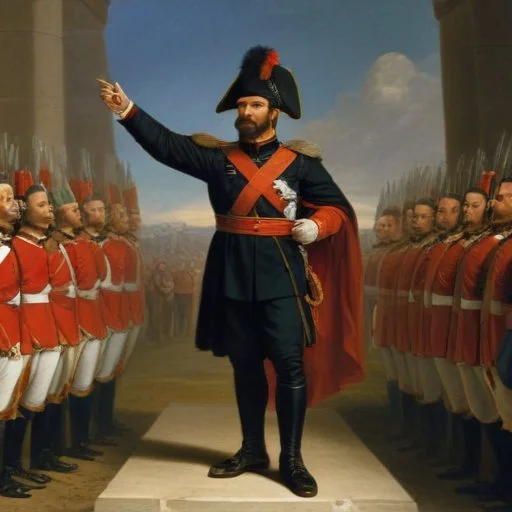
Pre-unification Italy was a fragmented nation, comprising numerous smaller states and kingdoms. The Austrian Empire, Kingdom of Sardinia, and the Papal States were just a few of the many entities vying for power. This lack of unity created an environment ripe for foreign domination and internal strife.
Giuseppe Garibaldi, a seasoned revolutionary and military strategist, emerged as the driving force behind the unification movement. With his passion, charisma, and military prowess, he rallied a thousand volunteers, mostly young men from across Italy, to join his quest for a unified nation.
The unification of Italy had far-reaching consequences, both domestically and internationally. The newly formed Kingdom of Italy, with Victor Emmanuel as its king, became a major player in European politics. The unification also sparked a wave of national pride, as Italians from all walks of life came together to build a modern, unified nation.
The Expedition of the Thousand and the subsequent unification of Italy left an indelible mark on Italian history. Garibaldi's bravery, strategic thinking, and unwavering commitment to the cause inspired generations to come. Today, Italy is a thriving democracy, proud of its rich history and cultural heritage.
"I offer neither pay, nor quarters, nor food; I offer only hunger, thirst, forced marches, battles and death. Let him who loves his country with his heart and not merely with his lips, follow me." - Giuseppe Garibaldi
The unification of Italy serves as a beacon of hope for nations struggling to find their identity. It demonstrates that, even in the face of seemingly insurmountable obstacles, a shared vision and collective effort can lead to profound change. As Garibaldi's Volunteer Army showed, ordinary people can achieve extraordinary things when driven by a common goal.
In the aftermath of the Revolutions of 1848, the European continent was in a state of flux. The Austrian Empire, Kingdom of Sardinia, and the Papal States vied for power, creating a complex web of alliances and rivalries. This geo-political landscape provided the backdrop for Garibaldi's Expedition of the Thousand.
As the unification movement gained momentum, the balance of power in Europe began to shift. The French Empire, under Napoleon III, saw an opportunity to expand its influence in the region and supported the Sardinian Kingdom. Meanwhile, the British Empire, wary of French expansion, backed the Papal States.
This delicate dance of alliances and rivalries created an environment where the unification of Italy became a pawn in the larger game of European politics.
Giuseppe Garibaldi, the charismatic leader of the Expedition of the Thousand, was a man of many contradictions. A fervent republican, he nonetheless supported the monarchist Victor Emmanuel II. A brilliant military strategist, he was also prone to impulsive decisions.
Garibaldi's passion and charisma inspired devotion in his followers, yet he was also known for his brutal treatment of enemies. His unwavering commitment to the cause of Italian unification earned him the respect of his contemporaries, but his ideological flexibility has been criticized by historians.
Despite these contradictions, Garibaldi remains an iconic figure in Italian history, a testament to the power of passion and determination in shaping the course of events.
The unification of Italy under Victor Emmanuel II was as much a product of pragmatic politics as it was a romantic ideal. Garibaldi's military victories created a fait accompli, forcing the Sardinian Kingdom to negotiate a unified government.
The subsequent establishment of the Kingdom of Italy was a masterclass in realpolitik. Victor Emmanuel II, aware of the limitations of his power, skillfully navigated the complex web of alliances and rivalries, securing British and French recognition of the new state.
This pragmatic approach to politics ensured the survival of the newly unified Italy, but also sowed the seeds of future conflict, as the young nation struggled to balance its own interests with those of its powerful neighbors.
The unification of Italy had a profound impact on the country's cultural landscape. The newly formed nation saw a surge in patriotic art, literature, and music, as Italians celebrated their newfound identity.
The opera, in particular, became a powerful symbol of Italian unity, with composers like Giuseppe Verdi and Arrigo Boito creating works that reflected the nation's struggles and triumphs.
Today, the cultural legacy of unification continues to shape Italian identity, with the nation's rich heritage serving as a testament to the power of collective endeavour.
The unification of Italy sent shockwaves throughout the European continent, as the balance of power shifted in response to the newly formed nation.
The British Empire, in particular, was forced to re-evaluate its diplomatic priorities, as the emergence of a unified Italy challenged its dominance in the Mediterranean.
Meanwhile, the American press hailed Garibaldi's victories as a beacon of hope for democratic movements worldwide, cementing the Italian hero's status as an international symbol of liberty and freedom.