


On January 6, 1941, United States President Franklin D. Roosevelt stood before Congress to deliver his eighth State of the Union address, forever etching the phrase "Four Freedoms" into the fabric of American history. In a world teetering on the brink of chaos, Roosevelt boldly proclaimed four essential human rights that would become the cornerstone of American foreign policy: freedom of speech, freedom of worship, freedom from want, and freedom from fear.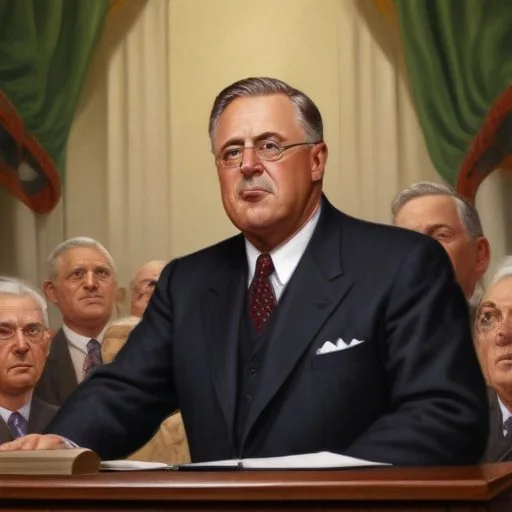
As the dark clouds of World War II gathered, Roosevelt knew that the American people needed a beacon of hope, a reminder of the values that made their nation great. The Great Depression had left deep scars, and the ongoing war in Europe had already claimed countless lives. In this precarious moment, the President's words would serve as a rallying cry, inspiring a nation to fight for democracy and paving the way for the United States' entry into World War II.
Roosevelt's speech resonated deeply with the American people, inspiring a sense of national purpose and unity. The Four Freedoms became a cultural touchstone, symbolizing the nation's commitment to democracy, freedom, and human rights. The speech also galvanized the American art community, with Norman Rockwell's paintings serving as a powerful visual representation of Roosevelt's vision.
"In the future days, which we seek to make secure, we look forward to a world founded upon four essential human freedoms."
"The first is freedom of speech and expression—everywhere in the world. The second is freedom of every person to worship God in his own way—everywhere in the world. The third is freedom from want—which, translated into universal terms, means economic understandings which will secure to every nation a healthy peacetime life for its inhabitants—everywhere in the world. The fourth is freedom from fear—which, translated into world terms, means a world-wide reduction of armaments to such a point and in such a thorough fashion that no nation will be in a position to commit an act of physical aggression against any neighbor—anywhere in the world."
The Four Freedoms speech had far-reaching implications, shaping American foreign policy, inspiring a nation, and paving the way for the United States' entry into World War II. The speech also influenced the creation of the United Nations, with the Four Freedoms serving as a foundation for the Universal Declaration of Human Rights.
Roosevelt's words continue to inspire generations, serving as a beacon of hope in the face of adversity and a powerful reminder of the importance of democracy, freedom, and human rights.
The concept of the Four Freedoms was not born overnight. It was the culmination of Roosevelt's decades-long commitment to human rights and democracy. In the 1930s, he had been instrumental in shaping the Good Neighbor Policy, which emphasized cooperation and mutual respect among nations in the Americas. This policy laid the groundwork for the Four Freedoms, which would later become a cornerstone of American foreign policy.
Roosevelt's speech was also influenced by the Atlantic Charter, a joint statement issued by Roosevelt and British Prime Minister Winston Churchill in August 1941. The charter outlined the Allied goals for the post-war world, including self-government, economic cooperation, and the protection of minority groups. The Four Freedoms built upon these principles, providing a more detailed and aspirational vision for a better world.

While Franklin D. Roosevelt is often credited with the Four Freedoms speech, his wife Eleanor played a crucial role in shaping its content. As a vocal advocate for human rights, Eleanor had been a driving force behind the creation of the Universal Declaration of Human Rights, adopted by the United Nations in 1948.
Eleanor's influence on the Four Freedoms speech is evident in its emphasis on human dignity, equality, and freedom. Her commitment to social justice and human rights resonated deeply with her husband, inspiring him to incorporate these ideals into his address.
Norman Rockwell's "Four Freedoms" paintings, inspired by Roosevelt's speech, have become an integral part of American cultural heritage. The series of four paintings, depicting everyday Americans exercising their freedoms, was first published in The Saturday Evening Post in 1943.
The paintings not only popularized the concept of the Four Freedoms but also helped to galvanize public support for the war effort. They have since been reproduced and exhibited countless times, serving as a powerful symbol of American values and ideals.

The Four Freedoms speech marked a significant turning point in American foreign policy, laying the groundwork for the country's post-war leadership in international affairs. The speech's emphasis on human rights, self-determination, and collective security paved the way for the creation of the United Nations.
The United Nations Charter, adopted in 1945, incorporated many of the principles outlined in Roosevelt's speech. The organization's commitment to promoting human rights, preventing conflict, and fostering international cooperation continues to reflect the ideals of the Four Freedoms.
In the years leading up to the Four Freedoms speech, the world was gripped by war, totalitarianism, and economic crisis. Europe was torn apart by conflict, while Asia was under threat from Japanese expansionism.
In this tumultuous environment, Roosevelt's speech served as a beacon of hope, offering a vision of a better world where freedom, democracy, and human rights would prevail. The speech helped to galvanize American public opinion, preparing the nation for its eventual entry into World War II.