


The United States Senate Committee on Armed Services and United States Senate Committee on Foreign Relations embarked on a historic inquiry, delving into the highly contentious decision of President Harry Truman to relieve General Douglas MacArthur of his command. This dramatic episode would resonate throughout the nation, sparking intense debate on the limits of executive power and the role of the military in international affairs.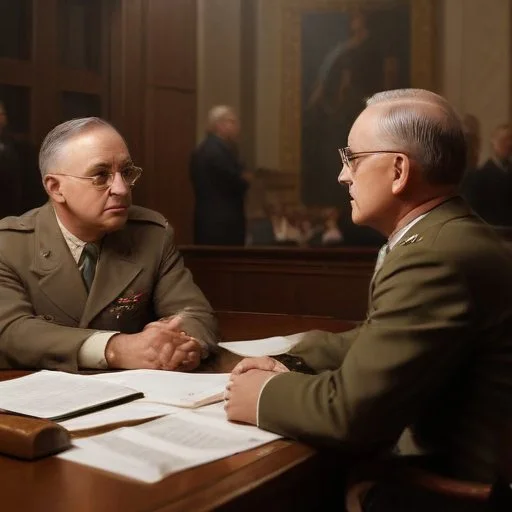
In the midst of the Korean War, General Douglas MacArthur, a decorated war hero and Commander-in-Chief of the United Nations Command, found himself at odds with President Truman over the conduct of the war. MacArthur's increasingly public disagreements with the administration's policies, particularly regarding the possible use of nuclear weapons, led Truman to make the unprecedented decision to relieve him of his duties.
In response to the growing uproar, the Senate Committee on Armed Services and Committee on Foreign Relations launched a series of closed-door hearings to investigate the circumstances surrounding MacArthur's relief. The stakes were high, with many questioning the President's authority to remove a senior military commander without congressional approval.
The Senate hearings ultimately upheld President Truman's decision to relieve MacArthur, acknowledging the President's constitutional authority as Commander-in-Chief. However, the inquiry also sparked a broader national conversation about the limits of executive power, the role of the military in foreign policy, and the importance of civilian oversight.
The MacArthur controversy and subsequent Senate hearings captivated the nation, with newspapers and magazines devoting extensive coverage to the drama. The event also inspired numerous books, films, and plays, cementing its place in American cultural history.
The decision to relieve MacArthur remains controversial to this day, with some viewing it as a necessary assertion of civilian control over the military, while others see it as an unjustified attack on a distinguished military leader. The Senate hearings, meanwhile, were criticized by some for being overly partisan, while others praised them as a necessary exercise in oversight.
"I believe it must be the policy of the United States to prevent the Chinese Government from accomplishing its object in Korea, and to accomplish this objective, it is necessary to destroy the Chinese army in Korea." - General Douglas MacArthur
"If there is one thing that is important in this world, it is the preservation of the civil authority of the government. That is the greatest asset we have." - President Harry Truman
Senator Richard Russell, Chairman of the Senate Committee on Armed Services, would later recall the tense atmosphere surrounding the hearings, noting that "the whole town was stirred up, and the committee was stirred up."
The Senate hearings on MacArthur's relief set an important precedent for future exercises in congressional oversight, solidifying the role of Congress in regulating the executive branch's use of military power.
The MacArthur controversy and subsequent Senate hearings have become a staple of American history and political science curricula, serving as a pivotal case study on the balance of power between the executive and legislative branches.
The backdrop of the Korean War set the stage for the dramatic showdown between President Truman and General MacArthur. As the war raged on, the stakes were high, and the tension between the two leaders continued to escalate. MacArthur's repeated calls for a more aggressive military strategy, including the use of nuclear weapons, put him at odds with the Truman administration, which feared such actions would trigger a wider conflict with China and the Soviet Union.
In this highly charged atmosphere, Truman's decision to relieve MacArthur sent shockwaves around the world. The move was seen by many as a bold assertion of civilian control over the military, while others viewed it as a reckless challenge to the authority of a decorated war hero.
The Senate hearings that followed were a critical moment in this drama, as lawmakers sought to unravel the complex web of events leading up to MacArthur's relief. The testimony of key players, including MacArthur himself, provided a rare glimpse into the inner workings of the military and the executive branch.

General Douglas MacArthur was a larger-than-life figure, renowned for his bravery and military genius. But behind the façade of confidence and authority, MacArthur was also a complex and multifaceted individual, driven by a deep sense of duty and patriotism.
Throughout his distinguished career, MacArthur had established himself as a master strategist, earning numerous accolades and decorations for his heroism in World War I and World War II. However, his unwavering commitment to his principles and his unshakeable confidence in his own judgment sometimes led him to clash with his superiors and other government officials.
Despite his flaws, MacArthur remained a beloved and respected figure in American society, and his relief sparked widespread outrage and controversy.
The showdown between President Truman and General MacArthur has drawn parallels with other notable instances of civil-military tension in American history. One such example is the conflict between President Abraham Lincoln and General George McClellan during the Civil War.
In both cases, the president and the general found themselves at odds over military strategy and the conduct of the war. While MacArthur's relief was a unique event in American history, it highlights the ongoing struggle for power and influence between the executive branch and the military.
This comparison also underscores the importance of maintaining a delicate balance between civilian control and military autonomy, lest the nation repeat the mistakes of the past.

The Senate hearings on MacArthur's relief captivated the nation, dominating the headlines and sparking intense public debate. The controversy also inspired a flurry of creative works, including films, plays, and books, cementing its place in American cultural history.
The media frenzy surrounding the event was unprecedented, with newspapers and magazines devoting extensive coverage to the drama. The public's fascination with the story was palpable, reflecting a deeper interest in the issues of power, accountability, and the role of the military in society.
The Senate hearings on MacArthur's relief marked a significant turning point in the development of American foreign policy. The controversy highlighted the need for greater congressional oversight of the executive branch's use of military power and the importance of maintaining a balance between civilian control and military autonomy.
The hearings also underscored the importance of a well-functioning system of checks and balances, ensuring that the executive branch is held accountable for its actions. In this sense, the MacArthur controversy contributed to a more nuanced understanding of the Constitution and the role of Congress in regulating the executive branch's use of power.