


This historic expedition, which set sail on February 12, 1502, marked a pivotal moment in the Age of Exploration, as Portuguese explorer Vasco da Gama embarked on his second journey to India, determined to solidify Portugal's dominance in the spice trade and expand its territorial reach.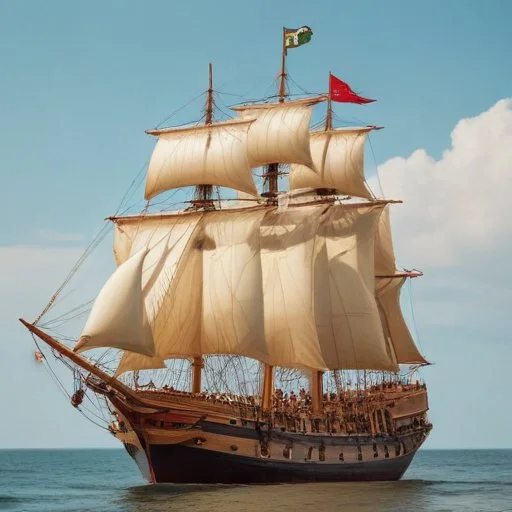
Da Gama's fleet consisted of 15 sturdy ships, each equipped with state-of-the-art navigational tools and a crew of 800 brave and skilled men. This formidable force was tasked with navigating the treacherous waters of the Indian Ocean, braving unpredictable weather conditions, and overcoming the challenges of scurvy and disease.
This second voyage marked a significant departure from da Gama's initial journey to India in 1497-1499. With the knowledge and experience gained from his first expedition, da Gama was better prepared to tackle the complexities of the Indian Ocean and capitalize on the lucrative spice trade.
Da Gama's fleet was also carrying a contingent of merchants, missionaries, and diplomats, who would play a crucial role in establishing trade agreements, spreading Christianity, and forging alliances with local rulers.
As the fleet set sail, the aroma of salted meats, dried fruits, and freshly baked bread wafted through the air, mingling with the sound of creaking wooden hulls and the chatter of excited sailors. The provisioning of the fleet was a monumental task, with thousands of kilograms of supplies, including olive oil, wine, and cheese, stowed away in the holds.
The cuisine on board was simple yet hearty, with staples like salted fish, beans, and biscuits providing sustenance for the long journey ahead. The scent of exotic spices, however, was a constant reminder of the riches that awaited them in India.
The fleet navigated the treacherous waters of the Atlantic, braving storms, mutinies, and disease. The notorious Cape of Good Hope, with its notorious currents and unpredictable weather, proved to be a major obstacle, claiming the lives of many sailors.
On May 30, 1502, after months at sea, the fleet finally reached the Indian port of Calicut, where da Gama was received with a mixture of curiosity and suspicion by the local ruler, the Zamorin.
Da Gama's diplomatic skills were put to the test as he negotiated with the Zamorin, securing a trade agreement that would grant Portugal a monopoly on the spice trade in the region. This historic agreement marked a significant shift in the balance of power, with Portugal emerging as a major player in the global spice trade.
Vasco da Gama's second voyage to India had far-reaching consequences, establishing Portugal as a dominant maritime power and paving the way for further exploration and colonization. The spices and treasures brought back from this journey would go on to shape the course of European cuisine, culture, and history.
In the end, da Gama's bold second voyage to India would cement his place in the annals of history, inspiring generations of explorers, traders, and adventurers to follow in his wake.
"The discovery of the sea route to India is the greatest event since the Creation of the World." - Vasco da Gama
Vasco da Gama's second voyage to India was not just a commercial venture, but also a political statement. The Portuguese crown had been seeking to expand its territories and influence in the Indian Ocean, and da Gama's expedition was a key part of this strategy. The fleet's arrival in Calicut was met with a mixture of curiosity and hostility, as the local ruler, the Zamorin, was wary of Portuguese intentions.
The Zamorin, however, was also keenly aware of the economic benefits of trade with the Portuguese. He had been dealing with Arab and Chinese merchants for centuries, but the Portuguese offered something new: a direct sea route to Europe, which promised to bypass the expensive and time-consuming overland Silk Road.
The negotiations between da Gama and the Zamorin were tense and delicate, with both sides seeking to gain the upper hand. The Portuguese were determined to secure a monopoly on the spice trade, while the Zamorin was keen to protect his kingdom's independence and interests.
Vasco da Gama's second-in-command, Pedro Álvares Cabral, was a seasoned explorer and navigator in his own right. Cabral had accompanied da Gama on his first voyage to India and had played a crucial role in the expedition's success.
Cabral was a member of the Portuguese nobility and had been knighted by King Manuel I for his services to the crown. He was known for his bravery, tactical genius, and diplomatic skills, which made him an invaluable asset to da Gama's expedition.
Despite his importance to the expedition, Cabral's role has often been overshadowed by da Gama's. However, it is clear that Cabral played a crucial role in the success of the second voyage, and his contributions deserve to be recognized.
The spices and treasures brought back by da Gama's fleet had a profound impact on European cuisine and culture. The introduction of new spices like cinnamon, pepper, and cloves revolutionized European cooking, and the wealthy elites of Europe clamored for these exotic flavors.
The influx of new spices also had a profound impact on European art and architecture. The ornate and intricate designs of Indian and Arab traders influenced the development of Renaissance art, and the wealth generated by the spice trade financed some of the most iconic buildings of the time.
In addition, the cultural exchange facilitated by da Gama's voyage helped to break down the boundaries between East and West. European scholars and intellectuals were fascinated by the learning and wisdom of Indian and Arab scholars, and the exchange of ideas helped to lay the foundations for the Enlightenment.
The economic impact of da Gama's second voyage was significant, with the Portuguese crown reaping a huge windfall from the spice trade. The monopoly on the spice trade granted to the Portuguese by the Zamorin gave them a stranglehold on the global spice market, and the wealth generated by this trade helped to finance Portuguese colonization and exploration.
The influx of new wealth also had a profound impact on the Portuguese economy, with the countrys' trade balance shifting decisively in favor of exports. The growth of the Portuguese economy also had a knock-on effect on the European economy as a whole, with the Portuguese becoming major players in international trade.
In addition, the establishment of a direct sea route to India helped to reduce the cost and duration of trade with Asia, making it cheaper and faster for European merchants to access the riches of the East.
Da Gama's second voyage took place against the backdrop of a rapidly shifting global landscape. The Ottoman Empire was expanding its territories in the Middle East and North Africa, while the Ming dynasty was dominant in China.
In Europe, the Portuguese were locked in a struggle for power with the Spanish, who were seeking to expand their own territories in the New World. The Pope had divided the New World between the two powers, but the Portuguese were determined to assert their claims in the Indian Ocean.
In this context, da Gama's voyage was a masterstroke of geopolitics, securing a vital advantage for the Portuguese in the struggle for dominance in the Indian Ocean.