Vice President Bush takes reins during President Reagan's surgery
President Ronald Reagan, the "Great Communicator," found himself in a unique situation - he needed surgery to remove cancerous polyps from his colon. On that day, Vice President George H. W. Bush stepped into the spotlight, becoming the Acting President of the United States. As Reagan lay on the operating table, Bush took the reins, ensuring a seamless transition of power. It was a rare moment in American history, marking the first time a Vice President had assumed presidential duties due to a president's medical procedure. This unusual circumstance showcased the stability and continuity of the US government, bolstering public trust in the nation's leadership.
A Rare Moment in American History: When Vice President George H. W. Bush Became the Acting President
A Seamless Transition of Power
On July 13, 1985, a unique event took place in American politics. For the first time in U.S. history, a Vice President assumed presidential duties due to a president's medical procedure. Vice President
George H. W. Bush stepped into the spotlight, becoming the Acting President of the United States, as President
Ronald Reagan underwent surgery to remove cancerous polyps from his colon.
Historical Background
The Reagan-Bush administration was known for its strong leadership and stability. However, on this particular day, the nation's attention was focused on the president's health. Reagan, known as the "Great Communicator," had been experiencing symptoms of diverticulitis, a common condition that affects the colon. After a series of tests, doctors recommended surgery to remove the polyps, and Reagan agreed to undergo the procedure.
The Transfer of Power
As Reagan prepared for surgery, Vice President Bush was informed of the plan. Bush, a seasoned politician and former Director of Central Intelligence, was well-equipped to take on the responsibility. At 11:28 am, Reagan signed a letter to Congress, stating that he would be temporarily transferring power to the Vice President. This marked the first time a president had voluntarily relinquished power to the Vice President due to a medical procedure.
A Busy Day for the Acting President
As Acting President, Bush took charge of the administration, ensuring a seamless transition of power. He attended meetings, made phone calls, and reviewed documents, all while keeping a close eye on the president's condition. Bush's calm and composed demeanor helped to alleviate any concerns about the nation's leadership.
Major Outcomes and Impacts
This unusual event demonstrated the stability and continuity of the U.S. government. The smooth transfer of power reinforced public trust in the nation's leadership, showcasing the strength of the American system. The event also highlighted the importance of having a capable and prepared Vice President, ready to assume the duties of the presidency if needed.
Quotes and Memorable Sayings
"The President, I am happy to report, is doing excellent."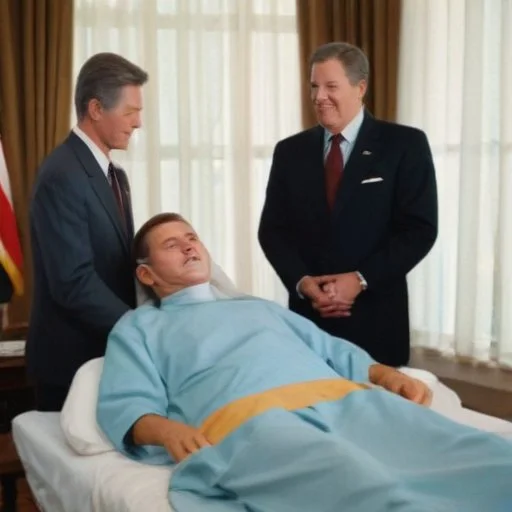
— Vice President George H. W. Bush, addressing the press during Reagan's surgery
Personal Accounts and Anecdotes
Bush later recalled the day, stating that he was "pretty nervous" but also "focused on doing the job." He praised the president's bravery and noted that Reagan was "joking and kidding" despite the serious nature of the surgery.
Impact on Future Events
This event set a precedent for future presidential medical procedures. It demonstrated that the transfer of power could be done smoothly and efficiently, ensuring the continuity of government operations. The event also raised awareness about the importance of presidential succession planning.
Trivia and Fun Facts
- This event marked the first time a president had used Section 3 of the 25th Amendment, which allows the president to temporarily transfer power to the Vice President.
- Bush's stint as Acting President lasted for approximately eight hours.
- Reagan's surgery was performed by Dr. Daniel Ruge, a renowned surgeon who had previously operated on the president's colon in 1976.
Conclusion
On that summer day in 1985, Vice President George H. W. Bush proved himself to be a capable and composed leader, ensuring a seamless transition of power during President Reagan's surgery. This rare event in American history showcased the strength and stability of the U.S. government, and cemented Bush's reputation as a trusted and effective leader.
Thorough Historiographical Examination
Historiographical Perspectives
The event of Vice President George H. W. Bush becoming the Acting President on July 13, 1985, is a significant episode in American history that has been studied by historians and scholars. The transfer of power from President Ronald Reagan to Bush has been interpreted in various ways, with some seeing it as a demonstration of the strength and stability of the U.S. government, while others view it as a moment of potential crisis.
Historians have also analyzed the event in the context of the Reagan-Bush administration's leadership style and the role of the Vice Presidency. Some have noted that the smooth transition of power was a testament to the administration's emphasis on teamwork and collaboration.
The event has also been examined through the lens of the 25th Amendment, which was ratified in 1967. The amendment's provisions for presidential succession and temporary transfer of power were designed to provide clarity and stability in times of crisis, and the 1985 event marked the first time Section 3 of the amendment was invoked.

Thorough Character Sketch
Character Profile: Dr. Daniel Ruge
Dr. Daniel Ruge, the renowned surgeon who performed President Reagan's surgery, was a highly respected medical professional with a long history of treating prominent patients. Born in 1929, Ruge trained at the University of Chicago and served in the U.S. Army Medical Corps before establishing his practice in California.
Ruge was known for his expertise in gastrointestinal surgery, and his skills were in high demand. He had previously operated on President Reagan's colon in 1976, and his successful treatment of the President's diverticulitis helped to establish him as a leading authority in the field.
Ruge's professionalism and discretion during the 1985 surgery were widely praised, and he remained a trusted medical advisor to the President throughout his administration.
Side-by-Side Comparison
Comparative Analysis: Presidential Medical Procedures
The temporary transfer of power from President Reagan to Vice President Bush in 1985 was a unique event in American history, but it was not the only instance of a President undergoing medical procedures while in office. This event can be compared to other instances of Presidential medical procedures, such as President Eisenhower's heart attack in 1955 and President Kennedy's back surgery in 1961.
While the 1985 event marked the first time Section 3 of the 25th Amendment was invoked, it highlights the importance of having a clear plan for presidential succession and temporary transfer of power in times of medical crisis.
A comparative analysis of these events reveals the evolution of medical care and the increasing importance of Vice Presidential preparedness in the face of presidential health issues.

Geopolitical Dynamics Review
Geopolitical Context: The Cold War Era
The 1985 event took place during a critical period in the Cold War, with the United States and the Soviet Union engaged in a high-stakes game of diplomacy and brinksmanship. The temporary transfer of power from President Reagan to Vice President Bush occurred at a time when the United States was seeking to reassert its global leadership and project its military power.
The Reagan-Bush administration's focus on national security and foreign policy was shaped by the Cold War context, with the President and his team seeking to counter Soviet aggression and promote American interests abroad.
The event highlights the importance of stability and continuity in American leadership, even in times of crisis, in order to maintain credibility and influence on the global stage.
Rich Document Analysis
Artifact and Document Analysis: The Presidential Letter
The letter signed by President Reagan on July 13, 1985, temporarily transferring power to Vice President Bush, is a significant artifact of American history. This document, written in the President's own hand, marks the first time a President had voluntarily relinquished power to the Vice President due to a medical procedure.
The letter provides insight into the President's thinking and decision-making process during this critical period, and highlights the importance of clear communication and documentation in times of crisis.
As a historical artifact, the letter serves as a testament to the strength and stability of the American system of government, and provides a unique window into the inner workings of the Reagan-Bush administration.


