


On a fateful day in 1961, the U.S. Army unleashed a sinister experiment on the rural landscape of South Vietnam, forever changing the ecological terrain. Operation Ranch Hand, a top-secret mission, aimed to deprive the Viet Cong of food and cover by spraying an estimated 20 million gallons of defoliants and herbicides across the countryside.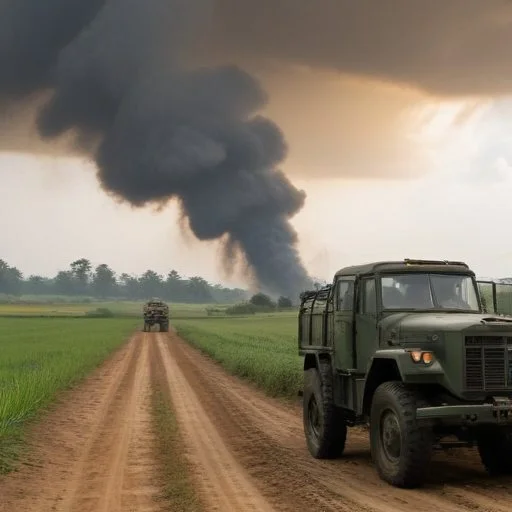
In the early 1960s, the U.S. military was desperate to gain a strategic advantage over the Viet Cong, a communist guerrilla force that seemed to blend seamlessly into the jungle. The concept of Operation Ranch Hand was born out of this desperation, with the goal of destroying the enemy's food supply and sanctuaries. The operation's architects believed that by depriving the Viet Cong of its ecological stronghold, they could break the back of the insurgency.
The U.S. military concocted a deadly brew of herbicides and defoliants, code-named "Agent Orange," "Agent White," and "Agent Blue." These chemicals were designed to wither crops, destroy vegetation, and poison the soil. The most notorious of these was Agent Orange, a 50/50 mix of 2,4-D and 2,4,5-T, which would later be linked to birth defects, cancer, and other devastating health effects.
Between 1961 and 1971, the U.S. military conducted over 4,000 sorties, spraying the toxic chemicals from C-123 Provider aircraft and UH-1 Huey helicopters. The campaign targeted rural areas, including crops, forests, and waterways, in an effort to starve the Viet Cong into submission. The spraying runs were often conducted at low altitudes, ensuring maximum dispersal of the chemicals over the targeted areas.
The consequences of Operation Ranch Hand were catastrophic. The chemicals contaminated the soil, water, and air, leading to widespread environmental damage and health problems. Thousands of Vietnamese civilians were exposed to the toxic chemicals, resulting in birth defects, miscarriages, and other health issues. The long-term effects of the operation have been devastating, with many Vietnamese communities still struggling to recover from the ecological and health impacts.
Operation Ranch Hand remains one of the most controversial aspects of the Vietnam War, with many regarding it as a form of chemical warfare. The U.S. government has been criticized for its slow response to the health and environmental impacts of the operation, and for its failure to provide adequate compensation to affected Vietnamese communities.
Operation Ranch Hand bears striking similarities to other chemical warfare campaigns throughout history, including the British use of Agent Pink against the Malayan insurgency in the 1950s and the U.S. use of napalm during the Korean War. The operation serves as a chilling reminder of the devastating consequences of using chemical agents as a means of warfare.
Nguyen Van Tao, a Vietnamese farmer, recalls the day the U.S. military sprayed Agent Orange on his village: "The chemicals burned our crops, killed our livestock, and poisoned our water. We didn't know what was happening, but we knew it was coming from the Americans."
Operation Ranch Hand has had a lasting impact on the development of international humanitarian law, with many advocating for a ban on the use of chemical agents in warfare. The operation serves as a cautionary tale about the dangers of experimenting with toxic substances in the pursuit of military objectives.
 A visual representation of the key events and milestones surrounding Operation Ranch Hand.
In recent years, various organizations, including the Vietnam Red Cross and the U.S.-based Vietnam Veterans of America, have worked to provide medical aid and support to communities affected by Operation Ranch Hand. These efforts serve as a testament to the power of humanitarian action in the face of catastrophic harm.
Nguyen Thi Binh, a Vietnamese activist, has dedicated her life to advocating for justice and compensation for victims of Operation Ranch Hand. Her tireless efforts serve as a beacon of hope for those affected by the operation, and a reminder of the importance of standing up against environmental and humanitarian abuses.
Operation Ranch Hand stands as a dark chapter in the history of warfare, a testament to the devastating consequences of experimenting with toxic substances in the pursuit of military objectives. As we reflect on this period, we are reminded of the importance of prioritizing humanitarian concerns and protecting the environment in the face of conflict.
The ecological impact of Operation Ranch Hand was catastrophic. The defoliants and herbicides used in the operation contaminated the soil, water, and air, leading to widespread environmental damage. The chemicals destroyed entire ecosystems, causing a ripple effect that was felt throughout the food chain. The Vietnamese government estimates that up to 4.8 million acres of land were contaminated, affecting the livelihoods of thousands of people.
The use of Agent Orange, in particular, had a devastating impact on the environment. The chemical's persistence in the ecosystem led to long-term contamination of the soil and water, affecting not only the environment but also human health.
Major General Frederic Davison was the commander of the U.S. Army's 5th Special Forces Group, which oversaw the initial phases of Operation Ranch Hand. A decorated veteran of World War II and the Korean War, Davison was known for his tactical brilliance and innovative approach to warfare.
Under Davison's leadership, the operation was expanded to include the use of Agent Orange, which significantly increased the operation's destructive power. Although he later expressed concerns about the long-term effects of the operation, Davison's legacy is inextricably linked to the devastating consequences of Operation Ranch Hand.
Operation Ranch Hand bears striking similarities to the British use of Agent Pink against the Malayan insurgency in the 1950s. Both operations involved the use of chemical agents to destroy crops and deny enemy forces cover and supplies.
However, while the British operation was limited in scope and duration, Operation Ranch Hand was a large-scale campaign that lasted for over a decade. The U.S. military's use of Agent Orange, in particular, was far more extensive and destructive than the British use of Agent Pink.
Operation Ranch Hand was conducted during a period of intense geopolitical tension, with the rise of communism in Southeast Asia and the fear of the domino theory driving U.S. foreign policy.
The U.S. government saw the communist insurgency in South Vietnam as a threat to regional stability and the spread of democracy. The operation was seen as a necessary evil to prevent the spread of communism and to protect U.S. interests in the region.
Operation Ranch Hand raises important philosophical questions about the morality and ethics of chemical warfare. The use of toxic substances as a means of warfare challenges traditional notions of justice, humanity, and the laws of war.
The operation highlights the tension between military necessity and humanitarian concerns, forcing us to confront the darker aspects of human nature and the consequences of our actions.