


In the sweltering summer of 1964, the United States made its first bold move in the Vietnam War, launching a series of airstrikes against North Vietnamese targets in retaliation for the alleged attacks on U.S. destroyers in the Gulf of Tonkin. Dubbed Operation Pierce Arrow, this pivotal event marked the beginning of a long and bloody conflict that would shake the nation and the world.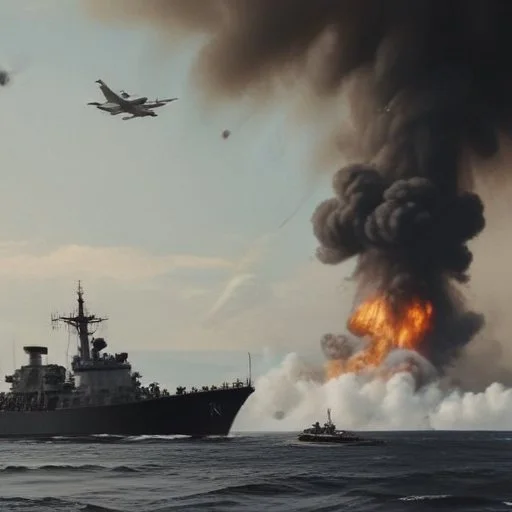
Led by aircraft from the USS Ticonderoga and USS Constellation, the operation saw fighter jets and Skyhawk attack planes rain down bombs on North Vietnamese naval facilities, fuel storage sites, and other strategic installations. The intense bombing campaign was a deliberate show of force, meant to send a strong message to the North Vietnamese government and to protect American interests in the region.
In the days leading up to the operation, tensions in the Gulf of Tonkin had been escalating. The USS Maddox, a U.S. Navy destroyer, had been conducting electronic surveillance in the area, prompting North Vietnamese naval forces to respond aggressively. On August 2, 1964, the Maddox reportedly came under attack by North Vietnamese torpedo boats, an incident that would become known as the Gulf of Tonkin Incident. Two days later, another reported attack led President Lyndon B. Johnson to approve Operation Pierce Arrow, marking the first direct involvement of the United States in the Vietnam War.
| Date | Event |
|---|---|
| August 2, 1964 | The USS Maddox reportedly comes under attack by North Vietnamese torpedo boats. |
| August 4, 1964 | A second reported attack on the Maddox leads President Johnson to approve Operation Pierce Arrow. |
| August 5, 1964 | American aircraft from the USS Ticonderoga and USS Constellation launch airstrikes against North Vietnamese targets. |
Operation Pierce Arrow marked a significant escalation of U.S. involvement in the Vietnam War, paving the way for a prolonged and bloody conflict. The operation also underscored the Johnson administration's commitment to preventing the spread of communism in Southeast Asia, a central pillar of the Cold War strategy.
The Gulf of Tonkin Incident and Operation Pierce Arrow had far-reaching cultural and social implications, contributing to a growing anti-war movement in the United States and sparking widespread protests and opposition to the Vietnam War.
For many Americans, Operation Pierce Arrow represented a call to duty, a demonstration of American strength and resolve in the face of communist aggression. For others, it marked a turning point in the nation's involvement in the Vietnam War, a conflict that would come to define a generation.
Operation Pierce Arrow was more than just a military operation – it was a powerful symbol of American determination and a harbinger of the tumultuous years to come.
The Gulf of Tonkin Incident and Operation Pierce Arrow have been subject to historical scrutiny, with some scholars questioning the accuracy of the reported attacks on the USS Maddox. This controversy has sparked debates about the nature of truth in historical narratives and the role of government in shaping public opinion.
Historians have also explored the parallels between Operation Pierce Arrow and previous military interventions, such as the Spanish-American War, highlighting the cyclical nature of American foreign policy.
Moreover, the Johnson administration's handling of the crisis has been critiqued for its impact on the domestic political landscape, with some arguing that it set a precedent for executive overreach and militarism.
Admiral U.S. Grant Sharp Jr.'s leadership during Operation Pierce Arrow was marked by a keen strategic sense and a commitment to protecting American interests. A seasoned naval officer, Sharp had previously served in World War II and the Korean War, earning a reputation as a shrewd tactician.
Sharp's command style was characterized by a strong emphasis on coordination and communication, ensuring that all units involved in the operation were working in tandem. This approach paid dividends, as the airstrikes were carried out with precision and effectiveness.
The cultural reverberations of Operation Pierce Arrow were felt across the United States, as the conflict sparked a wave of anti-war protests and activism. The event became a rallying cry for the counterculture movement, with many young Americans rejecting the government's narrative and embracing a more pacifist ideology.
The incident also influenced popular culture, with musicians like Bob Dylan and Joan Baez incorporating anti-war themes into their music.
The geopolitical context of Operation Pierce Arrow was marked by a complex web of alliances and rivalries. The United States was part of a collective defense treaty with South Vietnam, known as the Southeast Asia Treaty Organization (SEATO), which committed member states to mutual defense in the event of an attack.
The Soviet Union, meanwhile, was supporting North Vietnam through a network of arms supplies and diplomatic backing. This polarization of the international community set the stage for a prolonged and bloody conflict.
The philosophical and ideological underpinnings of Operation Pierce Arrow were rooted in the Cold War ideology of containment and the Domino Theory. The Johnson administration believed that if South Vietnam fell to communism, a chain reaction of communist takeovers would sweep across Southeast Asia, threatening American interests and stability in the region.
This worldview was shaped by a deep-seated fear of communist expansion and a commitment to promoting democracy and capitalism. The operation was seen as a necessary measure to prevent the spread of communism and maintain American credibility in the global arena.