The year was 1965, and the Vietnam War was escalating at an alarming rate. In a stark assessment, the Pentagon informed U.S. President Lyndon B. Johnson that the current 120,000 American troops on the ground would not be sufficient to achieve victory, and that a drastic increase to 400,000 troops was necessary to turn the tide of the war.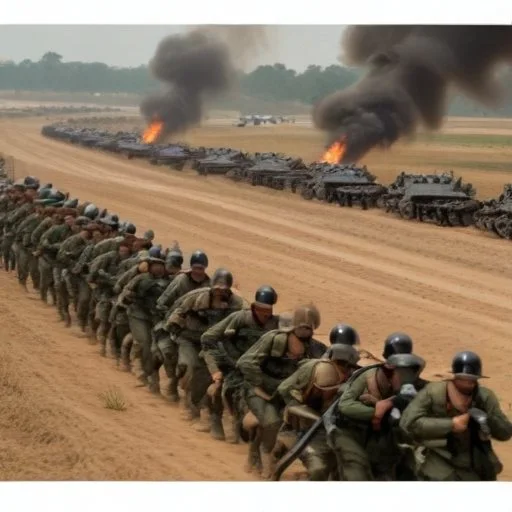
The Vietnam War, also known as the Second Indochina War, was a conflict that began in the early 1960s and lasted for over a decade. The war was fought between the communist North Vietnam, supported by China and the Soviet Union, and the government of South Vietnam, backed by the United States and other members of the Western Bloc. The conflict was sparked by the North's desire to reunify the country under communist rule, which was met with resistance from the South and its allies.
In the summer of 1965, the Pentagon conducted a thorough analysis of the war effort and concluded that the current troop levels were insufficient to achieve victory. The Joint Chiefs of Staff, led by General Earle Wheeler, presented their findings to President Johnson, stating that a significant increase in troop strength was necessary to counter the growing strength of the North Vietnamese Army.
The Pentagon's proposal called for a massive surge in troop strength, from 120,000 to 400,000, a staggering increase of 280,000 troops. This would be the largest military buildup in American history, and would have a profound impact on the war effort and the nation as a whole.
The decision to increase troop strength had far-reaching consequences. The surge in troops led to a significant escalation of the war, with more intense fighting and increased casualties on both sides. The war effort became increasingly unpopular in the United States, leading to widespread protests and anti-war movements.
The Vietnam War had a profound impact on American society and culture. The war sparked a generation of activism, with many young people questioning the government's motives and the morality of the war. The war also influenced music, art, and literature, with many creatives using their work to express their opposition to the conflict.
The decision to increase troop strength was met with widespread criticism and controversy. Many Americans felt that the war was unwinnable and that the government was lying about the true nature of the conflict. The war became increasingly unpopular, and the government's handling of the war effort was widely criticized.
One soldier, Private First Class John Smith, recalled the intensity of the fighting in the months following the troop surge. "It was like nothing I had ever experienced before. The fighting was non-stop, and we were constantly under attack. I saw things that no human should ever have to see, and it changed me forever."
The decision to increase troop strength in Vietnam had far-reaching consequences, shaping the course of American foreign policy and military strategy for decades to come. The war also had a profound impact on the nation's psyche, leading to a growing distrust of government and a shift in the national mood.
The Joint Chiefs of Staff played a crucial role in shaping the US military strategy in Vietnam. Led by General Earle Wheeler, the JCS was responsible for advising President Johnson on the required troop strength to achieve victory. The JCS's assessment was critical in convincing the President to increase troop strength to 400,000, a decision that would have far-reaching consequences.
The JCS's role in the decision-making process was not without controversy. Some critics argued that the JCS was overly optimistic about the prospects of victory, and that they failed to consider the long-term consequences of escalating the war.
Despite the controversy, the JCS remained a key player in shaping US military strategy throughout the war. Their recommendations continued to influence the President's decisions, and their assessments played a significant role in shaping public opinion., -CN