


Voyager 2, a trailblazing spacecraft, etched its name in the annals of space exploration history on August 20, 1977, when it embarked on an interstellar journey to explore the outer Solar System and beyond. This iconic spacecraft is renowned for being the only human-made object to have visited all four gas giant planets – Jupiter, Saturn, Uranus, and Neptune – and for carrying a golden record containing sounds of Earth, effectively serving as a cosmic ambassador of humanity.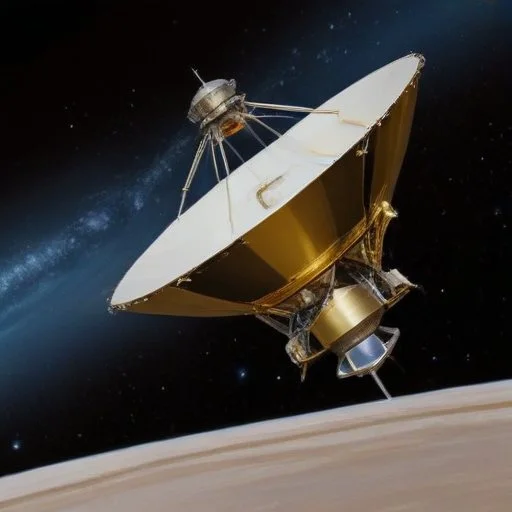
The Voyager 2 spacecraft was launched from Cape Canaveral, Florida, aboard a Titan IIIE rocket, with a primary mission to study the outer planets and their moons. The spacecraft was designed to take advantage of a rare alignment of the outer planets, which occurs once every 175 years, allowing it to fly by multiple planets in a single journey.
One of the most fascinating aspects of Voyager 2 is the golden record it carries, which contains sounds and images of Earth. This 12-inch gold-plated copper record is a time capsule of human existence, featuring natural sounds like rain and thunder, human voices in 55 languages, and an eclectic mix of music from different cultures. The record is a poignant message to any extraterrestrial life form that might encounter the spacecraft, offering a glimpse into human life and culture.
Voyager 2 is equipped with a suite of instruments designed to study the outer planets and their environments. These instruments include:
Voyager 2 has made numerous groundbreaking discoveries during its journey, including:
After completing its primary mission, Voyager 2 entered the interstellar medium, the region of space outside our solar system. It is now the most distant human-made object in space, with a distance of over 12 billion miles from Earth. As it journeys into the unknown, Voyager 2 continues to send back valuable data, providing insights into the cosmos and inspiring future generations of space explorers.
"The Voyager mission has given us a new perspective on the universe, and it has inspired us to continue exploring." – Edward C. Stone, Voyager Project Scientist
Voyager 2's journey has contributed significantly to our understanding of the outer Solar System. One of the most notable discoveries was the detection of Jupiter's ring system, which was previously unknown. The spacecraft's instruments also revealed the presence of active volcanoes on Io, Jupiter's moon, and provided valuable insights into the planet's magnetic field.
In addition, Voyager 2's flyby of Uranus and Neptune led to the discovery of their magnetic fields, which were previously unknown. The spacecraft's instruments also detected the solar wind, a stream of charged particles emanating from the Sun.

Edward C. Stone, the Voyager Project Scientist, played a crucial role in the development and success of the Voyager 2 mission. Stone's vision and leadership enabled the spacecraft to achieve its primary mission objectives and continue to send back valuable data even after completing its primary mission.
Stone's contributions to the Voyager 2 mission were recognized with numerous awards, including the National Medal of Science. His dedication to space exploration has inspired generations of scientists and engineers.
Voyager 2's success was dependent on several technological innovations, including the development of advanced power sources, communication systems, and propulsion systems. The spacecraft's radioisotope thermoelectric generators (RTGs) provided a reliable source of power, while its high-gain antenna enabled communication with Earth.
The spacecraft's propulsion system, which used a combination of gravity assists and trajectory correction maneuvers, allowed it to achieve its primary mission objectives and continue its journey into interstellar space.

Voyager 2's golden record, containing sounds and images of Earth, has become a cultural icon of humanity's existence. The record's eclectic mix of music, human voices, and natural sounds has sparked curiosity and inspiration in people around the world.
The golden record has also become a symbol of humanity's desire to reach out to the universe and make contact with other intelligent life forms. It has inspired numerous artistic and musical works, and continues to be a source of fascination and wonder.
The golden record, containing sounds and images of Earth, is more than just a message to extraterrestrial life forms. It is a window into human existence, revealing our hopes, fears, and aspirations.
A closer analysis of the record's contents reveals the diversity and complexity of human culture, from the sounds of rain and thunder to the music of different cultures. The record is a poignant reminder of our shared human experience and our place in the universe.