


The Battle of New Orleans, fought on January 8, 1815, is etched in the annals of American history as a triumph of the underdog spirit, where a ragtag army of militiamen, pirates, and Native Americans led by the indefatigable Andrew Jackson defeated the mighty British Empire, securing a crushing victory for the United States in the War of 1812.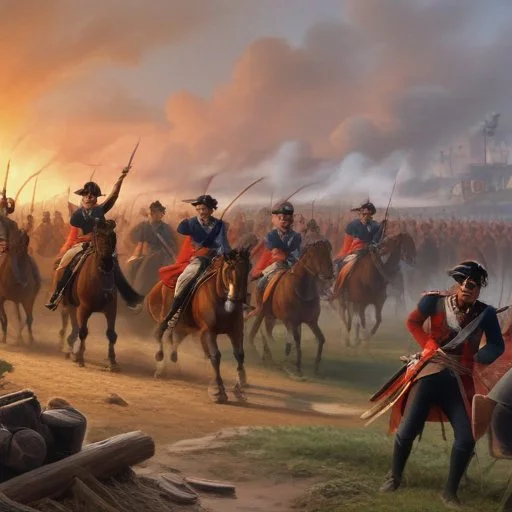
The War of 1812, sparked by British impressment of American sailors, trade restrictions, and British support of Native American resistance against American expansion, found America pitted against the British Empire. As the war raged on, the British turned their attention to the strategic port city of New Orleans, a vital locus of trade and commerce.
Enter Andrew Jackson, a charismatic and fearless leader, who, despite being outnumbered and outgunned, would rally his troops to victory. A seasoned military commander and statesman, Jackson had fought against the British in the Creek War and had earned the respect and admiration of his men. Under his leadership, the American forces prepared to face the British behemoth.
On that fateful winter morning, the British forces, numbering over 8,000 troops, advanced upon the American lines, only to be met with a withering hail of artillery and rifle fire. The American forces, comprising some 4,000 militiamen, pirates, and Native Americans, had constructed a series of earthworks and breastworks to defend their position. As the British troops surged forward, they were cut down by a merciless barrage of cannonballs and bullets.
The British suffered a staggering 2,000 casualties, including high-ranking officers, while the American forces emerged victorious with minimal losses. The devastating defeat would be the war's final battle, and it marked a resounding triumph for the United States, securing her independence and cementing Andrew Jackson's place in history as a national hero.
The Battle of New Orleans has left an indelible mark on American culture, inspiring countless songs, stories, and artworks. The battle's folklore has also contributed to the city's vibrant cultural heritage, with its jazz and blues music, rich Creole cuisine, and Mardi Gras celebrations.
Andrew Jackson's own account of the battle, as recorded in his memoirs, paints a vivid picture of the fierce fighting and the unwavering resolve of his troops. "The carnage was dreadful," he wrote, "but our men stood firm, and the enemy were repulsed with great slaughter."
The Battle of New Orleans cemented Andrew Jackson's reputation as a brilliant military strategist and a symbol of American grit and determination. His victory paved the way for his subsequent presidential campaign, and he went on to become the seventh President of the United States, serving two terms from 1829 to 1837.
In recognition of his bravery and leadership during the Battle of New Orleans, Andrew Jackson was awarded the Congressional Gold Medal in 1815. The battle is also commemorated by the Chalmette National Cemetery, the final resting place of over 15,000 American veterans, including those who fought and died in the Battle of New Orleans.
Did you know that the Battle of New Orleans was fought after the Treaty of Ghent had been signed, but before the news had reached America? This anomaly has led to its being referred to as the "unnecessary battle."
Did you know that the pirate Jean Lafitte and his crew played a significant role in the battle, providing critical support to the American forces?
The Battle of New Orleans serves as a testament to the power of courage, determination, and resilience. Andrew Jackson's unwavering leadership and the bravery of his troops inspire us to stand strong in the face of adversity, to fight for what we believe in, and to never give up.
The Battle of New Orleans, a shining moment in American history, reminds us of the nation's capacity for courage, ingenuity, and perseverance. As we reflect on this pivotal event, we are reminded of the enduring spirit of the American people and the importance of preserving our national heritage.
The Battle of New Orleans had a profound impact on the cultural landscape of the city. The victory galvanized the city's residents, fostering a sense of pride and identity that continues to shape its cultural heritage. The city's jazz and blues music, rich Creole cuisine, and vibrant Mardi Gras celebrations all owe a debt to the battle, which infused the city with a spirit of resilience and joie de vivre.
The battle also inspired a rich tradition of folklore and storytelling. The heroism of Andrew Jackson and his troops has been immortalized in song, story, and art, passing down through generations as a testament to the city's unyielding spirit.

Andrew Jackson's leadership during the Battle of New Orleans was a defining moment in his military career. His bravery, tactical genius, and charismatic leadership inspired his troops to fight against overwhelming odds, cementing his reputation as a brilliant military strategist.
Jackson's personal qualities – his fearlessness, integrity, and unwavering commitment to his troops – earned him the respect and admiration of his men. His leadership style, which emphasized discipline, adaptability, and initiative, proved instrumental in securing the American victory.
The British invasion of Louisiana was not an isolated event, but part of a larger strategy to cripple the American economy. By seizing control of the Mississippi River and the port of New Orleans, the British hoped to strangle American trade and commerce, forcing the fledgling nation to negotiate a peace treaty on British terms.
The American victory, however, thwarted British plans, securing American access to the Gulf of Mexico and the lucrative trade routes of the Mississippi River. The battle ensured the continued growth and development of the American economy, paving the way for westward expansion and the rise of the United States as a global power.

The Battle of New Orleans had a significant impact on the American economy, both in the short and long term. The victory ensured American control over the strategic port of New Orleans, guaranteeing access to the Mississippi River and the lucrative trade routes of the Gulf of Mexico.
The battle also buoyed American morale, boosting confidence in the nation's military prowess and ability to defend its economic interests. This, in turn, attracted foreign investment, stimulated trade, and fueled economic growth, laying the foundations for the United States' emergence as a global economic power.
The Battle of New Orleans was fought against the backdrop of a complex geopolitical landscape. The War of 1812 was, in part, a struggle for dominance in North America, with the British Empire seeking to maintain its influence over the continent and the United States seeking to expand its territory and assert its independence.
The battle, therefore, had far-reaching implications for the balance of power in North America. The American victory marked a significant shift in the geopolitical landscape, limiting British influence and paving the way for American expansion westward and the rise of the United States as a global power.