


In the annals of military history, few battles stand out as a testament to genius and cunning as the Battle of Ulm, where Austrian General Mack surrendered his army to the great Napoleon Bonaparte.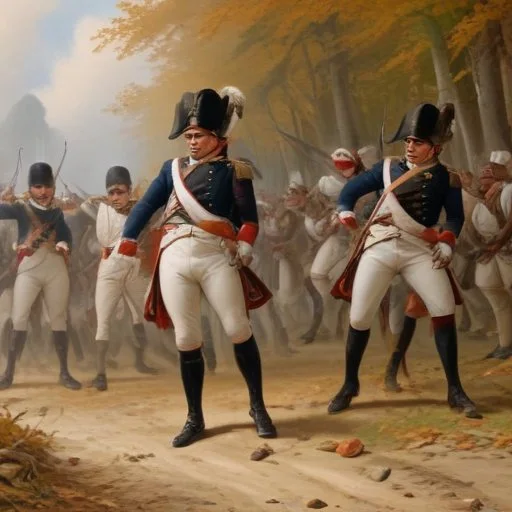
This pivotal event, which took place on October 20, 1805, would cement Napoleon's reputation as a master strategist, leaving a lasting impact on the course of European history.
The War of the Third Coalition was a conflict born out of Napoleon's relentless drive for European dominance. As tensions escalated, Austria, Russia, and their allies formed an alliance to counter the French threat. General Mack, a seasoned Austrian commander, was tasked with leading the Austrian army against the French forces.
Napoleon Bonaparte, the Corsican-born French general, was a force to be reckoned with. With a string of victories under his belt, he had earned a reputation for boldness and tactical brilliance. His ability to read the battlefield, adapt to changing circumstances, and inspire loyalty in his troops made him a formidable opponent.
In the autumn of 1805, Napoleon's forces were closing in on the Austrian army, led by General Mack, near the city of Ulm in southern Germany. Mack, confident in his own abilities, underestimated Napoleon's cunning and failed to prepare for a possible encirclement.
Napoleon, sensing an opportunity, deployed his troops to surround the Austrians, cutting off their lines of communication and supply. The French army, fresh and well-fed, waited patiently for the perfect moment to strike.
The Austrian army, exhausted and hungry, was trapped. General Mack, realizing too late the gravity of his situation, was forced to confront the reality of defeat. With no escape route available, he reluctantly raised the white flag, acknowledging Napoleon's mastery of the battlefield.
The Battle of Ulm was a crushing defeat for the Austrians, with over 60,000 soldiers captured or surrendered. The blow to Austrian morale was devastating, paving the way for Napoleon's continued conquest of Europe.
The Battle of Ulm remains an exemplar of military strategy, showcasing Napoleon's unparalleled ability to outmaneuver and outsmart his opponents. This triumph cemented his status as one of history's greatest generals, inspiring generations of military leaders and strategists to come.
In the words of Napoleon himself, "An army of sheep led by a lion is better than an army of lions led by a sheep." The Battle of Ulm was a testament to the power of genius, and Napoleon's unwavering confidence in his own abilities.
"Victory belongs to the most persevering." - Napoleon Bonaparte
The Austrian army, led by General Mack, was not only outmaneuvered but also outnumbered. Napoleon's forces totaled around 50,000 soldiers, while the Austrians had approximately 40,000 troops. Despite being outnumbered, Napoleon's strategic genius and clever deployment of his troops allowed him to gain the upper hand.
The battle was not without its irony. General Mack, confident in his own abilities, had previously boasted that he would defeat Napoleon and emerge victorious. However, it was Mack who ultimately found himself trapped and forced to surrender.

General Mack: A Study in Contrasts
General Karl Mack von Leiberich was a seasoned Austrian commander with a mixed record of success. While he demonstrated bravery and tactical prowess in earlier campaigns, his performance at Ulm was marred by hubris and poor decision-making.
In contrast, Napoleon Bonaparte was a master of adaptability, able to adjust his strategy mid-battle to capitalize on his opponent's mistakes. This flexibility, combined with his unwavering confidence, earned him a resounding victory at Ulm.
The Geopolitical Context of the War of the Third Coalition
The War of the Third Coalition was a complex conflict involving multiple European powers. Napoleon's aggressive expansionist policies had created a sense of unease among his neighbors, who formed an alliance to counter the French threat.
Austria, Russia, and their allies sought to contain Napoleon's ambitions, while Napoleon aimed to assert French dominance over Europe. The Battle of Ulm was a pivotal moment in this struggle, as Napoleon's mastery of the battlefield paved the way for further French conquests.

A Tale of Two Generals
The Battle of Ulm serves as a stark contrast between two divergent approaches to warfare. General Mack's static and inflexible defense allowed Napoleon to outmaneuver him, while Napoleon's fluid and adaptive strategy enabled him to exploit his opponent's weaknesses.
This dichotomy highlights the importance of adaptability and creativity in military strategy, as demonstrated by Napoleon's willingness to think outside the box and seize opportunities as they arose.
The Cultural Impact of the Battle of Ulm
The Battle of Ulm had far-reaching cultural implications, as it cemented Napoleon's status as a military genius and reinforced the notion that France was the dominant power in Europe.
This perception of French superiority had a profound impact on European art, literature, and politics, as many began to emulate French culture and aspire to its ideals of liberty, equality, and fraternity.