


In the Wardha session of the Indian National Congress in 1942, Mahatma Gandhi's impassioned plea for India's independence from British rule culminated in the approval of the Quit India resolution. This pivotal moment marked the beginning of a mass civil disobedience movement, authorizing Gandhi to spearhead a nationwide campaign for India's freedom from Britain.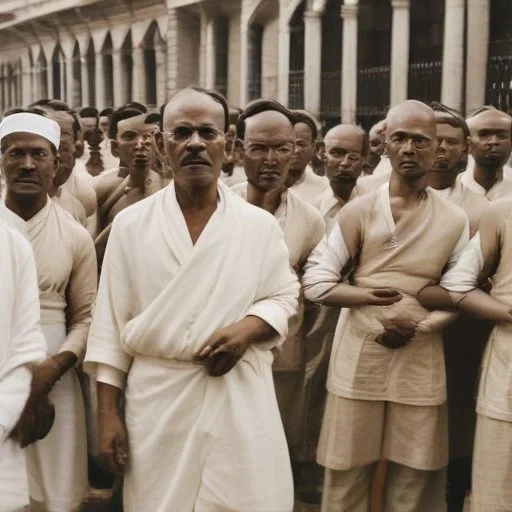
In the early 1940s, India was still reeling under British colonial rule. The Indian National Congress, led by Gandhi, had been advocating for Swaraj or self-rule for decades. However, the onset of World War II had brought new challenges and opportunities for the Indian independence movement.
Despite Gandhi's imprisonment, the Indian National Congress convened in Wardha, Maharashtra, in July 1942. The session was marked by emotional speeches, passionate debates, and a sense of urgency, as India's freedom fighters sensed an opportunity to strike a decisive blow against British rule.
Gandhi, in a letter to the Congress Working Committee, urged them to adopt a bold and uncompromising stance, calling for 'an orderly British withdrawal' from India. His message was clear: India would no longer tolerate British rule, and it was time for the nation to assert its independence.
On August 8, 1942, the Quit India resolution was approved, authorizing Gandhi to lead a mass civil disobedience movement against British rule. The resolution, drafted by Jawaharlal Nehru, was adopted with near-unanimity, signaling a new era of defiance and resistance against British colonialism.
The Quit India movement that followed was marked by widespread protests, strikes, and acts of civil disobedience across India. Although the movement was eventually crushed by the British, it marked a significant shift in the balance of power, as India's freedom fighters demonstrated their ability to mobilize millions and challenge British authority.
The Quit India movement had far-reaching consequences for India's struggle for independence:
The Quit India movement remains an iconic moment in Indian history, symbolizing the nation's determination to break free from colonial rule. As Gandhi's courageous leadership and unwavering commitment to nonviolent resistance continue to inspire generations, the Quit India movement stands as a testament to the power of mass mobilization and people's movements in shaping the course of human history.
The Quit India movement was not an isolated event, but rather a culmination of decades of resistance against British colonial rule. The Indian National Congress, founded in 1885, had been advocating for Swaraj or self-rule since its inception. The movement gained momentum in the early 20th century, with the rise of leaders like Gandhi, who employed non-violent resistance as a means to challenge British authority. The Quit India movement was a bold and defiant cry for independence, building upon the foundations laid by earlier freedom fighters.
The movement's success can be attributed to its ability to mobilize the masses, transcending regional and communal boundaries. The Indian National Congress, with its vast network of volunteers and supporters, played a crucial role in organizing and executing the movement. The Quit India movement's impact was felt far beyond India's borders, inspiring anti-colonial movements across the world.
The British government's response to the movement was brutal, with widespread arrests, torture, and violence. However, the movement's momentum could not be contained, and it continued to gain strength, ultimately contributing to India's independence in 1947. The Quit India movement's legacy serves as a powerful reminder of the ability of ordinary people to challenge oppressive regimes and fight for their rights.

Gandhi's leadership during the Quit India movement was instrumental in its success. His vision of a free and independent India, combined with his commitment to non-violent resistance, inspired millions to join the movement. Gandhi's leadership style was unique, emphasizing the importance of personal sacrifice and moral courage. He encouraged his followers to adopt a simple and austere lifestyle, renouncing material possessions and embracing a life of self-discipline and self-sacrifice.
Gandhi's message resonated with the Indian masses, who saw him as a symbol of hope and freedom. His leadership during the Quit India movement cemented his position as the father of the Indian independence movement. Gandhi's role in the movement went beyond mere leadership; he embodied the spirit of resistance, his presence inspiring others to take up the mantle of freedom fighters.
The Quit India movement shares striking similarities with other anti-colonial movements across the world. The Algerian War of Independence, the Mau Mau Uprising in Kenya, and the Vietnamese War of Independence against French colonial rule all drew inspiration from the Quit India movement. These movements, like the Quit India movement, were characterized by widespread protests, boycotts, and civil disobedience, as well as the use of non-violent resistance as a means to challenge colonial authority.
The Quit India movement's impact extended beyond the Indian subcontinent, influencing anti-colonial movements in Africa and Asia. The movement's success in mobilizing the masses and challenging colonial rule served as a beacon of hope for colonized peoples around the world. The Quit India movement's legacy can be seen in the wave of decolonization that swept across the world in the decades following World War II.

The Quit India movement was sandwiched between two global conflicts – World War I and World War II. The movement's timing was crucial, as the British government was preoccupied with the war effort, leaving India relatively undefended. The Indian National Congress capitalized on this opportunity, using the wartime context to advance their demand for independence.
TheQuit India movement's international implications were significant, as it marked a turning point in the balance of power between colonial powers and colonized nations. The movement's success emboldened other colonized peoples, inspiring anti-colonial movements across the world. The Quit India movement's legacy can be seen in the emergence of a new world order, where colonized nations increasingly challenged Western dominance.
The Quit India movement was underpinned by a strong ideological commitment to non-violent resistance and civil disobedience. Gandhi's leadership was guided by a philosophical framework that emphasized the importance of moral courage, self-sacrifice, and individual liberty. The movement's success was a testament to the power of non-violent resistance as a means to challenge oppressive regimes.
The Quit India movement's philosophical underpinnings went beyond the realm of politics, influencing Indian society and culture. The movement's emphasis on self-reliance and self-sufficiency inspired a new generation of Indians to adopt a more austere and simple lifestyle, rejecting the trappings of Western modernity. The Quit India movement's legacy can be seen in India's continued commitment to non-violent resistance as a means to address social and political injustices.